







On the outskirts west of Jerusalem, a burial chamber was disturbed long before scientists reached it, its contents partly scattered and partly preserved by chance. What remained did not look remarkable at first glance: broken pottery, mixed human remains, and soil already altered by construction and looting. Yet within that disorder lay material that would later draw together archaeologists and geneticists trying to recover traces of people who lived during the First Temple period. The findings, reported through Haaretz, sit at the meeting point of ancestry, identity, and the limits of ancient DNA research in the southern Levant.
Archaeological rescue dig reveals disturbed First Temple–era burial site
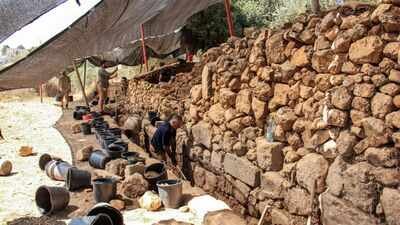
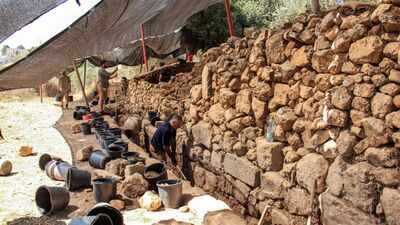
The burial site was recorded near Abu Ghosh, close to the ancient settlement of Kiryat Yearim. By the time archaeologists arrived, it had already been heavily damaged. Construction work had cut through parts of the chamber, and later disturbance finished what remained intact. A salvage excavation followed, recovering what could still be documented.Roughly 150 pottery vessels were collected alongside fragmented skeletal remains belonging to multiple individuals, including adults and children. The burial clearly had a long use-life, likely extending over generations. Nothing about it survived in a complete form. Everything had been displaced, reshaped by modern interference before any controlled excavation could take place.Even so, the ceramics and burial structure placed the tomb within the late Iron Age horizon, commonly associated with the final centuries of the Kingdom of Judah.
How archaeologists recovered fragile DNA from two individuals in the tomb
Ancient DNA rarely survives in the southern Levant. Heat, humidity, and microbial activity usually destroy genetic material long before it can be recovered. Yet one part of the human body occasionally preserves traces when everything else has failed: the petrous bone inside the skull.It was from this dense bone that partial genetic material was eventually retrieved from two individuals in the tomb. The work brought together archaeologists and geneticists, including David Reich and archaeologist Israel Finkelstein, both involved in interpreting the fragile dataset.The information recovered was limited. Only fragments of the genome were readable, with most of the data coming from mitochondrial and Y-chromosome sequences. These represent direct maternal and paternal lines, offering only a narrow view of ancestry. The broader genetic picture remains incomplete and awaits further sequencing.
What burial context reveals about possible connections to Jerusalem region populations
One of the immediate questions was whether the individuals could confidently be identified as Israelites. The tomb contained no inscriptions or explicit ethnic markers. There was no written confirmation of identity.Interpretation therefore relied on indirect evidence. The pottery style and burial practices matched patterns known from First Temple period contexts in the Jerusalem region. Geographic proximity to known sites of the Kingdom of Judah added further context. Still, these indicators remain circumstantial rather than definitive.In this period, cultural identity was not fixed in the way modern categories might suggest. Material culture often overlaps across political boundaries, and social identity could shift over time. The tomb may represent a local elite family tied into regional networks of power, though whether that network belonged to Judah or a neighbouring polity is still debated.
What the DNA can and cannot tell us about identity in the First Temple Era
The genetic data provided only partial insight. The male individual carried a Y-chromosome associated with haplogroup J2, a lineage found widely across western Asia and parts of the Caucasus region. It is not specific enough to define a population or cultural group.The two individuals also showed different mitochondrial lineages, indicating distinct maternal origins within the same burial context. One lineage connects broadly to ancient populations across the Near East and parts of Europe. The other appears in a range of modern populations around the Mediterranean and Middle East, though its ancient distribution is still not fully mapped.What emerges is not a clear ancestral portrait, but a set of scattered signals pointing to long-term regional movement and mixing.