









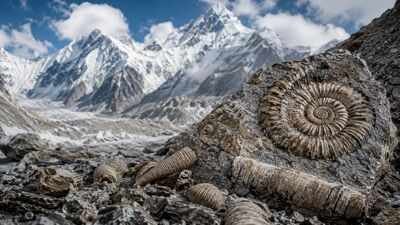
Standing on the summit of Mount Everest feels like reaching the highest possible point on Earth. The mountain rises nearly nine kilometres above sea level, surrounded by ice, rock and thin air. Yet the rocks beneath a climber’s boots tell a very different story. They do not speak of towering peaks or glaciers. They speak of a vanished ocean.Geologists studying limestone collected from the summit pyramid of Everest have identified fossils of marine creatures that lived hundreds of millions of years ago. Among them are trilobites, crinoids and tiny crustaceans that once inhabited shallow tropical seas. According to research published in Wiley Library, titled “Geology of the summit limestone of Mount Qomolangma (Everest) and cooling history of the Yellow Band under the Qomolangma detachment”, some of these fossils were recovered from limestone exposed just six metres below the mountain’s highest point. The discovery highlights one of geology’s most remarkable realities: the highest place on Earth was once part of an ancient seabed.
Mount Everest summit rocks contain 450-million-year-old marine fossils
Everest’s summit is composed largely of the Qomolangma Formation, a sequence of marine limestones deposited during the Ordovician Period, more than 450 million years ago. At that time, the region was not a mountain range. It lay beneath a warm sea situated along the northern margin of the ancient Indian continent.According to the study, the limestone near the summit contains fine-grained carbonate sediments alongside layers rich in fossil fragments. Their analysis identified remains of trilobites, ostracods and crinoids preserved within the rock. These organisms lived in marine environments and became incorporated into sediments that later hardened into limestone.The fossils are not large museum-style specimens. Many occur as broken skeletal fragments embedded within the rock itself. Even so, they provide direct evidence that the summit rocks originated beneath seawater rather than on land.
Marine fossils found just metres below Mount Everest’s summit
One of the most striking aspects of the discovery is its location. The limestone containing fossil material was collected from outcrops extremely close to the summit. As per the study, fossil-bearing rocks were found at approximately six metres below Everest’s highest point. Within these limestones, researchers identified debris derived from marine organisms including trilobites, sea lilies and ostracods.Sea lilies, known scientifically as crinoids, are relatives of modern starfish and sea urchins. Trilobites were marine arthropods that flourished in ancient oceans for hundreds of millions of years before disappearing during the end-Permian mass extinction. Ostracods are tiny crustaceans enclosed within shell-like coverings and remain common in aquatic environments today. Finding traces of these animals almost 8,850 metres above sea level is a reminder of the immense geological forces that reshaped the region.
How plate tectonics lifted an ancient seabed to form Mount Everest
The answer lies in plate tectonics. For tens of millions of years, the Indian tectonic plate drifted northwards across an ancient ocean known as the Tethys Ocean. Eventually it collided with the Eurasian plate. The collision compressed vast accumulations of marine sediments and gradually lifted them skyward.The Himalaya emerged as layers of seabed rock were folded, faulted and thrust upwards. Everest became part of this process. Rather than being formed by volcanic activity, the mountain is largely built from rocks that originated as sediments deposited in ancient marine environments.According to the study published in GeoScience World titled “Stratigraphic correlation of Cambrian–Ordovician deposits along the Himalaya: Implications for the age and nature of rocks in the Mount Everest region”, it refined the geological picture of Everest’s summit. Their work linked the summit pyramid to Ordovician strata found elsewhere across the Himalaya and identified a thick microbial carbonate unit close to the mountain’s uppermost section. The researchers concluded that the summit rocks belong to a coherent marine sedimentary sequence deposited along the former northern margin of India.
How Mount Everest still preserves evidence of its ancient ocean past
pc: Canva
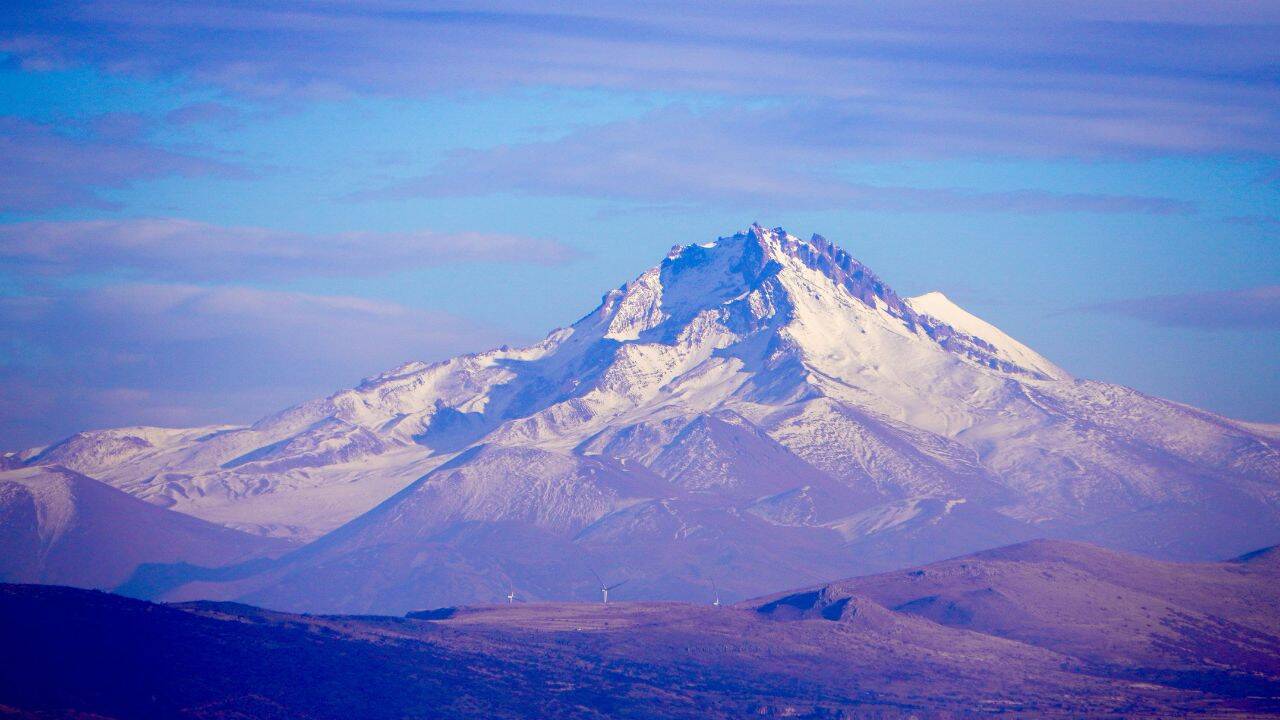
Although Everest has been altered by mountain-building, deformation and faulting, evidence of its marine origins remains surprisingly clear. According to the study published in the Journal of Structural Geology, titled “The structural evolution of the Qomolangma Formation, Mount Everest, Nepal”, it noted that rocks from the summit contain fossil-bearing limestones with crinoid fragments, as well as trilobite and ostracod remains, as described in earlier investigations. The authors observed that despite later tectonic deformation, parts of the Qomolangma Formation still preserve clues to their original sedimentary environment. Geologists examining the summit therefore see two stories recorded in the same rocks. One is the story of an ancient tropical sea filled with marine life. The other is the story of continental collision, uplift and mountain formation.Both histories are written into the limestone that forms the very top of Everest. The result is a geological paradox unlike almost anywhere else on Earth. Near the planet’s highest point, embedded within rock exposed to freezing winds and permanent snow, are fossils from creatures that once lived beneath the waves of a long-vanished ocean.