










Singapore is an island nation with very little land, which creates difficulty for it to achieve the goal of massive solar farms. With a total area of less than 280 square miles, every inch of land faces the tough choice between housing, industry, and greenery. To meet its ambitious ‘Green Plan 2030’ goals, the government shifted towards the surrounding blue sea.According to Energies Media, an engineering success was achieved by the ‘Sunseap Group’ in the Strait of Johor where 13,312 solar panels were set upon a vast network of 30,000 floating pontoons. This 5-megawatt floating solar farm was designed to power over 1,200 homes. Later, engineers discovered that they were not the only ones interested in this area. Beneath the pontoons, thousands of barnacles and mussels attached themselves like unwanted passengers, creating a massive challenge for generating clean energy at sea.
Why is Singapore using the seas for generating solar power
As reported by Energies Media, land scarcity is one of the biggest challenges for the global transition to renewable energy, and in Singapore, this creates a unique hurdle. With virtually no open land left for extensive solar farms, the nation had to explore other options to achieve net-zero emissions. This led to the deployment of floating solar panels, which are now producing clean energy without taking over the mainland.Locally built and flexible in design, the system generates nearly 6 million kWh of clean electricity annually, helping to balance over 4,200 metric tonnes of carbon emissions every year.
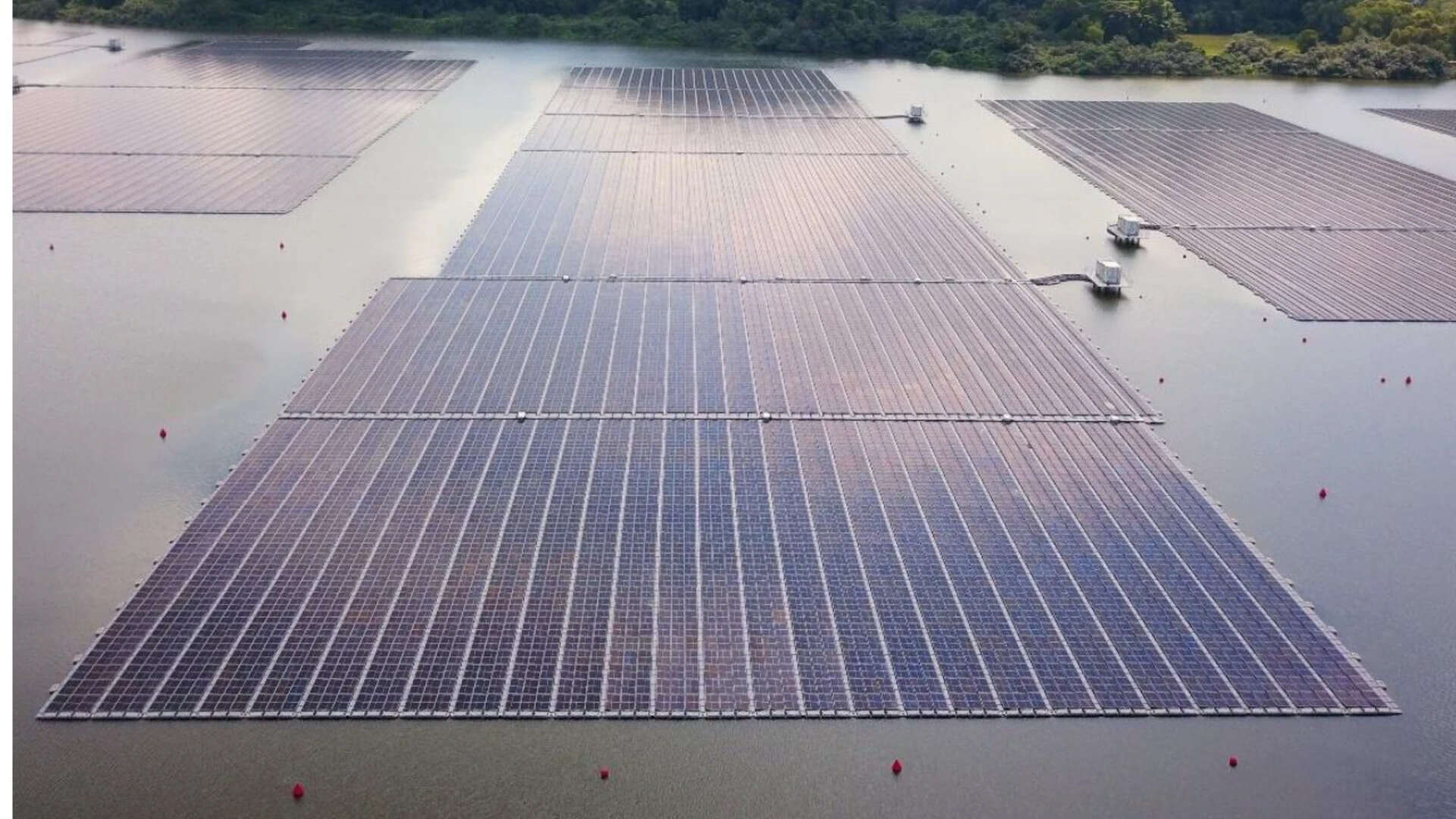
Image Credit: Singapore International Water Week
What happens when marine ecosystem meets high-tech energy
Energies Media reports that warm tropical seawater acts as a catalyst for ‘biofouling’ (the unwanted buildup of marine organisms on underwater structures). Soon after the solar farm was constructed, micro-organisms, algae, and thousands of barnacles began to accumulate on pontoons and anchors.These organisms form dense, hard layers that are incredibly difficult to remove. This buildup is not just a mess; their heavy growth adds significant weight to the structures. Observations from the research project by STEWART, titled ‘Science-based environmentally friendly new layout for floating PV’ suggest that this marine buildup can increase the mass of the floater by almost 43%. This extra weight reduces the buoyancy of the platforms, resulting in lower level of the solar panels.
How does biofouling threaten the health of a floating solar farm
Energies Media explains that as the buoyancy becomes weak, the corrosion on the equipment grows rapidly. Saltwater is naturally aggressive, and the constant presence of biofouling makes it worse.Also, marine growth can restrict the movement of mechanical parts, such as the hinges that allow the arrays to flex with the waves. If the pontoons sink too low under the weight of these organisms, electrical components like connectors (which are designed to stay dry), could sink with them too. This can lead to electrical faults, grounding issues, or other damage that stops the panels from generating power.
Who are these uninvited marine passengers
According to a study published by PEMSEA titled ‘A Rapid Assessment Study on Biofouling Management and Invasive Aquatic Species in the East Asian Seas Region,’ one major micro-organism is the American brackish-water mussel, ‘Mytella strigata,’ which has been spreading rapidly along Singapore’s northern coast since 2016. These mussels are known to form dense mats, sometimes reaching clumps of up to 10,000 individuals.Another common organism is the Caribbean bivalve ‘Mytilopsis Sallei,’ also known as the black striped mussel. According to researchers, these species can displace native marine life and have a direct impact on solar energy structures by compromising their stability and increasing the costs of maintenance.
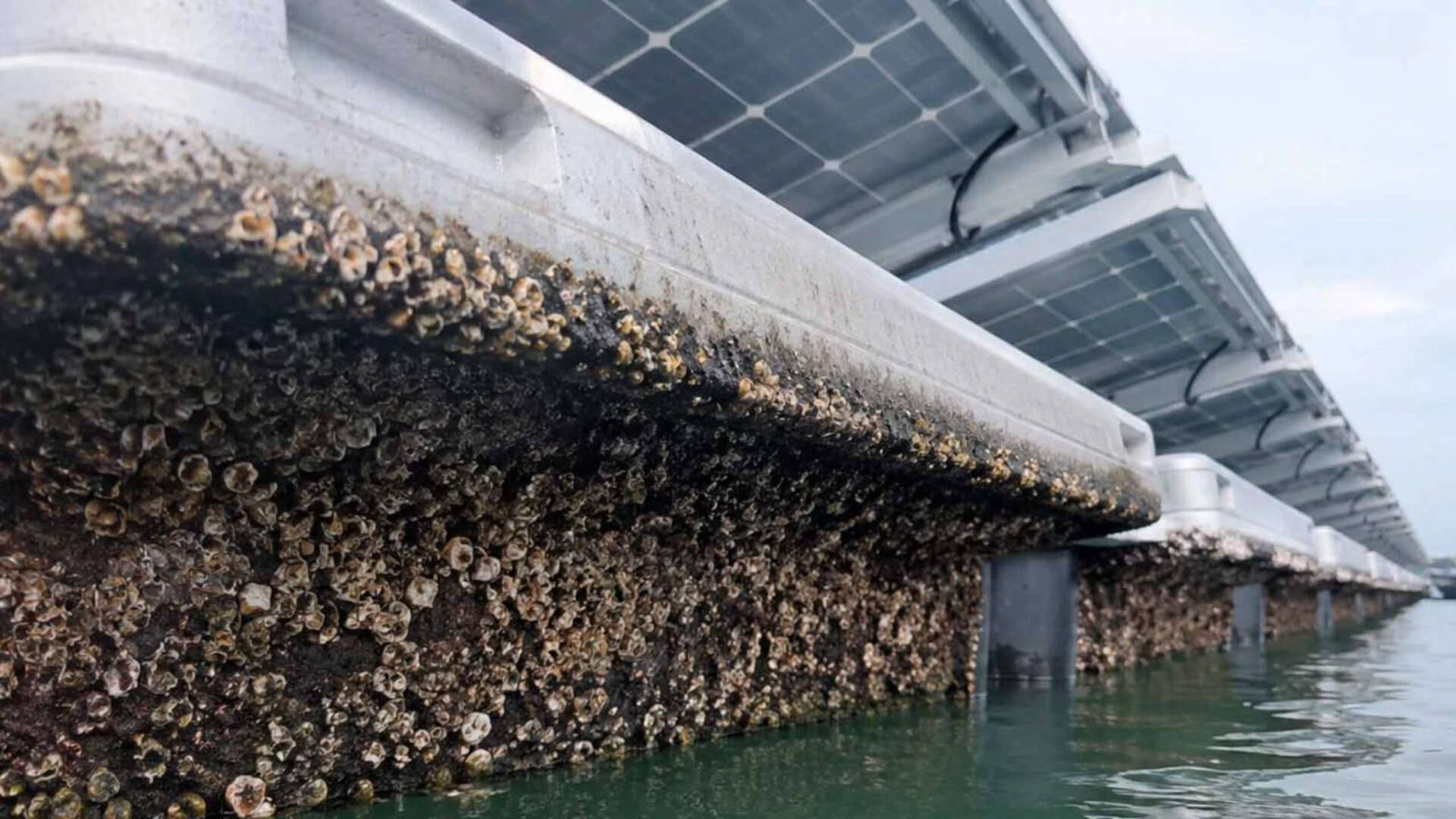
Image Credit: AI Generated
Can we counter the growth of barnacles with better solar farm design
The Straits Times reports that Sunseap’s modular floater system was rigorously tested for corrosion and biofouling before it was ever put in the sea. One interesting solution proposed by the STEWART project is ‘geometric separation,’ which means designing the pontoons in a way that the hinges and panel edges are elevated above the water surface, to keep them away from the danger zone where barnacles grow the most.Manufacturers are now using reinforced glass and corrosion-resistant frames that are built to endure up to 25 years of exposure to the harsh marine atmosphere.
What does it take to maintain a floating solar plant
Keeping a solar farm running at sea is no easy task. As per the Energies Media, the Sunseap project requires constant, specialised marine maintenance. Workers must regularly go out to clean the panels and inspect the floaters to ensure everything is clean and healthy.Many new projects are developing digital models that use remote monitoring and sensors to predict exactly when the maintenance is needed and how much weight the barnacles are adding. Singapore’s experience highlights that harnessing the open ocean for green energy is far more difficult than building on land.