







What if some of the skills students learn in classrooms today — recognising patterns, understanding shapes and organising information — were already being used by humans 60,000 years ago?That is the intriguing possibility emerging from a new study of ancient ostrich eggshells from southern Africa. ScienceDaily reported on the research on August 9, 2026, based on findings from researchers at the University of Bologna. The study, published in PLOS One, suggests that the engravings were far more organised than previously thought.Long before schools, textbooks or written language, Homo sapiens were engraving ostrich eggshells with lines and geometric designs. Researchers say these were not simply random scratches or improvised decorations. Instead, many of the markings followed recurring geometric principles, including parallel lines, right-angle relationships and repeated patterns.The discovery offers a fascinating glimpse into how human thinking may have evolved — and how some of the abilities that underpin modern learning could have extremely deep roots.
These were not random lines
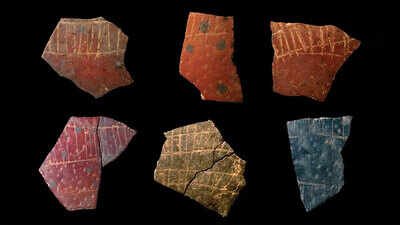
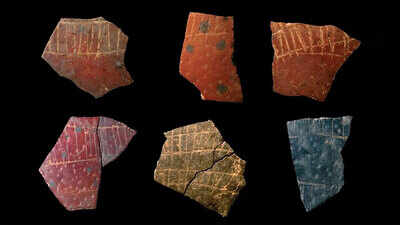
Researchers from the University of Bologna examined 112 engraved ostrich eggshell fragments recovered from three archaeological sites: Diepkloof and Klipdrift in South Africa, and Apollo 11 in Namibia.Using geometric and statistical techniques, the team studied the direction, angles and paths of the engraved lines.The results were striking.More than 80% of the configurations showed consistent spatial patterns, including repeated groups of parallel lines and angles close to 90 degrees. Some of the more complex designs included hatched bands, grids and diamond-shaped motifs.The researchers also identified evidence of rotation, repetition, translation and what they describe as “embedding” — building different levels of signs or patterns on the same surface.In simple terms, the ancient makers were not merely putting lines onto an eggshell. They appear to have been following rules.
A lesson in learning from 60,000 years ago
For students, this may be the most fascinating part of the discovery.Pattern recognition is everywhere in modern education. It is used in mathematics to understand sequences and geometry, in computer science to develop algorithms and in science to identify relationships and structures.But these ancient engravings suggest that the ability to organise shapes and recognise visual relationships existed long before formal education.The researchers describe this as visuo-spatial planning — the ability to organise forms in space and potentially have an overall image in mind before creating it.That does not mean ancient humans were studying geometry as students do today. There is no evidence of formal mathematical lessons or textbooks.Instead, the findings point towards something more fundamental: humans were capable of identifying patterns, applying rules and transforming simple forms into organised systems.
From ancient patterns to modern classrooms
The exact purpose of the engravings remains uncertain. The ostrich eggshells were probably used as containers for carrying or storing water, according to the research, but the meaning of the designs is not known.What researchers believe is significant is the cognitive ability required to create such organised designs.The study suggests that arranging shapes and lines according to consistent rules may represent an important indicator of emerging abstract thought, a major development in human cognition.And that makes these tiny fragments more than archaeological curiosities.A student solving a geometry problem today may draw a line, rotate a shape or search for a repeating pattern on a page.More than 60,000 years ago, a human somewhere in southern Africa was doing something surprisingly similar — not in a classroom, but on an eggshell.The tools have changed. The classrooms have changed.But the human instinct to observe, recognise patterns and make sense of the world around us may be far older than we ever imagined.Disclaimer:This article is based on information and research published by the University of Bologna and reported by ScienceDaily.