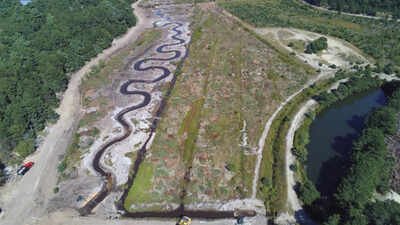








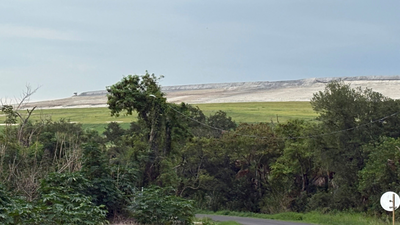
In Progress Village, Florida, a huge mound of industrial waste has become a symbol of a much bigger environmental and public-health debate. The historically Black community sits beside a massive phosphogypsum stack, a structure created from the waste left behind during phosphate fertiliser production.The stack is difficult to miss. The structure covers about 367 acres and is topped by a retention pond containing millions of gallons of water associated with fertiliser production. Residents have spent years questioning whether living so close to the site exposes their families to unacceptable environmental risks.The concerns are particularly serious because phosphogypsum is not simply ordinary industrial waste. It can contain naturally occurring radioactive materials, including uranium, thorium and radium, which are inherited from the phosphate rock used during fertiliser production. The debate has therefore centred not only on the enormous scale of the waste pile but also on how communities can be protected when industrial sites containing radioactive materials sit close to homes, schools and everyday life.
A massive industrial waste stack towers over a historically Black community
Phosphogypsum is produced when phosphate rock is processed to manufacture phosphoric acid, which is then used to make fertiliser. Large quantities of the by-product are generated during the process, leaving companies with a difficult waste-management problem.The US Environmental Protection Agency explains that phosphate ore contains uranium and radium, meaning these radionuclides can remain in phosphogypsum. Radium is particularly important because it decays into radon, a radioactive gas that can increase the risk of lung cancer following prolonged exposure at elevated levels.A 2025 review by Linda Maina, Katarzyna Kiegiel and Grażyna Zakrzewska-Kołtuniewicz, published in Sustainability under the title ‘Challenges and Strategies for the Sustainable Environmental Management of Phosphogypsum’, highlighted the wider environmental problems associated with the material. The authors noted that phosphogypsum can contain radionuclides and potentially toxic trace elements, with the composition varying according to the geological source of the phosphate rock.The researchers specifically identified phosphate rock from Florida as having comparatively high concentrations of uranium, thorium and their decay products, reinforcing the need for careful management and monitoring of the resulting waste.
Progress Village has lived beside the problem for decades
The concerns surrounding the stack are inseparable from the history of Progress Village itself. The community was established in the 1950s as a planned neighbourhood for Black residents during a period when racial segregation severely restricted where African Americans could live. Over time, industrial development expanded around the community.Residents later opposed the construction of another phosphogypsum stack in the area during the 1980s. Their objections did not prevent the project from going ahead, and the resulting waste structure eventually became a permanent part of the landscape.Today, residents continue to question whether their community has carried an unfair share of the environmental burden created by the region’s phosphate industry. WUSF reported that environmental engineer and Progress Village resident Walter Smith II has worked to raise awareness of the potential health and safety risks facing people living near the industrial facilities.
The concern extends beyond radiation to water and flooding
Radiation is only one part of the problem residents worry about. Phosphogypsum stacks are often topped by large retention ponds containing process water. That creates another potential environmental vulnerability, particularly in a state regularly exposed to hurricanes and extreme rainfall.The dangers of poorly contained phosphate-industry wastewater became especially visible in 2021, when a serious leak at the former Piney Point facility in Florida led authorities to evacuate nearby residents and discharge millions of gallons of contaminated water to prevent a potentially larger failure.Progress Village residents therefore face a difficult question: what could happen if a major storm, flooding event or structural failure compromised one of the enormous industrial waste structures surrounding the community?The local environmental advocates have specifically raised concerns about the consequences of a major hurricane striking the area, given the combination of the phosphogypsum stack, its wastewater reservoir and existing flooding vulnerabilities.
Scientists have found that phosphogypsum can affect air and water quality
Research into Florida’s phosphogypsum stacks has provided reasons for continued monitoring, although it does not establish that every person living near a stack will develop cancer.The study published in Environmental Monitoring and Assessment measured radon and particulate matter near three large Florida phosphogypsum stacks. The researchers described phosphogypsum as a major source of concern because of its radon emissions and investigated how atmospheric concentrations varied with distance and weather conditions.Water contamination is another issue scientists have investigated. Research titled ‘Fate and transport of radioactive gypsum stack water entering the Floridan aquifer due to a sinkhole collapse,’ found that after a 2016 sinkhole beneath Florida phosphogypsum stack allowed contaminated water to enter the underlying aquifer. The research modelled the movement of radioactive stack water through the Floridan aquifer system, highlighting the importance of protecting groundwater around these facilities.These studies do not prove a specific cancer burden in Progress Village. They instead demonstrate why communities near phosphogypsum storage facilities have legitimate reasons to demand environmental monitoring and transparent risk assessments.
The health question is more complicated than it looks
Radon is a recognised lung-cancer risk, and phosphogypsum can contain radium that produces radon. But the existence of radioactive material near a community does not by itself establish how much radiation or radon each resident receives, nor does it prove that a particular cancer was caused by the stack.Cancer can have many causes, exposure levels differ between individuals, and some diseases can take decades to develop. Determining whether an industrial site has caused an increase in cancer requires long-term epidemiological research alongside reliable exposure measurements.That distinction is important because residents’ concerns should not be dismissed, but neither should a potential risk be presented as a proven outcome for every person living nearby.
Florida’s phosphate industry faces a much larger waste problem
The Progress Village stack is part of a much wider challenge. The 2025 Sustainability review noted that phosphogypsum is generated in enormous quantities worldwide, with global production exceeding 200 million tonnes a year and billions of tonnes already stockpiled. Only a relatively small proportion is currently reused, leaving much of the material in long-term storage.The authors argue that the future of phosphogypsum management could involve a shift away from simply storing the material towards carefully controlled reuse. Potential applications include construction materials, cement, plasterboard, agriculture and land reclamation, although radioactive components and differences in chemical composition mean that safety and regulatory controls remain essential.In other words, the challenge is not simply how to store the waste. It is how to deal with billions of tonnes of material without transferring environmental risks from one place to another.
A community is asking how long the waste can remain part of its landscape
For Progress Village, the issue is deeply personal. The phosphogypsum stack is not an abstract environmental problem located far from homes. It stands beside a community whose residents have watched industrial development reshape the landscape around them for generations. The question now is what happens next.Stronger monitoring of air, water and radiation levels could provide residents with clearer information about actual exposure. Better emergency planning could address the risks posed by hurricanes and flooding. And research into safer ways of managing or reusing phosphogypsum could eventually reduce the need for enormous waste stacks.The experience of Progress Village illustrates why environmental protection is also an issue of community trust. People living beside industrial waste want to know not only what is stored next door, but what the measurable risks are, how those risks are being controlled and who will be responsible if something goes wrong.For a community that has spent decades living in the shadow of a massive waste pile, those answers matter just as much as the mound itself.