








In 1988, researchers working with the United States Department of Agriculture released a small population of European flea beetles onto infested rangeland near Valley City, North Dakota, hoping the insects might help control a plant that had been quietly overrunning the Northern Great Plains for decades. That plant was leafy spurge, an aggressive Eurasian weed that had already spread across more than two million hectares of pasture and rangeland in 35 American states by the time the beetles arrived. What began as a modest, closely monitored release near two small test sites went on to seed one of the most successful biological control programs in American agricultural history, with descendants of those original beetles eventually establishing populations across the northern United States and into Canada, reducing leafy spurge cover on treated land by as much as 90 per cent within a few years.
Why leafy spurge became such a stubborn problem for ranchers
Leafy spurge is a deep-rooted perennial weed native to Eurasia that spreads aggressively once established, and by the early 2000s the North Dakota Department of Agriculture estimated the plant had infested roughly 526,000 hectares of land within the state alone. The weed thrives across pastures, rangelands, roadsides and riparian areas on a wide variety of soil types, and its milky latex sap makes it toxic and unpalatable to cattle, effectively removing infested pastureland from productive grazing use. Because its root system extends deep underground and can regenerate even after the visible plant is destroyed, leafy spurge proved remarkably resistant to conventional herbicide treatment, pushing researchers to search for a biological alternative that could attack the plant from below the surface rather than above it.
How researchers chose flea beetles as a biological weapon
According to the North Dakota Department of Agriculture’s official account of the state’s noxious weed program, researchers first released a flea beetle species called Aphthona flava in North Dakota in 1986, though it established at only a few sites and never reached densities high enough to meaningfully control the weed. Two years later, in 1988, a mixed population made up of Aphthona czwalinae and Aphthona lacertosa was released near Valley City, marking the beginning of the state’s more successful beetle program. By 1995, more than 90 per cent of that mixed population had shifted almost entirely to Aphthona lacertosa, the species that would go on to become one of the two dominant flea beetles used for leafy spurge control across the northern Great Plains.
What made this particular beetle so effective against the weed
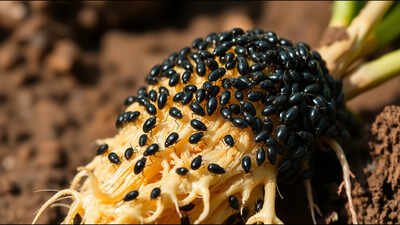
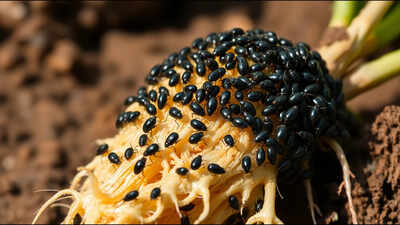
Unlike the adult beetles, which feed on the plant’s foliage and flowers and cause relatively little lasting damage, it is the larval stage that does the real work. Flea beetle larvae burrow into the soil and feed directly on leafy spurge roots, disrupting the plant’s ability to transport water and nutrients while also creating entry points for soil-borne fungal pathogens that further weaken the weed from within. A study titled Long-term dynamics of leafy spurge (Euphorbia esula) and its biocontrol agent, flea beetles in the genus Aphthona, published in the journal Biological Control and authored by researchers Diane Larson, James Grace and Jennifer Larson, tracked flea beetle populations and leafy spurge stem counts across multiple sites in North Dakota between 1998 and 2006, finding that black flea beetle populations spread steadily across the study sites even as their year to year impact on the weed varied considerably depending on local soil conditions.
How far the beetles actually spread across North America
Once established, the beetles proved remarkably good at colonising new territory on their own, and land managers accelerated that spread deliberately through organised redistribution efforts. Research conducted at Theodore Roosevelt National Park in western North Dakota documented flea beetle releases at more than 1,800 points across the park’s 18,600-hectare South Unit beginning in 1989, with most of that redistribution occurring after 1994. Similar collection and redistribution programs operated across the northern Great Plains throughout the 1990s, moving tens of thousands of beetles collected from established colonies into new infestation sites each year, a process that steadily expanded the insects’ range well beyond their original North Dakota release points and into neighbouring states and Canadian provinces.
Why the results eventually surprised even the researchers involved
Field studies conducted across multiple states over the following decades documented dramatic reductions in leafy spurge cover at flea beetle release sites. According to a summary of USDA Forest Service research on the program, leafy spurge foliar cover fell from more than 50 per cent before treatment to around 10 per cent within four to five years of flea beetle establishment across study sites in Montana, North Dakota and South Dakota. On roughly two-thirds of all release sites studied, leafy spurge cover eventually dropped below 5 per cent, a level researchers consider low enough to fall below the threshold of meaningful economic damage to grazing land, effectively restoring pastures that ranchers had once been forced to write off entirely.
What this beetle program says about biological pest control more broadly
More than three decades after that first small release near Valley City, flea beetles remain the primary tool used to manage leafy spurge across the northern United States and Canada, a rare example of a biological control program that scaled successfully from a handful of test sites into a self-sustaining, continent-spanning population. The program’s success has not been uniform everywhere, since results still depend heavily on local soil type, climate and which specific Aphthona species establishes at a given site, and researchers continue monitoring long-term outcomes to understand where and why control breaks down. Even with those limitations, the leafy spurge program stands as one of the clearest demonstrations of how a carefully chosen insect, introduced in small numbers under close scientific supervision, can go on to reshape millions of acres of landscape largely on its own.