









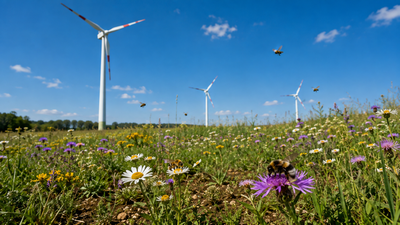
At a wind farm in western Poland, the ground beneath the turbines has quietly turned into unexpected pollinator territory. A wind turbine standing 394 feet tall rises above sprayed grain fields near Gołańcz, and the unmown gravel patch encircling its base has been found to hold as many wild bees as the seminatural grasslands set aside nearby for conservation, and considerably more than the crop fields surrounding both. Researchers spent a full season sweeping insects and cataloguing weeds across ten turbines, ten grassland patches and the fields bordering them, hoping to work out whether these overlooked service squares carried any ecological value beyond their engineering purpose. What they found challenges the assumption that wind infrastructure is purely a cost to biodiversity. Bare gravel, light foot traffic and minimal management appear to have created conditions that ground-nesting bees actively seek out, turning a patch of land nobody thought to protect into one of the more productive habitats in the entire landscape.
Wind turbine bases support diverse wild plants and pollinators in farmland
Every turbine in the study sat on a gravelled service square roughly 20 by 30 metres, used by maintenance crews and otherwise left alone. According to the study published in PubMed Central, titled ‘The association of windmills with conservation of pollinating insects and wild plants in homogeneous farmland of western Poland’, the edges of these squares and the ground around the tower base were quietly colonised by segetal weeds, the same flowering plants that have been vanishing from intensively farmed fields for decades. Between May and August 2014, the team surveyed ten of these turbine sites alongside ten control grasslands and the crop fields bordering both, sweeping insects from four points at each location across three separate visits.The scale of the difference was stark. According to the study, plant species richness and the Shannon diversity index of weeds were both higher at turbine sites than on the grasslands or in the fields, even though grasslands carried denser overall plant cover. Fields, by contrast, trailed behind on every measure. The turbine bases, it turned out, were not just tolerating weeds. They were hosting more of them, and a more varied mix, than the habitat typically set aside for conservation.
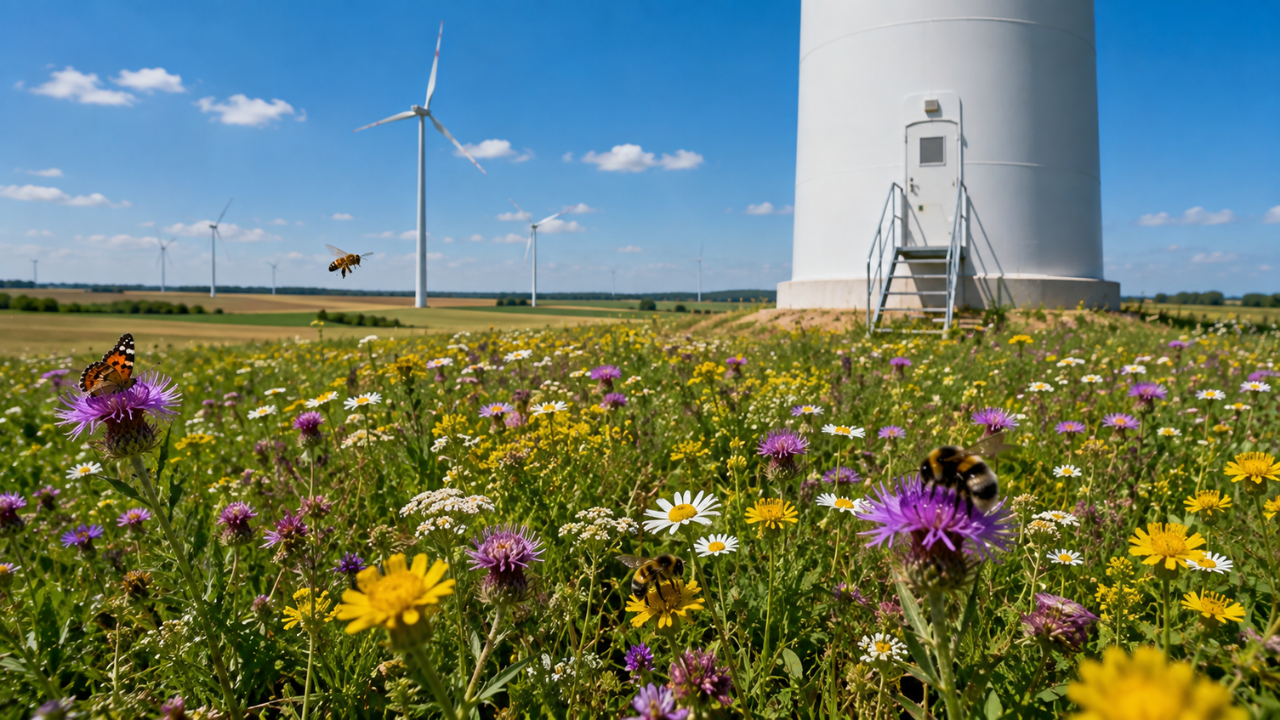
Image AI generated
Wind turbine sites support the highest bee diversity and abundance
The headline result concerned bees specifically. Bee diversity, species richness and abundance were all highest at the turbine sites, significantly outperforming both grasslands and fields. Even after the researchers stripped honeybees out of the count to look at wild bees alone, turbine bases still came out ahead on diversity and richness, with wild bee numbers matching those found on grasslands and beating the fields. The explanation likely lies in bare ground. Many ground-nesting bee species actively prefer sparsely vegetated soil for building nests, and the gravel margins around turbines, kept clear by light foot traffic and limited management, offered exactly that. Grasslands, thick with grass cover, may simply have less room for these species to dig in. Wild bee diversity at turbine sites also rose the further a turbine sat from its nearest neighbour, and richness climbed with distance from the nearest grassland, suggesting the turbine habitat was functioning as something more than a spillover zone from grasslands nearby.
Butterflies thrive more on grasslands than around wind turbines
Not every pollinator group responded the same way. Butterflies were significantly more diverse and abundant on grasslands than at turbine sites, a pattern the researchers put down to the reliance of many butterfly species on grasses and flowering plants across multiple life stages, something turbine margins could not fully replicate. Even so, turbines still supported considerably more butterflies than the crop fields did.Flies split the difference. Fly diversity, richness and abundance at turbines were statistically indistinguishable from grasslands, with both comfortably ahead of fields. The researchers linked this to the broad habitat tolerance of many fly species, particularly hoverflies, which made up the bulk of the fly catch and are increasingly recognised as significant pollinators in their own right despite receiving far less research attention than bees.
How planting native flowers around turbines could strengthen their biodiversity benefits
Taken together, the results position wind turbine margins as what the researchers call a genuine biodiversity contribution inside otherwise homogeneous farmland, not merely a consolation prize for the land lost to construction. Species composition of both plants and pollinators differed meaningfully between turbines, grasslands and fields, meaning turbines were not simply drawing insects away from existing habitat but supporting distinct communities of their own.The researchers were careful to frame this alongside the well-documented downsides of wind farms, including bird and bat collisions, without treating one as cancelling out the other. Simple management choices could make turbine margins even more valuable: planting native, regionally appropriate flowering species timed to bloom across the season, resisting the urge to over-tidy the bare ground that ground-nesting bees depend on, and cutting back on herbicide use near the towers. In a landscape where 76 per cent of the district was already given over to arable land, the unassuming gravel ring around a turbine base emerged as an unlikely refuge, proof that even industrial infrastructure can leave room for wild things to persist.