








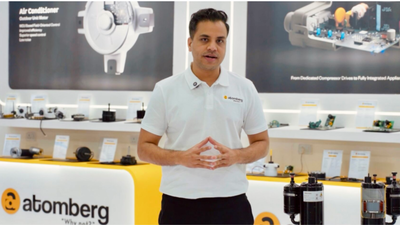
Manoj Meena had an offer most engineering students in India spend years chasing.An Indian Space Research Organisation (ISRO) job was waiting for him after his final year at the Indian Institute of Technology (IIT) Bombay. For his family in rural Rajasthan, the decision seemed already made. A government job meant stability. Stability was not something to walk away from.Meena walked away from it.He had spent his years at IIT Bombay around robotics and electronics, building things, entering competitions, taking projects apart to understand how they worked. Somewhere in that process, a belief had formed: engineering was only useful if it solved a problem someone actually had. A government job could offer security. It could not offer the freedom to chase that belief.His family did not understand the decision right away. Meena took it anyway.What he built afterward would eventually be called Atomberg Technologies.
The company did not start with a fan
Meena founded Atomberg in 2012. Fellow IIT Bombay alumnus Sibabrata Das joined him a year later, in 2013.There was no fan in the original plan. There was barely a plan at all.The company was incubated at the Society for Innovation and Entrepreneurship (SINE), IIT Bombay, and the first few years looked less like a startup story and more like survival. The founders bootstrapped. They took on engineering projects wherever they could find them, building data acquisition systems, motor control units, process control solutions for institutions and research bodies that needed technical work done.They tried vehicle tracking. They tried other ideas that came and quietly went. Meena and Das were doing all of it themselves: writing the code, building the hardware, visiting clients, fixing devices when something broke.For four years, this was less a company finding its market and more two engineers looking for a problem worth solving. The skills were there. The problem was not.
Four years of searching, one motor
The answer arrived in 2015, and it did not look like an answer at first. It looked like a fan.While working on motors and power electronics, the founders started paying attention to the ceiling fan market, an appliance that had barely changed in decades, at least not in the way that mattered most: how much electricity it used.A standard ceiling fan ran on roughly 75 to 80 watts. Atomberg’s team built a brushless direct current (BLDC) motor that produced comparable output at around 28 watts. The company said its fans could use up to 65 percent less power than conventional ones.That single number became the foundation of everything that followed.The first fan launched under the Gorilla brand in 2015. It began with institutional buyers. In 2016, Atomberg made the harder move: selling directly to consumers.That is where the real difficulty began.
‘Who will buy your fans?’
Atomberg was entering a market owned by names that had been around for decades: Bajaj, Crompton, Havells, Usha. It also wanted to sell fans online, in a category where people still walked into stores to buy them.Investors asked the obvious question. Why would anyone buy a fan from a company nobody had heard of, made by a company with no retail presence, competing against brands that had spent decades building trust one household at a time.The founders pitched anyway. They kept hearing no anyway.By FY19, according to Forbes India, Atomberg’s operating revenue had reached Rs 37 crore, and the company was producing around 1,000 fans a day. The business was growing. So were its costs. Growth, it turned out, needed more capital than the founders had.Then came 2019, and with it, the closest the company came to not existing anymore.
One month of runway left
Das later described this period plainly: the company was almost out of money.Salaries were delayed. Vendors wanted payments Atomberg could not make. Funding conversations were not converting into funding. Years of work, the kind built on failed ideas and long nights, were suddenly close to amounting to nothing.In his account to Forbes India, Das recalled wondering whether the company would have to shut down. Not as a distant possibility. As the most likely outcome.Then the founders came across a newly formed fund and reached out, expecting little. They had reached out to enough investors by then to expect silence.This time, someone replied.The fund moved fast. Within weeks, Atomberg had the capital it needed to stay open. A company that had been weeks from closing was suddenly being asked how fast it could scale.
From energy efficiency to smart appliance
What changed after 2019 was not just Atomberg’s bank balance. It was what the company understood itself to be.The BLDC motor had made the fans more efficient. It also made them smaller, which opened up design possibilities a conventional motor never allowed. Atomberg added remote controls, LED interfaces, Wi-Fi connectivity, app-based control.The product line evolved with it. The Renaissance range introduced smaller motors and a design language that looked nothing like the ceiling fans most Indian households grew up with.Somewhere in that shift, the company stopped describing its fans as energy-efficient appliances and started describing them as smart appliances. The distinction mattered. One is a feature. The other is a category.The same motor and electronics expertise that built the fan began showing up elsewhere. Atomberg expanded into mixer grinders and water purifiers, and started exploring uses for its technology in air-conditioning components and drone motors.
From an incubator to Rs 1,000 crore
The company that investors once doubted eventually became one of India’s more recognised consumer technology brands.By FY25, Atomberg’s operating revenue had reached close to Rs 958 crore. Total income crossed Rs 1,000 crore.Meena has since been named to the Forbes India 30 Under 30 and Forbes Asia 30 Under 30 lists, received the National Entrepreneurship Award, and was recognised with IIT Bombay’s Young Alumni Achievers Award. Das has appeared on Forbes’ 30 Under 30 lists as well and received the same alumni honour from IIT Bombay.But the more revealing part of this story is not the revenue figure or the awards.It starts in rural Rajasthan, in a place where electricity was not something to take for granted. Where power, quite literally, mattered.Years later, the engineer who had once been offered a career at India’s space agency was instead building a company around one of the most ordinary uses of electricity there is: a fan spinning in a living room.Atomberg was not built on one good idea. It was built on four years of ideas that did not work, investors who said no, a company that nearly ran out of money, and one question simple enough to sound unimportant.