









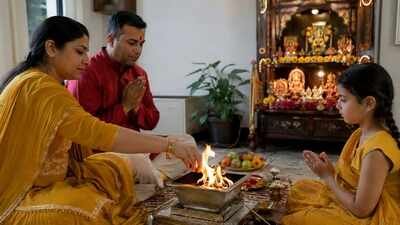
You can want the full ritual and still not be able to do it. That is the starting point for many Hindu families in the US and UK. Not indifference. Not lack of faith. Just real life.A proper yagya, also written yajna, is a Vedic fire ritual with trained chanting, offerings into a consecrated fire, and rules that can vary by sampradaya, meaning lineage or tradition. In India, that may happen in a temple hall, ancestral home, community mandap, meaning pavilion, or with a family priest who knows your gotra, meaning lineage, and your family’s way of doing things.Abroad, the obstacles are plain. Smoke alarms. Lease rules. Semi-detached homes in Leicester. Flats in Wembley. Kids’ football on Saturday. A priest who is free only on a weekday morning when nobody can take time off work.So the question is not, “How do we replace a yagya?” You can’t pretend a scaled-down arrangement is the same thing. The better question is, “What can we still do with honesty, reverence, and some practical sense?”
The ritual as it exists in India
In its fuller form, a yagya usually includes sankalpa, meaning formal intention; kalasha sthapana, meaning installation of a sacred water vessel; invocation of deities; recitation of mantras; agni prajvalana, meaning kindling the ritual fire; repeated ahuti, meaning offerings into the fire; and concluding prayers such as purnahuti, meaning final offering. Depending on the rite, there may also be specific dravyas, meaning ritual materials, a set count of mantras, and priestly roles that one person at home cannot simply recreate.That matters because many families blur three different things. First, there is the canonical ritual, the form recognised in a given sampradaya. Second, there is family custom, the way your grandmother’s house did it, perhaps with a certain sweet, a certain sequence, or a local priest’s habit. Third, there is pragmatic adaptation abroad, which is what many of us end up doing because the conditions are different.Those three are not identical. They can overlap, but they should not be confused.
What a flat in Birmingham or a suburb in New Jersey changes
A full fire ritual may not be allowed in your building at all. Even where it is technically allowed, ventilation can be poor, neighbours can complain, and many families are not comfortable managing an open flame indoors.In the UK, temple access can depend on where you live. A family in Harrow or Leicester may have several options. A family in rural Yorkshire may have none within easy reach. In the US, someone in Edison, New Jersey, or the Bay Area will find more priests and temples than a family in Minnesota, North Carolina, or a suburb outside Seattle.Time also changes things. Hindu observances often follow local tithi, meaning lunar date, sunrise, sunset, or temple timing, so a family in London may not match relatives in Delhi, and a family in Texas may be observing at a slightly different time from both. Some global calendars also state this openly. One 2026 Maharishi Jyotish listing notes that dates for global celebrations can differ by time zone and that sponsored yagya timings are set according to the relevant muhurta, meaning auspicious time, for the person and place.This is why arguments over “the correct date” become common in diaspora homes. Sometimes the answer is not that one side is wrong. It is that two panchang, meaning Hindu calendar, traditions are being used.
Start with sankalpa, not with guilt
If a full yagya is not feasible, the first thing to preserve is sankalpa. That is not a lesser leftover. It is the declared purpose of the act. Are you praying for griha shanti, meaning household peace, a birthday observance, a shraddha, meaning ancestral rite, a festival offering, or a prayer before a new home, exam season, surgery, or marriage?Sit before your home mandir, meaning shrine, or a clean cloth with your deities’ images. Light a diya, meaning lamp, if you can do so safely. Place a small lota, meaning water vessel, or even a clean cup of water. State your name, your family members’ names if relevant, your gotra if you know it, the occasion, and your prayer.If you don’t know the formal Sanskrit wording, say it in English or your home language. Clarity matters more than performance.For many families abroad, this is the most workable centre. You may not be able to perform a full Vedic fire rite, but you can still make a truthful offering of intention.
When a simple havan is possible at home
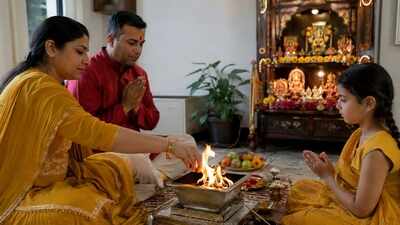
If your family tradition permits a smaller home havan, meaning fire offering, and your housing rules allow it, keep it modest. Use a small havan kund, meaning fire vessel, on a protected surface, with windows open and a fire extinguisher nearby. Do it in daylight if possible. Keep children close, not running about. Use minimal samagri, meaning offering mixture, and a very small, controlled flame.This is where honesty matters. A short home havan led by a knowledgeable family elder, or with priest guidance over video, may be a practical adaptation. It is not automatically the same as a full prescribed yagya in every sampradaya.In some traditions, a simplified havan may be acceptable for certain occasions, while others will insist that the full rite requires a trained priest and proper setting. Confirm with your family tradition or temple.If smoke is the issue, do not force it. A ritual that leaves your child coughing and your smoke detector screaming is not more authentic because it was unpleasant.
Online priest guidance can help, with caveats
Since the pandemic, many families have used Zoom, WhatsApp video, or temple livestreams for puja guidance. This can be useful, especially across time zones. A priest in India may guide a family in Manchester in the evening, which is late at night in India, or a family in New York may book a morning slot that suits both sides.But there are caveats. A priest chanting from a screen is not physically present to inspect materials, correct fire handling, or adjust the rite on the spot. Internet delay can affect mantra repetition. Some priests are excellent at guiding diaspora households. Others are not.Ask practical questions before booking. Will the priest provide a materials list that can actually be sourced in the US or UK? Will the ritual be in Sanskrit only, or explained in English or Hindi? Is this a full priest-led rite done remotely, or a sankalpa and guided home puja? How long will it take on a school night?If the answers are vague, keep looking.
Temple sponsorship is often the cleanest option
For many families, sponsoring a yagya at a temple is the most honest middle path. The ritual is performed in a proper setting, by priests who handle the fire, mantras, and sequence, while the family joins in person or remotely where possible.This is common in larger temples in London, Milton Keynes, Leicester, Houston, Atlanta, New Jersey, and the Greater Toronto Area, and is increasingly common through online booking portals as well.Some temples abroad will let you sponsor a specific homa, meaning fire offering, on your behalf, with your names included in the sankalpa. Some organisations in India also offer this. If you are using a temple in India while living abroad, check whether they will tell you the date and time according to your location or theirs.That sounds small, but it matters if you plan to fast, join live, or explain the observance to children.Also check what exactly is being sponsored. Is it a standard temple seva, meaning devotional service, a community ritual where many names are included, or a dedicated ceremony for your family alone? None of these is wrong. They are simply different.
What changes and what does not
What changes is the form. You may use filtered water where Gangajal, meaning Ganga water, is unavailable, or keep a small stored bottle of Gangajal and add a few drops to clean water if your family does that. You may offer fewer materials because fresh mango leaves, specific woods, or certain herbs are hard to find. You may schedule around school runs and office calls. You may join a priest by video instead of sitting beside one. You may sponsor the ritual at a temple instead of hosting it at home.What does not change is the need to be truthful about the category of what you are doing. A temple-sponsored yagya is not the same as a five-minute home prayer, though both can be sincere. A simple havan is not automatically a scriptural equivalent to every full rite. Family custom is not always a canonical requirement, though it can carry deep meaning. And your location does not make your prayer less real.The purpose also does not change. Offering, remembrance, gratitude, prayer, discipline, and bringing the family together remain.If your children see you wash a small copper bowl, sit down before dinner, say the sankalpa properly, and join folded hands while a priest chants from a tablet on the kitchen counter, they are not seeing a failed version of Hindu life. They are seeing what continuity looks like when distance is not optional.
Finding the right help abroad
Ask your local temple first, not just Google. Temple offices usually know which priests are comfortable with North Indian, South Indian, Gujarati, Bengali, Tamil, Telugu, Kannada, or Marathi family requirements, and which ones explain things well to second-generation children.In the UK, many temples publish seva lists and priest contact details online. In the US, larger temples often have weekday office hours that suit local time zones, while priests in India may respond better over WhatsApp.When you call, describe the actual situation. Say you live in a flat. Say you cannot do smoke. Say you need something after 6 pm. Say your children understand English better than Sanskrit. Say you want to keep to your family sampradaya but need a practical format.A good priest won’t be offended by this. They’ll recognise the problem at once.If all you manage this month is a clean altar, one lamp, a spoken sankalpa, and a booked temple sponsorship for the weekend, that is still a family sitting down and choosing not to let the thread snap.On many evenings abroad, that is where the fire begins.