









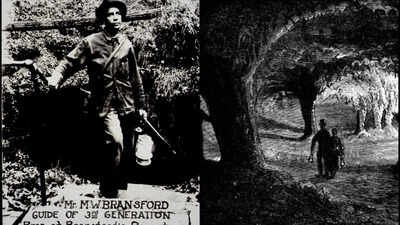
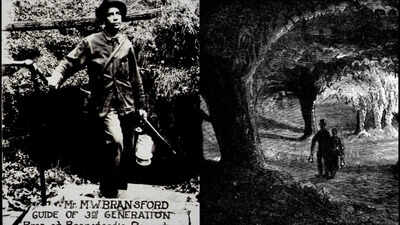
Deep below the forests of Kentucky is a world of water, stone and centuries-old human history. Mammoth Cave National Park has the world’s longest known cave system, but its story is about far more than underground passages. It’s also a story about indigenous exploration, enslaved guides, ambitious entrepreneurs, tourism, conservation, and families changed by the landscape’s transformation into a national park. One such story is that of Matt Bransford, a Black cave guide with family deep roots in Mammoth Cave and its tourism industry. Scroll down to read the story and what makes it so unique
A cave with a history of thousands of years
Mammoth Cave is an incredible natural system, with more than 412 miles of mapped passages. Its limestone chambers and tunnels hold evidence of human activity for thousands of years. Before modern tourism was a thing, native Americans explored and mined the upper levels of the cave. Archeological finds include torches, pottery, woven objects, shells and other relics of early cave dwellers. Some groups entered the cave in search of minerals such as gypsum, selenite and other mineral deposits Later the cave became a major source of saltpeter. Some 400,000 pounds of the material were mined before and during the War of 1812 for the production of gunpowder.
Legendary explorers with enslaved guides
In the 19th century, as Mammoth Cave became a tourist attraction, African Americans were enslaved to serve as guides. In 1838, Franklin Gorin purchased the cave property and brought enslaved people to show visitors around. The following year when Dr John Croghan bought the cave he kept experienced guides who knew its winding passages.They were Stephen Bishop, Nick Bransford and Matt Bransford. Their knowledge of the cave was amazing. They guided visitors through difficult passages, found some previously unknown areas, and helped to build Mammoth Cave’s reputation as a remarkable destination. Their contributions remain a significant part of the site’s history, especially as their expertise was developed under slavery.
From tourism to growing community
In the 19th century, the popularity of Mammoth Cave grew. Hotels, transportation networks and other businesses grew up around the attraction. From 1886 to 1929, the Mammoth Cave Railroad brought tourists to the cave and bolstered the local economy. Visitors could ride the rail to the Mammoth Cave Hotel, making it easier to get to the spot. The rising popularity of the cave also brought fierce competition. In the early 20th century many caves in the area were being promoted to tourists which led to what became known as the Kentucky Cave Wars.
Matt Bransford and the new landscape
Matt Bransford was one of a number of generations of Black guides whose lives were closely tied to Mammoth Cave. His family remained engaged with the area’s tourism economy even as the region went through a period of major change. Bransford sold the 14-room Mammoth Cave hotel and land for $3,000 in 1934. The sale took place at a time when there was growing momentum for the creation of a national park and land was being bought up across the area. The Bransford family then moved some twenty miles away and the area around Mammoth Cave was slowly converted into a public park. Their story is one of a larger change. More and more land that had been private business, farms and communities, was being brought under the ownership of government to form the national park.
Creating Mammoth Cave National Park
Creating the park was a massive land-acquisition effort. From about 600 land-owners, more than 45,000 acres had to be secured. In 1935, workers from the Civilian Conservation Corps arrived and started building roads, trails and other facilities. Much of the infrastructure that made the area a national park was put in place because of their efforts. Mammoth Cave National Park was officially established in 1941. It kept getting bigger and bigger. The cave and its surrounding landscape were designated as a World Heritage Site in 1981 and a Biosphere Reserve in 1990.
A landscape where history and nature meet
Today Mammoth Cave National Park conserves much more than its famous underground caverns. Forests, grasslands, rivers and karst landscapes are home to more than 1,300 plant species and many threatened or endangered species. The Green River, which flows through the park, is also famous for its incredible diversity of freshwater mussels. Here, visitors can hike, camp, ride bikes, canoes and horseback above ground. Historic sites, old churches and cemeteries and the remains of the area’s once-thriving communities, add another dimension to the story of the park. Of special interest is the Old Guide Cemetery. It is the resting place of cave guides, explorers and victims of the failed tuberculosis treatment experiment that was carried out inside the cave.
A legacy preserved above and below ground
The tale of Mammoth Cave is ultimately a reminder that natural marvels are seldom free of human influence. Humans have explored its passages, used its resources, struggled over its future and built communities around it for thousands of years. That history is made all the more meaningful by the stories of people like Matt Bransford and other Black cave guides. Generations of visitors have come to experience a world hidden beneath the forests of Kentucky with their help. Today, Mammoth Cave is a geological wonder and a living historical record, where ancient artifacts, historic structures and sprawling natural landscapes tell a story that stretches far beyond the cave walls.