






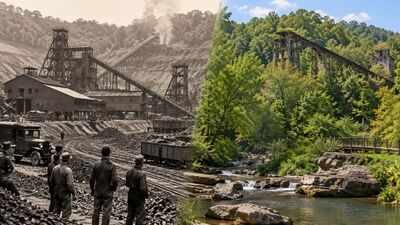
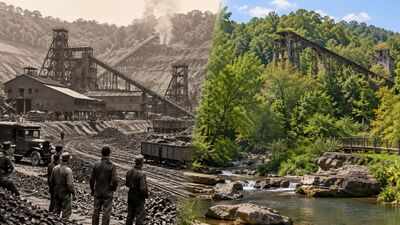
Hidden deep in a West Virginia gorge is an abandoned coal town with a surprising connection to Henry Ford. Nuttallburg was once a thriving mining community, its fortunes built on the rich coal and the railway that carried the fuel to distant customers. For decades, miners, railway workers and their families helped turn the isolated settlement into a busy industrial centre. Then Ford arrived. In the 1920s, his company took control of the mines as part of an ambitious attempt to secure the raw materials needed for his expanding industrial operations.But the plan exposed an unexpected weakness: owning the mine did not mean controlling the railway that transported its coal. Ford eventually sold his interests in 1928. Mining continued until 1958, after which Nuttallburg slowly disappeared beneath vegetation. Today, its surviving tipple, foundations and roads offer a rare glimpse into a coal town that once played a small but fascinating role in Ford’s industrial empire.
How Nuttallburg turned a remote gorge into a thriving mining community
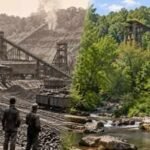
Nuttallburg began taking shape in the late 19th century, when the demand for coal was transforming the New River Gorge. According to the National Park Service, in 1870, John Nuttall, an English-born entrepreneur, recognised the potential of the coal seams around Keeneys Creek and began acquiring land and developing the infrastructure needed to extract and move the fuel.The Chesapeake and Ohio Railway reached the gorge in 1873, providing something the isolated mining settlements badly needed: a way to get coal out.Nuttallburg grew alongside the railway. Coal mined high above the river was brought down towards the processing works, prepared for shipment and then loaded onto trains. The coal from the New River region was prized for its low smoke, making it attractive to industrial customers far beyond West Virginia.By the turn of the 20th century, Nuttallburg was no longer simply a collection of mine workings. It had become a functioning community, with workers and families living around an industry that dominated nearly every part of daily life.John Nuttall died in 1897, but the operation continued under his heirs. For decades, the settlement remained connected to the fortunes of the coal trade. Then came Henry Ford.
How Ford brought Nuttallburg into his vision
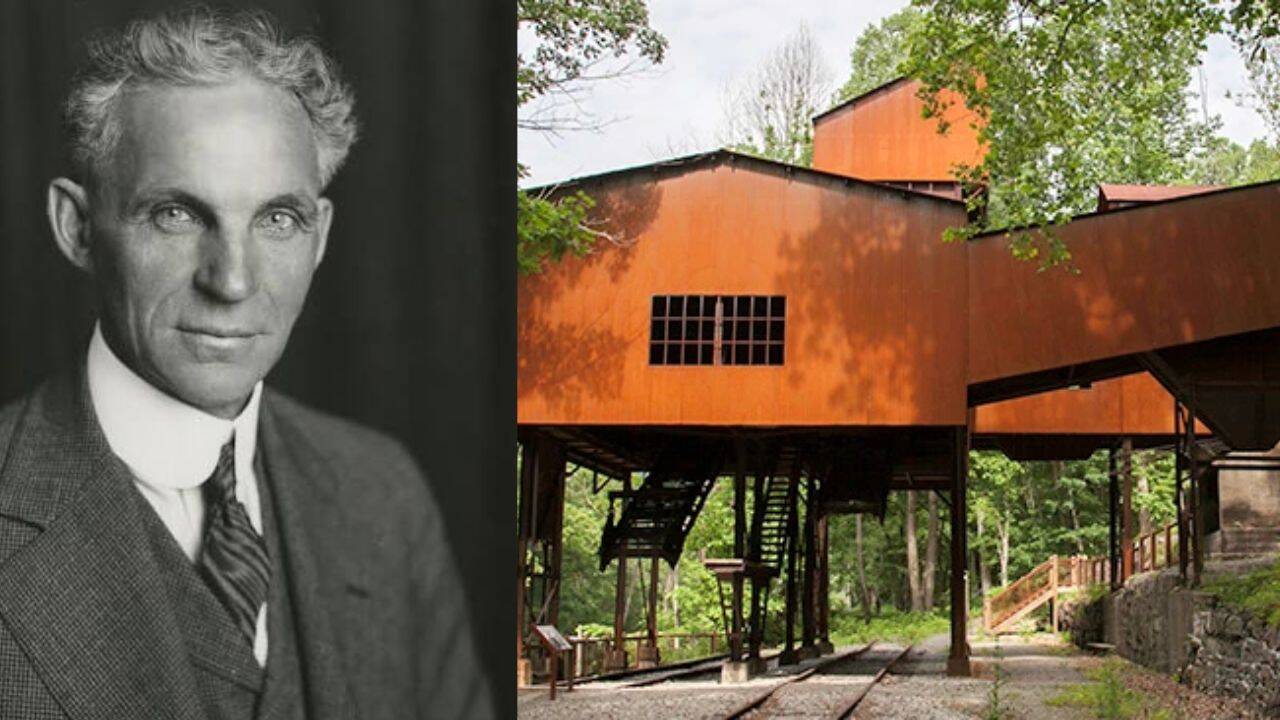
During the 1920s, Ford was pursuing a business strategy that went beyond making cars. He wanted greater control over the materials and processes feeding his industrial operations, a concept known as vertical integration.Coal was important to that system. It was needed for industrial production, including the steelmaking operations supplying Ford’s factories. Nuttallburg caught Ford’s attention.His company leased the town’s mines and took control of the operation during the 1920s. Under the Fordson Coal Company, the site received investment and changes intended to make the mining complex more efficient. The old operation was being reshaped to fit a much larger industrial vision.For a remote settlement tucked into a narrow gorge, the connection was unusual. Ford’s name was associated with mass production, motor cars and enormous factories. Nuttallburg, by contrast, was reached by a steep road and surrounded by rugged Appalachian terrain.Yet the mine fitted into Ford’s plans because of what lay underground.
PC: NPS
How Nuttallburg showed the limits of Ford’s industrial empire
The strategy ran into a basic difficulty. Mining the coal was only part of the job. It still had to be transported to the places where Ford needed it.The railway remained essential. Ford could lease and improve the mine, but he could not gain the same control over the railway that carried the coal away. That weakened the logic behind his attempt to bring the different stages of production under one roof, or at least under one corporate structure.According to the National Park Service, after about eight years, Ford’s involvement with Nuttallburg came to an end. He sold his interests in the mines in 1928, bringing the chapter of Ford’s direct association with the operation to a close.It was an important lesson in the limits of industrial control. Owning or managing a mine did not mean controlling the network that connected it to the wider economy.
How the end of coal mining transformed Nuttallburg forever
Nuttallburg did not shut down when Ford left. The mine passed through three owners, although its importance gradually diminished as the market for New River coal changed. In its later years, production was increasingly directed towards local needs rather than the distant industrial markets that had helped make the settlement prosperous.The decline was slow rather than sudden. Mines could remain active long after their most prosperous period had passed, especially in communities where coal was the main source of employment.At Nuttallburg, commercial mining finally stopped in 1958.The change was profound. A settlement that had once depended on miners, railway workers and the movement of coal was left without the industry that had created it. Houses disappeared, buildings deteriorated and vegetation began reclaiming parts of the site.What had been an industrial workplace was gradually becoming an archaeological landscape.
What Nuttallburg’s surviving buildings reveal about its industrial past
The most striking survivor is the coal tipple, the large structure used in handling and loading coal. It stands above the old railway alignment, giving an idea of the scale of the operation that once occupied the valley.Other remnants are scattered through the site. Foundations, industrial structures, old roads and traces of the settlement remain, although some are easier to recognise than others.The surrounding landscape has become part of the story. Trees and vines now grow around structures that were once maintained because they were essential to production. In places, the boundary between the industrial remains and the forest is difficult to distinguish.
Seventy years later, Nuttallburg changed hands
The Ford era was long over by the time the Nuttall family made a decision that would shape the site’s future.In 1998, ownership of Nuttallburg was transferred to the National Park Service. The timing came four decades after mining had ended and roughly 70 years after Ford’s involvement with the operation. The site was subsequently documented and assessed for its historical significance. In 2005, Nuttallburg was added to the National Register of Historic Places.Preservation work followed. Vegetation that had obscured parts of the old complex was cleared, while surviving structures were stabilised. By 2011, the National Park Service had completed a multi-year effort aimed at making the remains safer to study and protecting what was left.The result is now regarded as one of West Virginia’s most intact historic coal-mining complexes and one of the country’s more complete surviving industrial coal sites.
How visitors reach historic Nuttallburg
Nuttallburg is not a place reached by an easy drive through a modern tourist district. The route itself reflects the geography that shaped the settlement.Keeneys Creek Road is narrow, winding and steep, with a mixture of paved and gravel sections. Much of it is only wide enough for one vehicle. Passing another car can mean finding a suitable pull-off, and in some sections there is little room to do so. Large vehicles and trailers are therefore discouraged.The main parking area lies beyond the former community, with accessible parking a little farther along, closer to the tipple.Visitors also pass through what was once Nuttallburg’s African American community on the approach. Interpretive panels along the road provide information about the people and places that formed part of the settlement’s history, rather than focusing solely on the machinery and mine workings.There is another way in for those approaching from the direction of Lansing. A trail from Beauty Mountain Road leads towards the headhouse area. It follows an old administrative road for roughly three-quarters of a mile, but the route is steep and strenuous.