







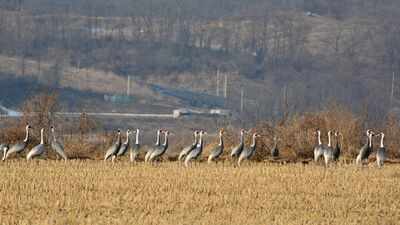
Soldiers on both sides stand behind fences and in between are thousands of landmines. For more than 70 years, humans have not ventured into a 155-mile-long corridor that divides two nations, North and South Korea. While boundaries and borders can ward people off, nature is above all such regulations. This is probably why a space where beings seldom step in has transformed into a surprising wildlife haven for flora and fauna.The Korean Demilitarised Zone (DMZ) was created by the armistice that halted the Korean War in 1953. To date, it remains surrounded by soldiers, fences, watchtowers and landmines, making it one of the most fortified and militarised borders in the world. For humans, it is among the most forbidden places on Earth, but for wildlife it is a home they return to.
A wildlife haven
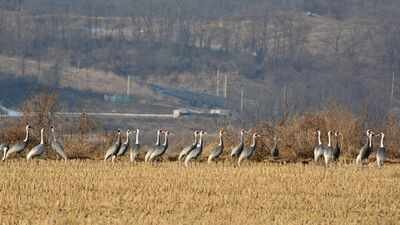
DMZ extends about 155 miles across the Korean Peninsula and is about 2.5 miles wide. It covers everything 2 kilometres north and south of the border between the two countries. Since civilian access to the area is severely restricted, it has escaped the trenches of roads, buildings and intensive farming found elsewhere. According to surveys, in the past seven decades, 6,168 species have been identified in the area in and around the DMZ, according to a report by AS. 38% (102) of the South Korean Peninsula’s 267 endangered species have been recorded there. This list includes musk deer, leopards, long-tailed gorals and Asiatic black bears. Otters are known to travel along the rivers without recognising the intense political divide. Remote cameras have even captured a young black bear, providing evidence that the animals may be breeding there.But the most striking residents of the area are found in the air. Seven of the world’s fifteen crane species have been seen in the region, including the endangered red-crowned and white-naped cranes. According to the DMZ Ecology Research Institute, while wetlands in China and Japan are disappearing, the DMZ offers a peaceful sanctuary for these migratory birds. As wetlands have disappeared elsewhere in East Asia, the rice paddies and marshes near the border have become invaluable stopping places.“The demilitarised zone is a symbol of hope. It shows everything can be restored,” Seung-ho Kim, Director of the DMZ Ecology Research Institute, told Earth.Org.
Conservation efforts
Even though human access to the area is severely restricted, numerous Korean organisations are involved in the conservation and preservation of the DMZ and its inhabitants. “For the past 30 years, Green Korea United has conducted extensive on-the-ground surveys across the Civilian Control Zone and border areas to monitor the habitats of endangered wildlife,” said Dasom Lee, Director of the Ecosystem Conservation Team of Green Korea United (GKU).The accumulated area from the surveys helped GKU successfully advocate for the designation of 70,000 hectares of land in the DMZ buffer zones as protected areas. “The preservation of the Civilian Control Zone south of the DMZ over the past 70 years is the result of both legal environmental protection and the restriction of human access due to military constraints,” Lee told Earth.Org.Pictures taken by unmanned eco cameras installed by the National Institute of Ecology offer a glimpse of the wildlife in the isolated area. Field research can only be done in the Civilian Control Zone (CCZ), a buffer area south of the DMZ. While public access is also heavily restricted here, a limited number of people are allowed to enter, and even farm, within the CCZ area. The agricultural land is mainly used to grow rice.Every week, Seung-ho Kim, Director of the DMZ Ecology Research Institute and volunteers from the institute enter the CCZ to conduct field research. “Interestingly, the small waterways of the rice paddies are home to the most endangered species. The paddies are very different from the rice fields outside the CCZ; they contain more weeds and are very traditional,” said Kim, who started the research centre in 2004 to preserve and protect the area through research and educational activities.“We are testing microhabitats which can function as corridors to bring more wildlife. For example, the weeds in rice paddies could function as a corridor for deer, leopard cats or birds. This year, we are also testing rock piles to see how they function as a microhabitat for small mammals such as mice, reptiles, and snakes,” he explained.
Eco-tourism
The uniqueness of the area, its ecological value and the wildlife it inhabits have gained attention worldwide. The presence of rare migratory birds has led to the development of bird-watching tours in the area. The South Korean government developed the DMZ Peace Trail to help restore tourism in the border regions and to boost the local economy.Those who want to walk one of the 11 routes need to go through an identification verification process and can enter the area in small groups guided by local tour guides. To protect the environment, only small parts of the route can be walked; the rest can be visited by bus.