








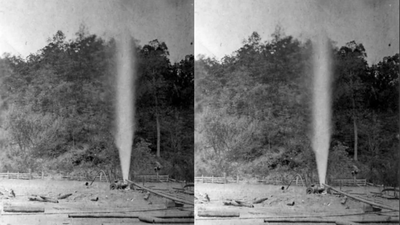
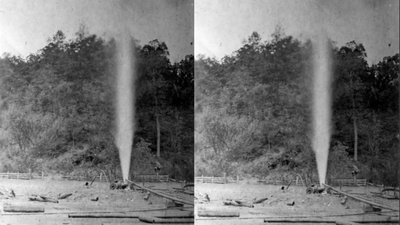
In 1895, a lightning strike turned an already uncontrollable natural gas well in West Virginia into a spectacular column of fire. The Big Moses gas well, located along Indian Creek in Tyler County, had become famous after drillers searching for oil instead struck an enormous underground supply of natural gas. According to West Virginia Explorer, the well produced gas with such extraordinary pressure that efforts to contain it repeatedly failed. When lightning ignited the escaping gas on June 14, 1895, flames reportedly rose 150 to 200 feet into the air and attracted crowds from the surrounding countryside. However, historical newspaper accounts cited by various sources reveal an important detail often lost in later retellings: the lightning-triggered fire itself lasted only about two hours before the force of the escaping gas blew it out.
A giant gas discovery
The story of Big Moses began in 1894, during a major oil and gas boom in Tyler County. Drillers were searching for oil on the Moses Spencer farm near Sistersville when they struck the well on September 6. Instead of oil, they encountered an enormous flow of natural gas. The pressure was extraordinary. As per contemporary accounts, the force of the escaping gas was powerful enough to blow the drilling tools completely out of the hole and through the derrick. Estimates of the well’s output varied considerably. Some historical accounts placed its initial flow at as much as 100 million cubic feet of gas per day, while a later federal estimate put it at about 35 million cubic feet per day. Whatever the exact figure, Big Moses was an exceptionally powerful well for its time and was widely regarded as one of the world’s largest gas wells.The problem was that the technology available in the 1890s was not well suited to controlling such a high-pressure source. Workers repeatedly attempted to shut the well, but the gas continued to force its way out. At one point, the owners installed a massive casing weighing several tons. Although the effort initially appeared successful, sand and small stones propelled upward by the gas eventually damaged the casing and allowed the well to escape again. Another attempt involved pumping water into the well for five days. Instead of stopping the gas, the pressure forced water through cracks in the surrounding ground, reportedly creating numerous small geysers, some nearly half a mile from the well.
Lightning creates a giant flame
As Big Moses continued releasing gas, it became both an industrial problem and a local spectacle. People travelled to see the enormous well, while newspapers described its deafening roar and the difficulty of standing close enough to speak normally. Then, on June 14, 1895, a thunderstorm passed through the area. Lightning struck the column of gas escaping from the well, igniting it almost instantly. The result was a spectacular blaze that illuminated the surrounding countryside. Various reports described the flames as reaching extraordinary heights, with one account putting them at between 150 and 200 feet. The fire appeared to create a new problem for the well’s owners. They had already struggled to contain the gas, and now the escaping fuel was burning above the wellhead. Crowds gathered to witness the unusual spectacle. Newspapers described the scene as both frightening and remarkable, with the enormous flame visible from a considerable distance. But the fire did not continue indefinitely.
The fire blew itself out
Despite later stories suggesting that Big Moses burned for a year or even decades, the contemporary accounts tell a different story. The lightning-triggered blaze lasted only about two hours. The reason was almost as remarkable as the fire itself: the tremendous pressure of the escaping gas eventually blew the flames out. A June 18, 1895, report in the Parkersburg Daily Sentinel said the fire had burned for about two hours before the immense force of the gas extinguished flames that had been reaching an estimated 150 to 200 feet into the air. West Virginia’s official historical archives preserve contemporary reports documenting both the lightning strike and the subsequent extinguishing of the blaze.Big Moses itself continued to be a major uncontrolled gas flow after the spectacular fire. Historical records indicate that the well ultimately stopped flowing on August 27, 1895, after months of attempts to control it. The episode became part of West Virginia’s early oil-and-gas history because it demonstrated both the enormous energy stored beneath the region and the limitations of 19th-century drilling technology. Big Moses had been drilled in search of oil, but instead revealed a huge natural gas resource that engineers of the era struggled to harness. More than a century later, the well remains memorable not because its lightning fire lasted for decades, but because of the extraordinary sequence of events surrounding it: an enormous gas discovery, repeated failed attempts to control the pressure, a lightning strike that created a towering flame and, finally, a fire powerful enough to be extinguished by the very gas that had created it.