








Deep beneath the surface of Lake Ontario, a layer of naturally cold water has become an unlikely part of Toronto’s urban infrastructure. Instead of relying entirely on conventional air-conditioning systems to cool its downtown buildings, the Canadian city uses the lake’s cold temperature as a source of cooling energy. According to a report by the Daily Commercial News, water drawn from about 83 metres below the surface was being used as part of a district cooling network serving buildings in Toronto’s downtown core. What started more than two decades ago has since grown into one of North America’s largest district energy systems. Today, the network serves around 200 buildings and more than 40 million square feet of downtown real estate, including offices, hospitals, hotels, condominiums, educational institutions and data centres.
A 2004 cooling experiment
Toronto-based Enwave had begun using its Deep Lake Water Cooling (DLWC) system to cool buildings in the downtown core. The report explained that the system drew water from a permanently cold layer about 83 metres beneath Lake Ontario and described it as the largest renewable lake-source cooling system of its kind at the time. The project initially produced enough air conditioning to cool about 20 million square feet of office space. It was also reported to reduce electricity use by 75% compared with traditional air conditioning and was expected to eliminate about 40,000 tonnes of carbon dioxide emissions.The key idea behind the system is that the water at the bottom of the lake remains cold enough to provide useful cooling even during Toronto’s hot summers. Rather than using the lake water directly inside buildings, Enwave uses its low temperature to transfer cooling energy into a separate water network.
How lake water cools buildings
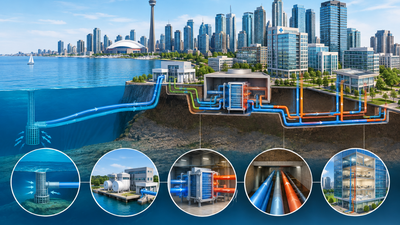
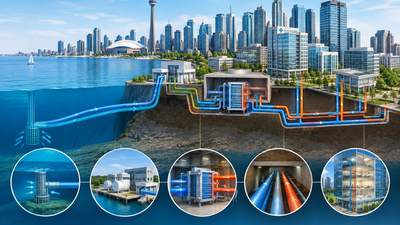
The process begins deep in Lake Ontario, where cold water is drawn through intake pipes and sent to the Island Filtration Plant. The water is treated before reaching the John Street Pumping Station, where heat exchangers transfer its cooling energy to Enwave’s separate chilled-water system. This distinction is important: the lake water itself does not circulate through the buildings’ air-conditioning systems. Instead, its cold temperature is used to cool another water loop. Heat exchangers transfer the cooling energy, creating chilled water that can then be distributed through underground pipes to connected buildings.Once inside a building, the chilled water absorbs heat from the building’s cooling system. The warmed water returns to the district system, where it can be cooled again and circulated back through the network. This centralised approach means individual buildings do not necessarily need to operate large conventional chiller plants of their own. Enwave says the system provides an alternative to traditional cooling towers and equipment, which can represent significant capital and operating costs for large buildings.
A network that keeps growing
The system has expanded considerably since its launch. Enwave’s current information for Toronto states that its district energy network serves 200 buildings and more than 40 million square feet of downtown real estate. The network is supported by four interconnected downtown plants and about 25 miles (40 kilometres) of underground pipes. Its customers include hospitals, commercial offices, hotels, condominiums, institutions and data centres. The Deep Lake Water Cooling system remains the main anchor of the wider district-energy network. Some individual buildings have also benefited by no longer needing conventional cooling infrastructure. According to Enwave, Brookfield Place, which contains more than 2.6 million square feet of office space, eliminated the need for conventional chiller plants after connecting to the system.
Turning nature into infrastructure
Toronto’s system demonstrates how a natural feature can become part of a city’s energy infrastructure. The cold water deep beneath Lake Ontario provides a stable source of cooling energy, while a centralised network distributes that cooling to hundreds of buildings. The system can reduce peak electricity-system generation compared with the demand that would otherwise be required by traditional cooling methods. That makes the concept particularly relevant for dense cities, where large numbers of buildings can place significant pressure on electricity systems during hot weather.More than 20 years after the original project began, Toronto’s Deep Lake Water Cooling system shows how district energy can move beyond individual building-by-building solutions. By using the naturally cold conditions deep within Lake Ontario and combining them with underground infrastructure and heat-exchange technology, the city has turned cold lake water into a large-scale cooling resource for its urban core.