









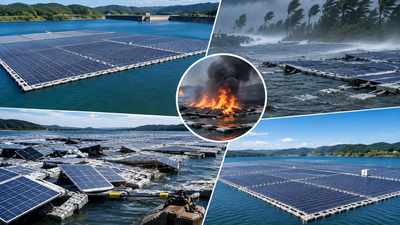
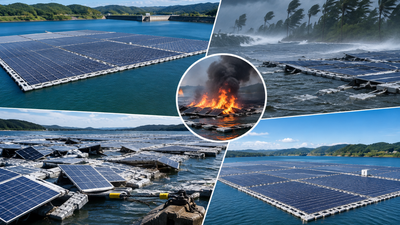
Japan’s push to generate renewable electricity from reservoirs took a dramatic turn in 2019 when a powerful typhoon damaged one of the country’s largest floating solar farms. The project at Yamakura Dam in Ichihara, Chiba Prefecture, began operating in March 2018 with thousands of solar panels spread across the reservoir. According to Kyocera, a Japanese technology and electronics company involved in the project, the 13.7-megawatt plant had 50,904 solar modules installed across about 180,000 square metres of the reservoir. Just 18 months later, Typhoon Faxai brought extremely strong winds to the region, tearing sections of the floating array apart. Some of the displaced panels piled onto other modules, eventually contributing to a fire that involved about 50 panels. The incident highlighted an unusual challenge facing floating solar technology: while placing solar panels on reservoirs can save valuable land, the installations must also withstand powerful winds and the forces created when large floating structures move across water.
Japan’s giant floating solar project
According to pv magazine, the 13.7-megawatt Yamakura Dam project was damaged when Typhoon Faxai struck the Chiba area with winds reported at about 120 mph. Several solar modules were torn loose and became stacked together, while firefighters said the resulting concentration of heat may have caused the fire. The blaze involved around 50 panels. The plant covered about 44 acres of water and contained 50,904 solar modules supplied by Kyocera.The project had been inaugurated in March 2018 by Kyocera TCL Solar, a joint venture between Kyocera and Tokyo Century. At the time, it was described as Japan’s largest floating solar plant by output. The array occupied approximately 180,000 square metres of the Yamakura Dam reservoir and had an estimated annual generation of 16,170 megawatt-hours, enough to supply electricity equivalent to the consumption of about 4,970 households. The project was built on a reservoir used for industrial water rather than on agricultural or urban land. That was an important reason for choosing floating solar. Japan has limited suitable land for large-scale solar installations, making reservoirs and dams an attractive alternative for renewable-energy projects.
When Typhoon Faxai struck
The situation changed dramatically in September 2019. Typhoon Faxai moved through the Chiba region with exceptionally strong winds. The storm was among the strongest to affect the Tokyo region in years, with wind gusts at a nearby Chiba weather station reaching about 207 km/h, or roughly 129 mph. At Yamakura Dam, the wind was strong enough to pull parts of the floating solar array away from their moorings. According to the initial report from pv magazine, several modules were blown loose and stacked on top of other panels. The firefighters investigating the incident said the contact and heat generated by the panels could have created the conditions for the fire. Around 50 modules were reportedly involved in the blaze. The damage, however, went far beyond the visible fire. A later investigation found that a substantial portion of the floating array had been destroyed.
Why the panels came loose
A subsequent investigation by Japan’s Ministry of Economy, Trade and Industry (METI) identified anchor failure as the main cause of the accident, according to pv magazine. The floating island was secured by 420 anchors connected to 823 mooring lines. During the typhoon, seven anchors on the central southern side came loose. Once those anchors failed, the wind loads were distributed unevenly across the remaining structure. This caused resin bolts to fail sequentially, creating a chain reaction that eventually ripped the floating array into three sections. The investigation also identified the size and shape of the floating island and the safety factors used during construction as contributing factors. The incident therefore became more than a single weather-related accident; it provided engineers with information about how large floating solar installations respond to extreme wind conditions.
Rebuilding the solar farm
The damaged project was not simply abandoned. Reconstruction began after the incident, with the floating-solar specialist Ciel & Terre and Kyocera working on a redesigned configuration. Instead of recreating the original large, complex floating island, the rebuilt section was divided into smaller square-shaped islands. The change was intended to reduce stress concentration and increase safety factors during extreme weather. By October 2021, Renewables Now reported that Kyocera had restored the roughly 14 MW floating solar park. The restoration demonstrated that the project could return to operation after suffering extensive typhoon damage.
A lesson for floating solar
The Yamakura Dam incident illustrates both the promise and vulnerability of floating solar power. Putting solar panels on reservoirs can make use of water surfaces that would otherwise remain unused while avoiding competition for valuable land. The original project was expected to generate more than 16,000 MWh of electricity annually. But floating arrays also face a different set of engineering challenges compared to ground-mounted solar farms. Strong winds can create uplift and movement across the water, placing enormous loads on anchors, mooring systems and floating structures.For Yamakura Dam, Typhoon Faxai exposed those weaknesses only 18 months after the plant began operating. The subsequent redesign turned the damaged facility into a case study in how floating solar systems can be adapted for extreme weather. What began as a showcase for renewable energy ultimately demonstrated another important requirement for the technology: solar panels on water must be designed not only to capture sunlight, but also to survive the storms that move across it.