








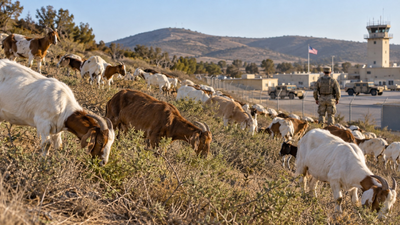
At Marine Corps Air Station Miramar in San Diego, a new group of workers has arrived with a rather unusual job description. They are expected to spend the coming months eating their way through dry vegetation.The base has brought in 471 goats as part of a pilot project aimed at reducing the amount of flammable brush around parts of the installation. Rather than relying entirely on machinery or sending crews into difficult terrain, officials are testing whether controlled grazing can provide another way to prepare potential fire breaks.The trial began in September and is expected to continue until the end of the year, with the animals working across several hundred acres.
Why goats are being used at MCAS Miramar
The project is focused initially on East Miramar, including land associated with the base’s explosive ordnance division. The area presents a particular challenge because vegetation can become a source of wildfire fuel while the rough ground makes access difficult for personnel.For firefighters and other crews, reaching some sections on foot can be hazardous. That is where the goats come in. They can move across uneven ground while feeding on vegetation, with their grazing and trampling expected to reduce the amount of dry material left standing.As reported by NBC 7 San Diego, Cole Bush, who runs Shepherdess Land and Livestock with her mother, is overseeing the livestock operation. The company is supplying not only the goats but also the herding dogs, a shepherd and the other services needed to manage the herd during the trial. The animals did not need much encouragement when they arrived. They began feeding on a designated hillside within minutes.
471 goats could clear up to five acres of vegetation each day
The pace of the grazing will depend on the vegetation and conditions at each site. Bush said the goats can work through between one and five acres in a day. That means the 471 animals will have several months to work across the areas selected for the pilot. The intention is not simply to remove every plant. Instead, the grazing is being tested as a practical way of reducing vegetation in places where creating and maintaining fire breaks can be complicated.If the approach proves useful, the programme could eventually extend to other parts of the installation. One longer-term possibility is grazing along the base perimeter, where a reduced layer of vegetation could form a buffer between the military property and surrounding communities.
MCAS Miramar tests goats as an alternative to machinery near sensitive habitat
Wildfire does not stop at the edge of a military installation, and fire moving through the region can affect land on either side of the base boundary. MCAS Miramar officials therefore see vegetation management as part of protecting both the installation and neighbouring communities.The goat project also gives the base an alternative to using heavy machinery in some locations.MCAS Miramar is home to several endangered species, according to officials. Bringing large machines into sensitive areas can disturb vegetation and habitat, while repeated vehicle movement can create its own environmental impacts. The pilot is intended to establish whether grazing can reduce some of those effects while still achieving the vegetation clearance required for fire management.
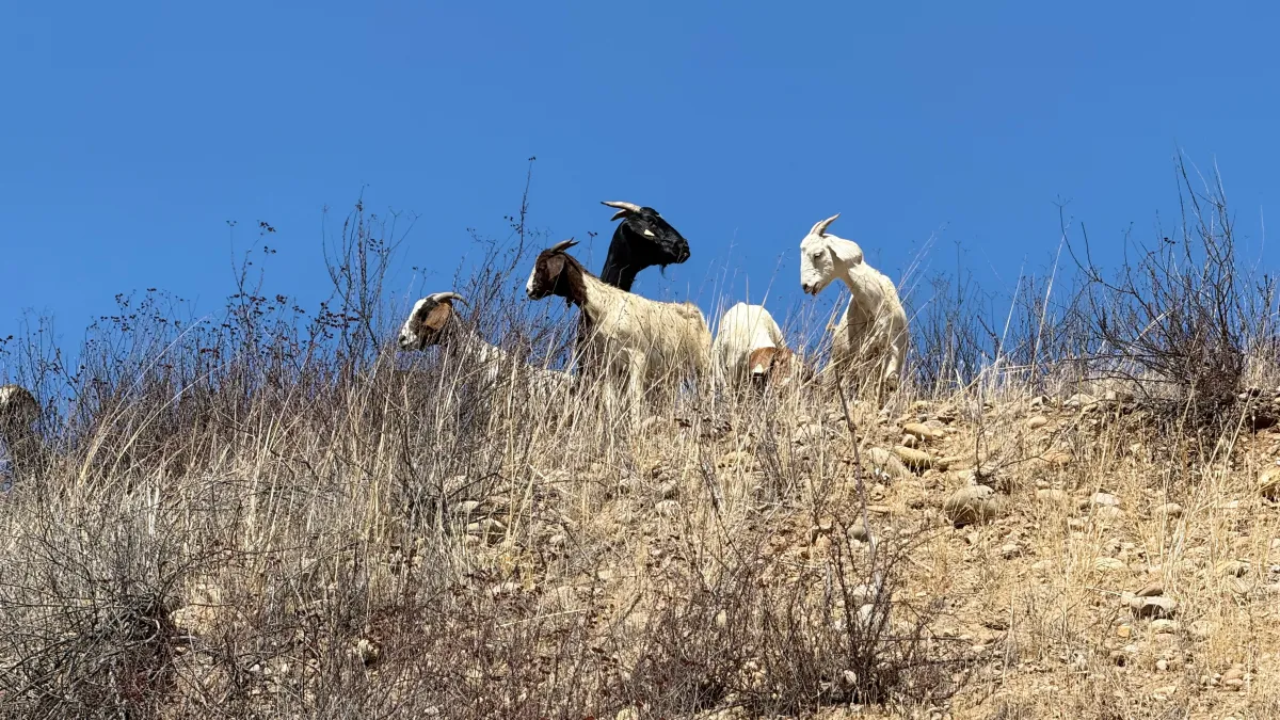
PC: NBC 7 San Diego
The idea has been under discussion for years
For MCAS Miramar Fire Department Fire Chief Joshua Allen, the arrival of the goats follows a proposal that had been discussed for much of the past decade. Allen said he had supported the idea of using goats on the base for years. The current programme gives officials a chance to test the concept in actual working conditions rather than relying on assumptions about how well it might perform. It is also being described by the base as the first programme of its kind at a US military installation.The results will help determine what happens next. Officials will be able to assess how much vegetation the herd can manage, where grazing works most effectively and whether the approach can be incorporated into future wildfire preparation.
What happens after the pilot
Reportedly, the goats are scheduled to remain on the base through the end of 2026. During that period, their work will provide a practical test of whether livestock can become part of the installation’s longer-term vegetation management strategy.There are limits to what the trial can establish. Grazing is not being presented as a replacement for every form of vegetation clearance or wildfire preparation. Instead, the base is examining where the animals can do work that might otherwise require machinery or personnel in difficult terrain.If the results support wider use, the method could become part of how MCAS Miramar manages vegetation around its perimeter and other fire-prone areas. The same trial could also offer information for other military installations considering whether managed grazing is suitable for their own landscapes.
The wildfire strategy behind Miramar’s goats has decades of history
Using goats to manage vegetation is far older than the Miramar experiment. Across Mediterranean landscapes, goats have shaped vegetation through centuries of pastoral grazing, with evidence from Crete showing sheep and goat pastoralism spanning roughly 2,000 years, as reported in the study published in Plos One, titled ‘2000 Years of Grazing History and the Making of the Cretan Mountain Landscape, Greece’. Their use for wildfire fuel reduction is more recent but also documented.California also has a documented history of using goats for fuel management. A 1982 US Forest Service report examined goats as a way to control brush regrowth on fuelbreaks, particularly in rough and mountainous terrain.