









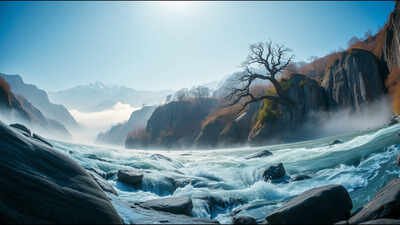
British adventurer Ash Dykes became the first person to walk the length of China’s Yangtze River, covering 6,437 kilometres, or about 4,000 miles, from the river’s scientific source in southern Qinghai to its mouth near Shanghai. Guinness World Records officially recognised the feat after Dykes began his expedition on August 26, 2018, and completed it 352 days later on August 12, 2019. Guinness estimates that the journey involved roughly 8 million steps. Starting on the Tibetan Plateau at an altitude of more than 5,000 metres, Dykes travelled through some of China’s most remote landscapes before reaching the densely populated lower reaches of the Yangtze. Along the way, he encountered sub-zero temperatures, difficult valleys and wild animals including wolves and bears, while also receiving support from people he met in communities along the route. The expedition became Dykes’s third world-first record.
Two years of preparation went into the attempt
Dykes spent 2 years preparing for the expedition before setting out. His official Mission Yangtze material described the journey as a year-long attempt to cover the 6,437-kilometre route on foot, with the expedition requiring extensive physical training, logistics and preparation for rapidly changing conditions. The journey began at what Dykes described as the scientific source of the Yangtze in southern Qinghai on the Tibetan Plateau. His expedition records place the starting point at more than 5,000 metres above sea level, meaning the early stages involved high-altitude conditions and sub-zero temperatures.The terrain presented another challenge. Dykes’s preparations accounted for isolation, difficult valleys, forests and major changes in climate as he travelled from the river’s headwaters towards eastern China. His expedition material also warned that he could encounter wildlife including snakes, bears, wolves and Asian giant hornets. By November 2018, after 11 weeks on the route, Dykes had covered about 1,500 miles and travelled through Qinghai, Sichuan and into Yunnan. He was gradually descending from the high-altitude headwaters as the landscape and climate changed around him.
The route took him from remote mountains to the Three Gorges
Dykes’s journey followed the Yangtze from its scientific source towards the East China Sea, taking him through dramatically different environments as the river grew from a high-altitude waterway into one of China’s major rivers. One of the landmarks he encountered was the Qutang Gorge, the first of the Yangtze’s Three Gorges. Dykes described it as the shortest of the 3 gorges and noted that the river narrows to about 150 metres between mountains reaching around 1,200 metres. The expedition also took him through areas with deep historical and cultural significance. Guinness notes that archaeological sites dating back thousands of years have been found around the Yangtze and that the river has played a major role in the development of Chinese civilisation.As Dykes moved further east, the contrast with the isolated headwaters became increasingly pronounced. His expedition records describe a progression from remote rural areas and difficult terrain towards forests, historic cities and densely populated urban landscapes. The Yangtze itself is the longest river in the world to flow entirely through a single country. Its source is on the Tibetan Plateau, often described as the “roof of the world”, while the river eventually reaches the East China Sea near Shanghai.
Wildlife and isolation were among the expedition’s challenges
The first half of the journey was particularly demanding because much of the route passed through sparsely populated, high-altitude and remote areas. Dykes documented encounters and close proximity to wildlife during the expedition, including bears, wolves, wild yak and other animals. Guinness described the journey as involving sub-zero temperatures, wolves, bears and treacherous valleys. Dykes’s own expedition updates also recorded camping in bear country and dealing with wild yak during the early stages.The physical challenges were accompanied by the logistical demands of maintaining a long-distance expedition over nearly a year. Dykes had to travel through changing climates while continuing to cover hundreds of kilometres at a time. His expedition website later described the journey as involving more than 8 million steps. The expedition was not entirely solitary, however. Dykes received support from people he encountered across China, with locals joining him for portions of his hikes, inviting him into their homes and helping him along the way. Guinness reported that this hospitality became an important part of his experience of the country.
The Yangtze expedition ended with a third world-first
After 352 days on the route, Dykes reached the Yangtze’s mouth near Shanghai on August 12, 2019. Guinness World Records lists him as the first person to walk the length of the Yangtze River, with the record covering 6,437 kilometres from southern Qinghai to Shanghai. The expedition became Dykes’s third world-first record. He had previously completed long-distance expeditions across Mongolia and Madagascar, including a 1,600-mile traverse of Madagascar’s interior in 2016.Reflecting on the Yangtze journey after completing it, Dykes described it as both a physical and cultural experience. He credited the people he met across rural and urban China for the hospitality and support he received during the expedition. The journey also became a record of the dramatic geographical transition along the Yangtze, beginning with a river at more than 5,000 metres above sea level on the Tibetan Plateau and ending nearly 4,000 miles later at its mouth near Shanghai.