




Pakistan is betting that military muscle can buy it a bigger seat at the global table. Islamabad has deepened defence ties with Saudi Arabia and Turkey through the Mecca pact, sought a larger role in Gulf security, marketed its fighter jets and drones abroad and cast itself as an emerging security partner across the Muslim world.But the bigger Pakistan’s ambitions become, thebigger the question: How much can its military and economy actually carry?The country is trying to project strategic strength while simultaneously operating under a $7 billon International Monetary Fund programme, managing large external financing needs and trying to keep its foreign exchange reserves above critical levels. Its latest federal budget increased defence spending sharply while cutting the federal development allocation.That tension is becoming harder to ignore.In June, Pakistan unveiled an PKR 18.77 trillion budget for the financial year beginning July 2026. Defence spending was raised 18% to PKR 3 trillion, while federal development spending was cut to PKR 1 trillion. The Shehbaz Sharif-led government is also targeting PKR 15.26 trillion in tax revenue and an overall fiscal deficit of PKR 5.23 trillion, or 3.6% of GDP.Pakistan finance minister Muhammad Aurangzeb justified the defence increase by pointing to regional uncertainty, saying defence spending had been raised “to make the country invincible”.However, the desperation to attain “invincibility” must be attributed to the setback Islamabad suffered at India’s hands during Operation Sindoor, when Pakistan lost multiple crucial airbases and key military infrastructure.The numbers underline the dilemma facing Islamabad: Pakistan wants to be a security provider abroad at a time when its government is still trying to create enough fiscal space to stabilise the economy at home.
From bilateral ties to a three-way defence pact
The biggest symbol of Pakistan’s expanding security role is its new defence arrangement with Saudi Arabia and Turkey.The three Islamic nations in August formed a Nato-style Mecca Pact. The agreement becomes crucial as the pact, also included a nuclear power.On August 7, Pakistan, Saudi Arabia and Turkey signed the Mecca Joint Defence Agreement, under which an armed attack on one of the three countries is to be treated as an attack on all. The agreement was signed in Mecca by Saudi Crown Prince Mohammed bin Salman, Turkish President Recep Tayyip Erdogan and Pakistan Prime Minister Shehbaz Sharif.Erdogan described the pact as being based on “collective deterrence”, while saying it was not directed against any particular country. Sharif called it a “historic pact” and described it as a “shield of peace”.Pakistan’s foreign minister Ishaq Dar has stressed that the agreement is “purely defensive in nature” and open to other countries that accept its principles.The arrangement brings together three countries with very different strengths.Pakistan has a large, combat-experienced military and is the only nuclear-armed country in the Muslim world. Saudi Arabia has enormous financial resources and significant influence across the Arab world. Turkey has Nato’s second-largest army and a rapidly expanding defence industry.On paper, the combination is formidable.In practice, however, the pact immediately raises questions about what Pakistan can actually contribute if Saudi Arabia faces a major security crisis.Those questions have become more pressing as Saudi Arabia has come under attack from Yemen’s Houthis.
The first real test came quickly
The defence agreement was signed against the backdrop of a rapidly changing Middle East. Since then, Iran-backed Houthi attacks have intensified, targeting Saudi cities, energy infrastructure and shipping routes.The issue has already forced Islamabad to clarify how far its treaty obligations extend.In September, Pakistan took a U-turn, saying there had been no discussion of a military response under the defence pact following Houthi attacks on Saudi Arabia. Foreign ministry spokesperson Sajjad Haider Khan said Islamabad remained committed to the agreement but added that action would come “when the time comes”.That careful wording illustrates the challenge.A collective-defence agreement can enhance deterrence without automatically requiring a country to enter every conflict involving its partner. But the credibility of such an arrangement ultimately depends on what happens when the security commitment is tested.Turkey has already signalled a willingness to provide military assistance to Saudi Arabia under the pact.
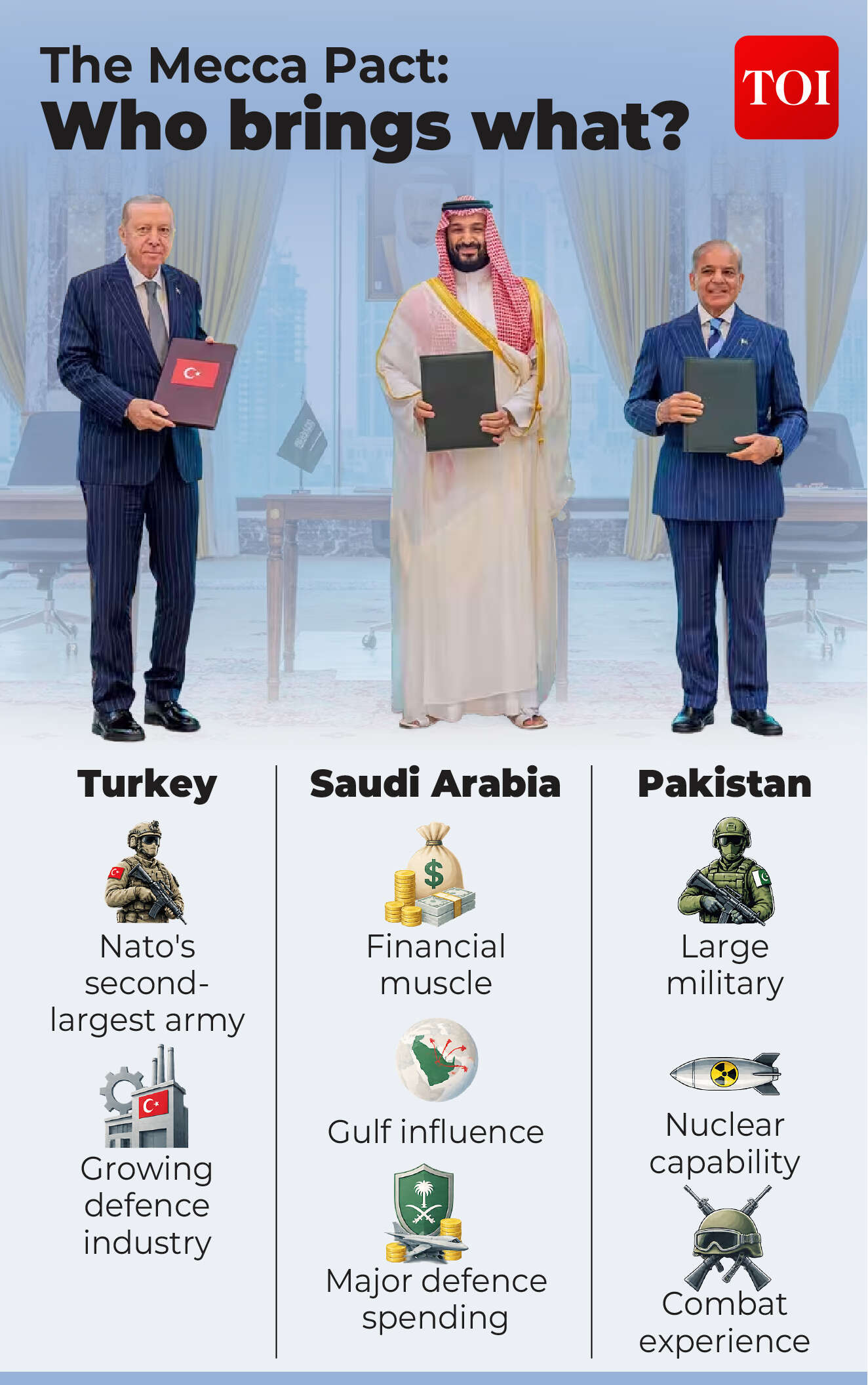
Nato-style defence pact: Who bring what?
Turkish foreign minister Hakan Fidan said Riyadh could have military needs, particularly technical ones, and that Ankara would have no problem meeting them.Pakistan, meanwhile, has pledged support for Saudi Arabia but has so far avoided spelling out the precise circumstances under which it would deploy combat forces.That caution is understandable. Pakistan has its own security challenges, a difficult economic position and a military stretched across multiple fronts.
Pakistan is trying to become an arms seller, too
There is another side to Islamabad’s new defence diplomacy.Pakistan does not want to remain only a buyer of military hardware or a provider of troops and security expertise. It increasingly wants to become a defence exporter.That effort received a major boost after the 2025 India-Pakistan conflict, when Pakistani officials began marketing the country’s military equipment as “combat tested”.However, the reality was totally different. Pakistan indulged in self-congratulation and boasted about its military performance despite losing a sizable chunk of its military infrastructure, including targets in Rawalpindi, the country’s military capital, located barely 15 kilometres from the political capital, Islamabad.Pakistan’s two highest authorities, Prime Minister Shehbaz Sharif and field marshal Asim Munir, also repeatedly credited US President Donald Trump for brokering the ceasefire, going as far as backing a Nobel Peace Prize for him.The reality, however, was that Pakistan’s Director General of Military Operations (DGMO) had approached his Indian counterpart and pleaded for an end to India’s counterterror operation.That apparent attempt to impress the MAGA supremo earned both men Trump’s attention. Munir was described by Trump as his “favourite field marshal”, while Sharif was praised as a “fantastic” prime minister.Reuters reported in January that Pakistan was in discussions with 13 countries over possible defence sales, with six to eight negotiations described as being at an advanced stage. The discussions involved JF-17 fighter jets, training aircraft, drones, air defence systems and armoured vehicles.Potential customers mentioned in the report included Saudi Arabia, Indonesia, Sudan, Nigeria, Morocco and Ethiopia, while Pakistan has also acknowledged discussions involving Bangladesh and Iraq.
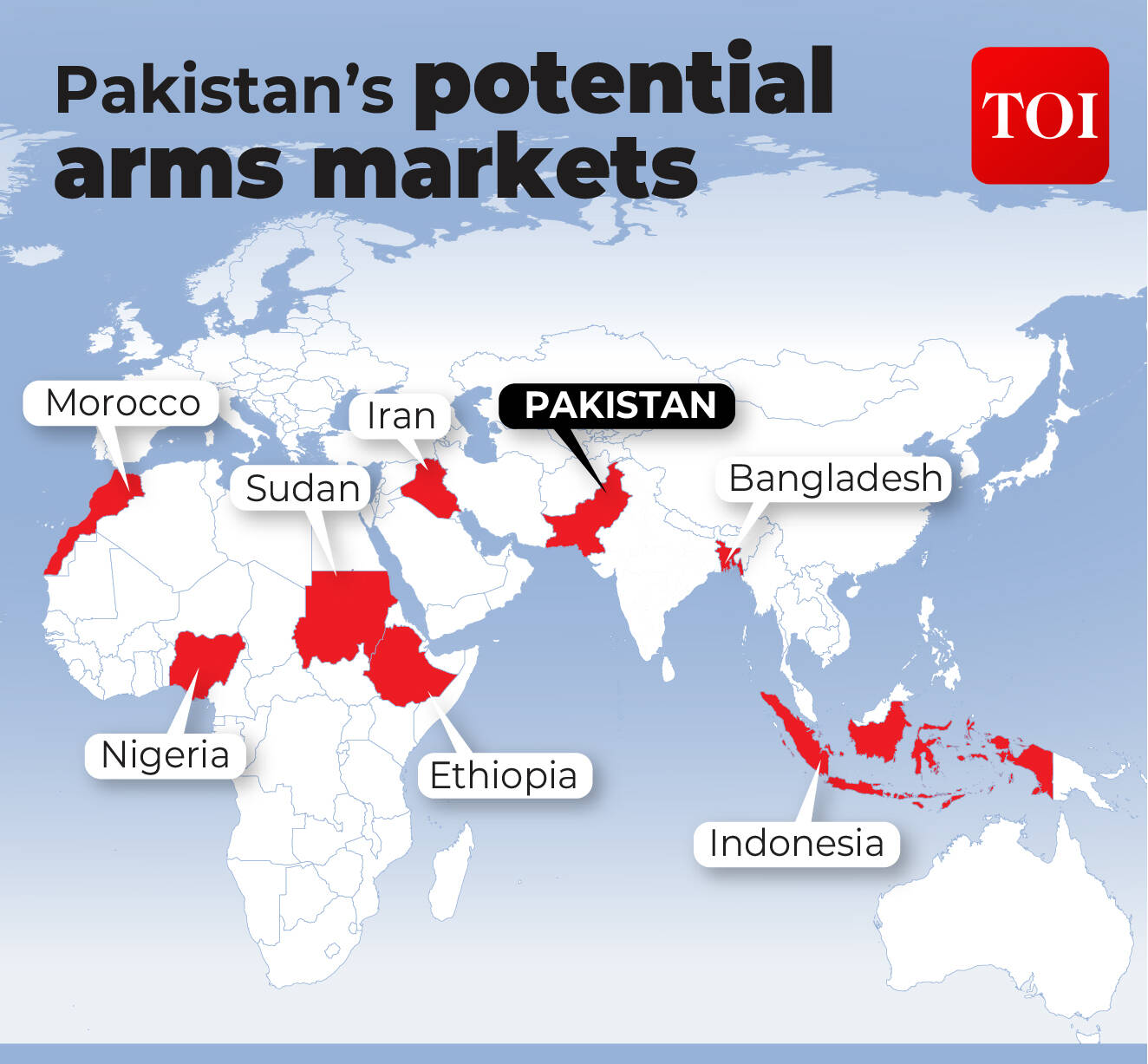
Where could its weapons find buyers?
The pitch is straightforward: Relatively capable equipment at a lower price.Reuters reported that Pakistani JF-17s are being offered at roughly $30 million to $40 million, significantly below some Western alternatives.Pakistan’s defence production minister Raza Hayat Harraj told Reuters that there were “a lot of queries” and that Islamabad was negotiating, while stressing that details of individual negotiations remained confidential.If even a portion of those talks turn into contracts, they could provide Pakistan with something it badly needs: foreign exchange earnings and a larger domestic defence-production ecosystem.The country’s private defence sector is already being pulled into the effort.Reuters reported that Pakistani companies are producing reconnaissance and kamikaze drones, with military demand helping drive the expansion of private-sector defence manufacturing.That could eventually create a cycle in which military investment generates exports, exports generate foreign currency and foreign currency helps finance further industrial development.But that cycle is not guaranteed.
The China factor
Pakistan’s defence-export ambitions are also tied closely to China.The JF-17 is jointly developed by Pakistan and China, while much of Pakistan’s broader military inventory has Chinese origins or components. That gives Islamabad access to a major defence-industrial partner, but it also means that Pakistan cannot always make export decisions in isolation.SIPRI researcher Siemon Wezeman told Reuters that it was unclear how many reported JF-17 discussions would ultimately become firm contracts. He also pointed to possible complications involving proposed sales to countries under UN arms embargoes.For Islamabad, therefore, becoming a defence exporter is not simply a matter of finding customers.It requires production capacity, financing, political relationships, technology partnerships and careful management of export controls.And there is another problem: Defence exports may take years to generate substantial returns, while the costs of maintaining a modern military are immediate.The domestic bill is much larger than the defence allocationPakistan’s PKR 3 trillion defence allocation is only one part of the country’s security burden.The economy must simultaneously finance debt servicing, public-sector salaries and pensions, energy subsidies and infrastructure, while meeting IMF conditions.The 2026-27 budget envisages a federal deficit of PKR 7.02 trillion. At the broader level, after factoring in a projected provincial surplus, the fiscal deficit target is PKR 5.23 trillion, equivalent to 3.6% of GDP.The government is also expected to generate PKR 15.26 trillion in tax revenue, despite the Federal Board of Revenue having missed its previous target.This is where Pakistan’s defence ambitions collide with a familiar domestic problem: the state needs more revenue, but expanding the tax base is politically and economically difficult.Reuters noted that sectors such as agriculture, retail and real estate remain difficult to tax fully, increasing the pressure on salaried workers and businesses already within the tax system.At the same time, Islamabad has promised the IMF a primary surplus of 2% of GDP.In simple terms, the government needs to collect more than it spends before interest payments are taken into account.That leaves limited room for additional spending, whether on welfare, infrastructure or defence.
Development is the opportunity cost
The clearest illustration of that squeeze is the development budget.As defence spending rose to PKR 3 trillion, federal development spending was set at PKR 1 trillion.That does not mean every rupee spent on defence comes directly at the expense of a school, hospital or road. Pakistan’s budget is considerably more complicated than that.But it does show the hierarchy of priorities in a country where fiscal resources are limited.Security has become a politically difficult area to cut, particularly after the 2025 conflict with India and amid continuing militant violence inside Pakistan.The Islamabad authorities also face two resentment-filled fronts in Balochistan and PoK, where growing discontent is being fuelled by economic hardship and demands for independence and autonomy.Development spending, meanwhile, can be delayed, reduced or shifted to provinces.The result is a structural trade-off: Pakistan wants to maintain military readiness against external threats while also addressing the economic conditions that underpin long-term national power.A country can buy aircraft, missiles and drones. It cannot build sustained strategic power without economic growth, industrial capacity, energy security and human capital.
Saudi Arabia is both security partner and financial lifeline
Pakistan’s relationship with Saudi Arabia makes this tension even more interesting.Riyadh is not merely a defence partner. It has repeatedly played a role in Pakistan’s financial stabilisation.In April, Saudi Arabia agreed to provide Pakistan with an additional $3 billion deposit to help it meet a $3.5 billion repayment to the UAE. The assistance came on top of the renewal of a $5 billion Saudi deposit arrangement.Pakistan’s foreign exchange reserves stood at around $16.4 billion at the end of March, according to Reuters, while the country remained under its $7 billion IMF programme.The same relationship that gives Islamabad an important strategic role in Gulf security also provides financial support when its external accounts come under pressure.That creates mutual dependence.Saudi Arabia gains access to a nuclear-armed security partner with decades of military cooperation. Pakistan gains a wealthy strategic partner willing to provide financial backing.But financial assistance is not the same thing as a permanent solution to Pakistan’s economic constraints.
Islamabad is still dependent on external financing
Pakistan’s dependence on outside financing remains visible in its dealings with both China and the United States.Finance minister Aurangzeb said this month that Islamabad plans to seek an expansion of its 30 billion yuan currency-swap arrangement with China when it comes up for renewal in 2027. Reuters reported that the entire existing facility had been drawn.Pakistan is also seeking a $10 billion exchange stabilisation facility from Washington and expects a US decision within months, while talks are under way with US financing institutions over other projects.Aurangzeb called Islamabad’s approach as an “and-and” strategy, arguing that relations with China and the US are not mutually exclusive.That balancing act mirrors Pakistan’s broader foreign-policy strategy.It wants China for defence and infrastructure, Saudi Arabia for investment and financial support, Turkey for defence technology and strategic cooperation, and the US for access to Western financial institutions and markets.The difficulty is ensuring that these relationships produce economic capacity rather than simply postponing the next financing challenge.
The military’s growing regional role
Pakistan’s security role is nevertheless changing.The country has long maintained close military ties with Saudi Arabia. In September 2025, Islamabad and Riyadh signed a Strategic Mutual Defense Agreement stating that aggression against either country would be considered aggression against both.The military’s growing role has almost made Rawalpindi a superior power centre in Pakistan compared to Islamabad. Pakistan has remained a country greatly influenced by its military. Asim Munir has been in power, seeking to supersede his predecessors, the military dictators.The de-facto head of Pakistan, Munir, has also gone far to advocate for peace, hosting talks for US-Iran peace.However, the peace talks failed.The newer three-way Mecca pact with Turkey expands that strategic architecture.Pakistan has also been trying to position itself as a mediator in the Middle East, including between Washington and Tehran, while simultaneously strengthening its security commitments to Riyadh.That is an unusually complicated diplomatic role.Islamabad must reassure Saudi Arabia without alienating Iran, maintain relations with the US without damaging its ties with China, and deepen military cooperation with Turkey while preserving its own strategic priorities.The danger is that a country with limited resources can accumulate commitments faster than it accumulates the capacity to fulfil them.
A bigger military does not automatically mean a stronger state
Pakistan’s military spending has been rising, but it remains much smaller in absolute terms than the defence budgets of its principal regional competitors.According to SIPRI, Pakistan’s military expenditure rose 11% in 2025 to $11.9 billion. India’s spending reached $92.1 billion, while Saudi Arabia spent $83.2 billion.The figures put Pakistan’s strategy into perspective.It cannot realistically compete by matching the spending of larger economies. Its answer has instead been to seek cost-effective platforms, leverage Chinese technology, develop domestic production and use its military relationships as a source of strategic influence.That explains the emphasis on the JF-17, drones, training and military cooperation.Pakistan’s defence industry can potentially occupy a niche between expensive Western systems and lower-cost equipment from other suppliers.The opportunity is real.But so is the capacity problem.A successful export industry needs factories that can produce at scale, supply chains that can withstand disruption, research and development, skilled workers and enough capital to keep investing.
The real test is economic endurance
Pakistan’s defence push is therefore not necessarily contradictory.A stronger defence industry could generate exports. Greater exports could bring in foreign currency. Joint production could create jobs and technology. Strategic partnerships could attract investment.But none of those outcomes are automatic.The immediate reality is that Islamabad is trying to maintain a large defence establishment while meeting IMF conditions, servicing debt and preserving foreign exchange reserves.
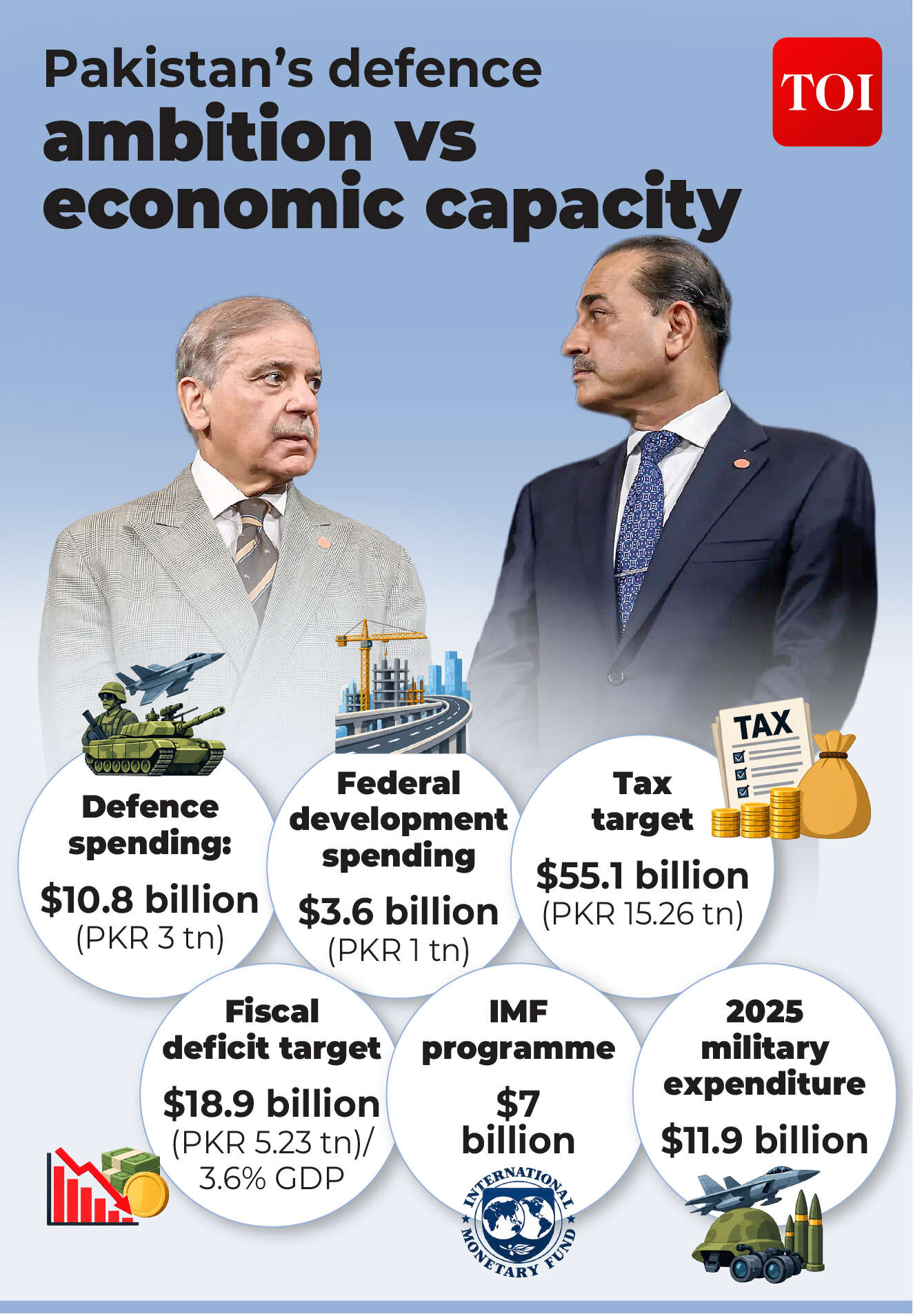
Pakistan wants a bigger military role. Can its economy keep up?
The June budget already showed the pressure: Defence spending rose 18%, while federal development spending fell to PKR 1 trillion.Meanwhile, Pakistan’s finance minister has warned that prolonged disruption in the Middle East could threaten the country’s 4% growth target because of higher oil prices.That matters because Pakistan is heavily exposed to energy prices and external financing.A sustained geopolitical crisis could therefore produce the paradox Islamabad least wants: More demand for military readiness at precisely the moment when the economy has less room to pay for it.
The promise and the hard reality
Pakistan is clearly trying to turn military capability into strategic influence.The new Saudi-Turkey-Pakistan defence pact gives Islamabad a larger role in Gulf security. Its relationship with Riyadh gives it both strategic and financial importance. Its defence industry is attracting foreign interest. Its JF-17 and drone programmes offer the prospect of export earnings. And its military’s experience gives it diplomatic weight that exceeds the size of Pakistan’s economy.But strategic influence has a price.Every new defence commitment creates an expectation of action. Every overseas weapons sale requires production capacity. Every new military platform creates long-term maintenance and training costs. And every promise made abroad ultimately has to be supported by an economy at home.That is Pakistan’s central challenge.The country may be able to sell itself as a security provider, arms producer and strategic partner. But to sustain that image, it will need something more difficult than a new defence pact or a successful weapons demonstration: A durable economic base capable of paying for its ambitions.For now, Pakistan is attempting to build that base while simultaneously expanding its security commitments.The contradiction is visible in its own budget.Islamabad says it needs more defence spending because the region is becoming more dangerous. At the same time, it is cutting development spending because the government’s finances are constrained.That may be manageable for a year or two.The bigger question is whether it can remain manageable for long enough for Pakistan’s new defence promises to translate into lasting strategic power.