








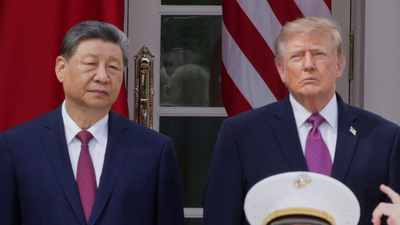
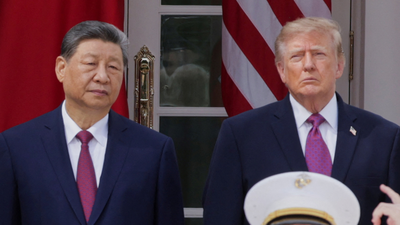
TOI correspondent from Washington: Implicitly suggesting that China is catching up with the United States if it hasn’t already, Chinese President Xi Jinping told Americans on Thursday that the two countries can avoid the historic conflict that often accompanies the rise of a new power, declaring that “the Thucydides Trap CAN be overcome.”The phrase “Thucydides Trap” was coined by Harvard political scientist Graham Allison, drawing on the Athenian historian Thucydides’ account of the Peloponnesian War.Thucydides identified the rise of Athens and the fear it generated in Sparta as the underlying force that made war increasingly difficult to avoid.Allison subsequently applied the historical pattern to modern great-power rivalry, examining 16 cases in which a rising power challenged an established one; in his analysis, 12 ended in war.Speaking at the White House welcome ceremony with President Trump sitting beside him, Xi said the US and China should pursue cooperation rather than confrontation and argued that China’s rise need not come at America’s expense.He called for the two countries to be “partners, not rivals,” arguing that China’s “great rejuvenation” and Trump’s ambition to “make America great again” could proceed together.China and the US should pursue a relationship in which competition is moderate, differences are manageable, and peace is predictable.It was hardly the language of a country preparing to surrender the geopolitical stage, nor was it quite the language of an adversary. It was Xi’s preferred formulation of the relationship: two great powers, different systems, competing interests — but neither destined to destroy the other.But it implicitly placed the burden of avoiding the trap on the established power, which may resist treating the rise of the challenger as an existential threat.Trump, for his part, responded with warmth that belied his past demonisation of China. In vapid remarks, he described Xi as a “great leader” and emphasised the personal relationship between the two men, saying the US and China had a “great relationship.”It was a strikingly different tone from the confrontational rhetoric – not just from Trump but from many American leaders – that has characterised the US approach to China in recent years.While Beijing portrays China’s rise as an opportunity for cooperation rather than a challenge requiring containment, critics in Washington counter that China’s military expansion, pressure around Taiwan and growing strategic influence demonstrate that the United States cannot simply assume benign intentions.Many of them are blasting Trump for being a “Deferential President”, as the Atlantic magazine put it in a headline, while sneering, “Not long ago, President Trump could claim that he ran the world. Now he’s waiting at the bottom of a set of airline steps for the Chinese president.”But a more sobering perspective came from secretary of state Marco Rubio, who earlier in the day asserted that it would be irresponsible not to engage Beijing at the highest level despite differences.“The relationship between the United States and China will define the 21st century,” Rubio said, echoing words that the US till recently had used for its ties with India, which is probably watching the scenario with consternation.