









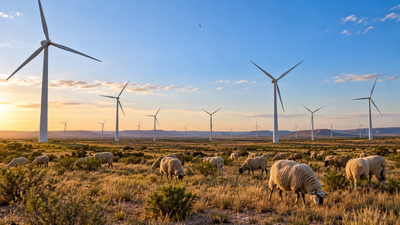
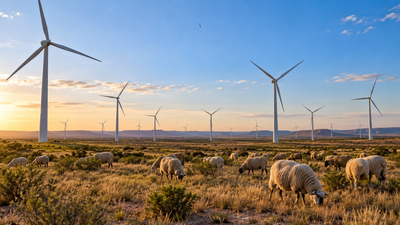
In May 2001, the Indian Mesa wind farm began operating in Pecos County, West Texas, with 125 turbines and a total installed capacity of 82.5 MW. The project sits on a mesa where the uses of the land include grazing livestock, primarily sheep, and hunting, and the project does not limit these uses. According to the US Government Accountability Office (GAO), the project paid about $930,000 in local school district taxes in 2003. The details appear in report GAO-04-756, published in September 2004, which summarises visits to nine wind power projects in five states.
When did the Indian Mesa wind farm in Texas begin operating
The Indian Mesa project is in Pecos County, Texas, and is owned by FPL Energy, a company based in Florida. The report states that the project started operating in May 2001 and has 125 turbines, with a total installed capacity of 82.5 MW. The GAO lists the power purchasers as the Lower Colorado River Authority and Texas Utilities Company, and records four landowners.The GAO states that “the Indian Mesa wind farm is located in West Texas, an area with strong, sustained wind resources.” The report gives an annual generation estimate of 250 million kWh for the project. In its wider findings, the GAO notes that California and Texas accounted for about one-half of the nation’s 6,374 MW of installed wind generation capacity at the end of 2003, and its state-by-state figure for Texas is 1,293.0 MW.
How much land does the Indian Mesa wind farm occupy
The GAO reports that “the project is located on 34,000 acres situated on a mesa” and that “one of the four landowners of this acreage is the University of Texas.” According to the report, “about 7,000 of these acres are leased for the project.” It continues: “The uses of the land include grazing livestock, primarily sheep and hunting. The project does not limit these uses.”On the wider question of land use, the GAO’s introductory letter states that “even large wind turbines use only about a quarter-acre of land each, including access roads, so farmers can continue to plant crops and graze livestock up to the base of the turbines.” The report also records that “University of Texas officials indicated that legal and technical resources available to the university were critical to negotiating a favourable lease agreement for a wind project on university property.” In its general description of how wind projects are developed, the GAO lists a lease or easement agreement with a term “sufficient for financing the project, usually 25 years or more.”
How did the project support local training through its tax agreement
According to the GAO, “as an incentive for locating the project in Pecos County, the county provided the project with a full property tax abatement for 5 years.” The report adds that “in return, the project owner (at that time) agreed to donate funds in an amount equivalent to about 10 per cent of the abated taxes to a regional technical training centre.” The GAO also states that “the owner also agreed to hire and use local companies and labour for the construction of the project, to the extent possible.“The report then records that “the project paid about $930,000 in local school district taxes in 2003.” A footnote in the report explains that “because one of the four landowners was a county commissioner, property taxes were assessed for this landowner’s parcel to avoid the appearance of a conflict of interest.” The GAO does not specify which school districts received the payment in its account of Indian Mesa.

Image AI generated
How did wind power projects affect Pecos County school tax revenues
According to the GAO, “in Pecos County, Texas, with a population of about 16,000 the school districts received about $5 million in 2002 from property tax revenues directly associated with wind power projects in that county.” The report states that “the Iraan-Sheffield School District, obtained one-third of its property tax revenues from wind power projects that year” and that “these projects also added about 30 to 35 full-time permanent jobs to operate and maintain the projects.” It also cites the Fort Stockton Economic Development Corporation, which said “the county experienced a 10 percent increase in gross sales during the construction of several wind power projects.”On employment at Indian Mesa itself, the GAO states that “the project owner currently employs 43 people to operate and maintain the four wind projects the company owns in the area, including the Indian Mesa project.” The report continues: “In the future, the owner plans to hire 4 additional people after the warranty and maintenance agreement with the turbine manufacturer expires.” Separately, the GAO asked the National Renewable Energy Laboratory (NREL) to model hypothetical projects. The GAO asked NREL to model hypothetical scenarios. In one, building a 150 MW project owned by an out-of-area company in Pecos County would create “the equivalent of only 36 full-time jobs for 1 year in the county”. That project is nearly twice Indian Mesa’s 82.5 MW, and the GAO said it did not expect high accuracy from the model.