









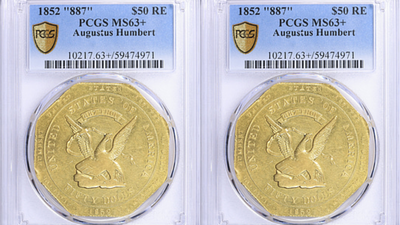
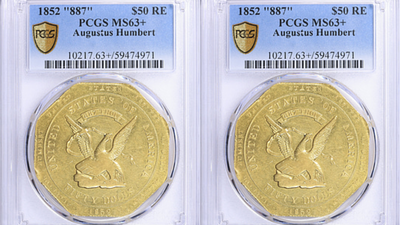
An 1852 California Gold $50 piece has brought nearly $368,000 at auction, highlighting the enduring appeal of coins linked to the early Gold Rush era. According to the auction house GreatCollections, the rare Augustus Humbert $50 was part of its Centennial Collection of Territorial Rarities, which featured eight certified territorial coins and drew 475 bids during the collection’s auction run. The collection was presented from September 6 through September 27, 2026. The coin itself, however, was listed among the collection’s September 6 offerings and sold for $367,875, including the buyer’s fee. Its rarity, preservation and connection to early California gold make it one of the standout pieces from the collection.
A coin from California’s Gold Rush era
GreatCollections identified the 1852 piece as an 1852 California Gold $50 U.S. Gold Assay Office Augustus Humbert 887 Reeded Edge, graded PCGS MS-63+. It was produced during the period when California’s enormous gold discoveries created an urgent need for reliable forms of gold-based currency. The coin was associated with the U.S. Assay Office in San Francisco and Augustus Humbert, an official United States assayer who produced large gold pieces during the early years of the California Gold Rush. GreatCollections describes territorial gold as privately or locally issued gold produced when federal coinage was scarce, including issues connected to the California, Georgia, Colorado and Utah gold rushes.These pieces are commonly known as “slugs,” reflecting their unusual size and appearance compared with conventional United States coins. Their historical importance comes partly from the monetary conditions of the period, when gold discovered in California needed to be assayed, weighed and converted into forms that could be used in commerce.
Rare Augustus Humbert $50
The 1852 $50 piece carries the Augustus Humbert name and the designation “887,” referring to its fineness. According to GreatCollections, the coin was struck at .887 fine to reflect the natural purity of California placer gold. It also described the piece as the rarest of three Humbert Reeded Edge varieties. Its condition was another factor that distinguished the coin. Rather than showing the extensive wear often associated with early territorial gold, the example was graded MS-63+, indicating that it retained a high level of preservation.GreatCollections also described it as the finest known example of the variety by two full grade points. The auction house said the coin had exceptional preservation and strong remaining detail for a historic Gold Rush issue. GreatCollections identified it as a plate coin in America’s Golden Age by Donald H. Kagin and David McCarthy, highlighting its significance in numismatic literature.
$367,875 auction result
GreatCollections reported that the $50 coin sold for $367,875, including the buyer’s fee. Its listing attracted 93 bids, according to the auction house’s results. The result placed the coin among the most valuable pieces in the Centennial Collection of Territorial Rarities. Another major highlight, an 1852 California Gold $10 Wass, Molitor & Company Close Date coin, sold for $354,375, including the buyer’s fee. That coin attracted 74 bids. The collection brought together eight PCGS-certified coins, with one also approved by CAC. Across the collection, GreatCollections recorded 475 bids, while hundreds of users followed the offerings during the auction period.
Eight territorial rarities
The Centennial Collection included several other early California gold pieces alongside the $50 Humbert issue. Among them were an 1852 California Gold $10 Wass, Molitor & Company coin, an 1852 California Gold $10 Moffat & Company piece, an 1854 California Gold $20 Kellogg & Company Double Eagle and an 1853 California Gold $20 U.S. Gold Assay Office coin. The collection also included two California State of California silver die trials from 1851, along with another 1852 U.S. Gold Assay Office Augustus Humbert $10.GreatCollections presented the collection between September 6 and September 27. While the collection concluded on September 27, the auction record for the $50 Humbert coin shows that its individual sale took place on September 6. The sale illustrates how pieces connected to California’s earliest gold-producing years continue to attract collectors, particularly when rarity, historical provenance and exceptional preservation come together in a single coin.