







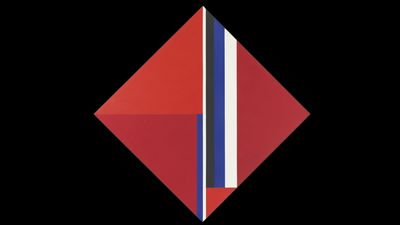
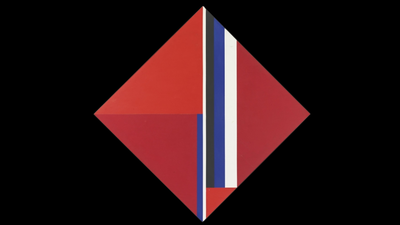
A North Carolina artist once walked into a Goodwill store looking for inexpensive material for her own artwork and walked out with what would turn out to be a valuable piece of American abstraction. Beth Feeback paid just $9.99 for a large painting in 2012, not because she admired the artwork, but because she wanted to reuse its canvas for one of her own paintings featuring cats. Months later, a friend’s suggestion to check the markings on the back changed the fate of the seemingly ordinary thrift-store find, according to a report by ABC News.The painting turned out to be “Vertical Diamond” by Ilya Bolotowsky, a Russian-born American abstract artist whose work is held by major museums. It was subsequently authenticated and offered at Sotheby’s in New York, where it sold for about $27,000 at auction. With the buyer’s premium included, Sotheby’s listed the final price as $34,375.The extraordinary discovery began with a purchase that Feeback had no reason to regard as an art investment. According to ABC News, Feeback, who lived in Concord, North Carolina, bought the painting in April 2012. She was not particularly drawn to its abstract style. Instead, she saw the large canvas as useful material for her own work. Her speciality was painting cat portraits, and she intended to paint over the existing artwork and create something of her own. The painting reportedly sat on the floor of her art studio for several months.Then a friend urged Feeback to inspect the labels and markings on the back before putting a brush to the canvas.That small piece of advice proved crucial. Feeback discovered the name Ilya Bolotowsky associated with the work and began researching the artist. The painting was identified as “Vertical Diamond,” a geometric abstract work. Rather than covering it with cat portraits, she decided to have it examined and pursue a sale.Contemporary reports said Sotheby’s estimated that the painting could sell for between $15,000 and $20,000. That estimate was already dramatically higher than the $9.99 Feeback had paid, but the final result went beyond it. When the painting went under the hammer in September 2012, Feeback watched the auction remotely with family and friends. She had concerns that it might not sell at all, particularly because some other works at the auction were selling below estimates or failing to find buyers. Instead, the Bolotowsky painting attracted a successful bid of roughly $27,000.Sotheby’s reported the total sale price as $34,375, a figure that included the premium paid by the buyer on top of the hammer price. ABC News specifically clarified the distinction, making the $34,375 figure different from the amount Feeback actually received from the sale.For Feeback, the result transformed a $9.99 purchase into a significant financial windfall. She told ABC News that she and her husband planned to use the money for long-delayed improvements to their home and to pay down debts. She also joked about the unlikely journey of the artwork: instead of painting cats over Bolotowsky’s work, she planned to create her own versions inspired by “Vertical Diamond,” this time incorporating large cat heads.The artist behind the thrift-store discovery had a significant place in the history of American abstraction. Ilya Bolotowsky was born in St Petersburg, Russia, in 1907 and died in New York in 1981. The Smithsonian’s Archives of American Art describes him as a Russian-American abstract painter. He immigrated to the United States in 1923 and studied at the National Academy of Design. Bolotowsky became closely associated with geometric abstraction and was a founding member of the American Abstract Artists, an organisation formed to promote abstract art in the United States. His work was strongly influenced by Dutch artist Piet Mondrian and the principles of geometric abstraction. Smithsonian American Art MuseumHis career also included work under the federal art programmes of the 1930s and teaching positions at institutions including Black Mountain College, the University of Wyoming and Brooklyn College. The Smithsonian records his involvement with the Public Works of Art Project and the Works Progress Administration’s Federal Art Project.Bolotowsky’s work later received institutional recognition, including a 1974 retrospective at New York’s Solomon R. Guggenheim Museum, according to museum and gallery records. “Vertical Diamond” itself is recorded as a 1966 oil-on-canvas work. Art-market records identify its September 21, 2012 sale and its $34,375 result, consistent with the contemporary reports of Feeback’s discovery.The provenance of the painting also helped explain why such a significant work could eventually end up in a thrift store. Reports noted a Weatherspoon Art Museum sticker on the back, connecting the canvas to the University of North Carolina at Greensboro’s museum. Contemporary accounts said museum records indicated that Burlington Industries had loaned the painting to the Weatherspoon for an exhibition in 1979. For Feeback, however, none of that history was apparent when she first saw the painting.At Goodwill, it was simply a large canvas she could buy for less than $10. Had her friend’s warning come too late, the artwork might have been painted over and its identity lost. Instead, a quick check of the label led to an artist, a title, an auction and a final reported price of $34,375 including the buyer’s premium.