





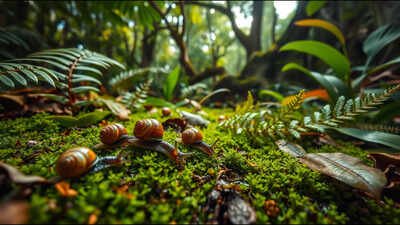
A tiny land snail once listed as extinct has made a remarkable return to Norfolk Island, after an unexpected discovery in 2020 triggered one of Australia’s first large-scale snail conservation and reintroduction programmes. The Campbell’s keeled glass-snail (Advena campbellii) had not been seen for decades when Norfolk Islander Mark Scott found large, unusual shells while surveying for rare plants. He contacted the Australian Museum, and in March 2020, malacologists including Dr Isabel Hyman visited the site and confirmed a small living population in a sheltered rainforest gully. Fewer than 50 individuals were found in the wild, with a 2024 study by members of the conservation team recording 21 individuals at the site in March 2020. Since then, a captive-breeding programme at Taronga Zoo Sydney has grown from 46 founder snails collected from the wild to more than 1,300 individuals returned to Norfolk Island, including a final release of 1,000 in 2026.
How a snail listed as extinct was found alive
The Campbell’s keeled glass-snail is endemic to Norfolk Island and had been considered lost for years. In her April 2020 account for the Australian Museum, Hyman wrote that Scott had found large and unusual shells while surveying the island for rare plants and took the researchers to the site. Hyman, Frank Koehler and Adnan Moussalli then confirmed a living population of the species in a single location.The discovery was significant because the species had been listed as Extinct on the IUCN Red List in 1996, while Australian conservation legislation classifies it as Critically Endangered. The Australian Government’s species profile still cites the IUCN Red List 2025.2 as listing the species as Extinct. The wild population was extremely small. Taronga later reported that fewer than 50 snails were found surviving in Norfolk Island National Park. With the species confined to a tiny area, conservationists feared that a single environmental or biological threat could wipe it out again.
How 46 snails became hundreds in captivity
The discovery led to a collaboration involving the Australian Museum, Taronga Conservation Society Australia, Parks Australia, Western Sydney University and the Norfolk Island Regional Council. The captive-breeding programme at Taronga Zoo Sydney was established from 46 founder snails collected from the wild. It became Australia’s first snail breeding programme and eventually grew the captive population to more than 800 animals. The early stages were difficult because researchers had little experience caring for the species in captivity. The team gradually learned more about the snails’ diet, breeding and sensitivity to handling and environmental conditions. By 2025, the captive population had grown sufficiently for conservationists to begin returning zoo-bred animals to Norfolk Island.The project also required researchers to understand how the snails could survive after release. Norfolk Island is home to around 60 endemic land-snail species, according to the Australian Museum, making the island an important centre of snail diversity. Campbell’s keeled glass-snails contribute to the ecosystem by helping decompose organic matter and disperse fungal spores.
Why rats and feral chickens remain a threat
The snails face threats from introduced animals as well as the vulnerability that comes with having a very small natural population. Introduced rats and feral chickens are recognised predators of native animals on Norfolk Island, and conservation teams have incorporated predator control into the snail recovery programme. Habitat loss and degradation have also contributed to the pressures facing Norfolk Island’s threatened snails. For the reintroduction, conservationists selected habitat with environmental conditions considered suitable for the species and established measures including irrigation and predator control. The aim was not simply to put captive-bred snails back on the island, but to give them a site where they could establish a new population with protection from some of their major threats.
The first release showed signs of reproduction
In 2025, more than 600 captive-bred snails were transported from Sydney to Norfolk Island. After spending time acclimatising to their new surroundings and diet, more than 300 were released into Norfolk Island National Park. The Australian Museum described the effort as the first large-scale snail translocation and reintroduction attempted in Australia and its surrounding islands. The released snails were individually tagged for monitoring, with each animal receiving a tiny identification label measuring 1.2 by 2.7 millimetres. Researchers then surveyed the release site to determine how the animals were responding to their new environment.One of the most encouraging developments came when researchers found baby Campbell’s keeled glass-snails at the release site. Their presence indicated that the reintroduced population was reproducing in the wild, providing an important early sign that the project could succeed beyond simply keeping the species alive in captivity.
More than 1,300 snails returned to Norfolk Island
The conservation programme reached another major milestone in 2026.In July 2026, Taronga announced that the final release had been completed, with 1,000 captive-bred Campbell’s keeled glass-snails released into Norfolk Island National Park. This built on the initial release of more than 300 snails in 2025. Taronga said the programme had ultimately returned more than 1,300 individuals to the wild from the original 46 founder snails. The captive-breeding phase has now ended, while monitoring of the released population continues to determine whether the snails survive, reproduce and establish themselves in their new habitat.For a species that had been regarded as extinct, the recovery represents a striking reversal. The discovery of a tiny surviving population in 2020 gave conservationists an opportunity to intervene before the remaining animals disappeared. Six years later, more than 1,300 captive-bred snails have been returned to their native island, giving the species a renewed chance to persist in the wild.