









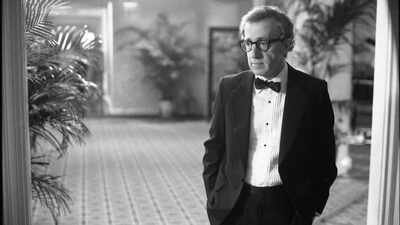
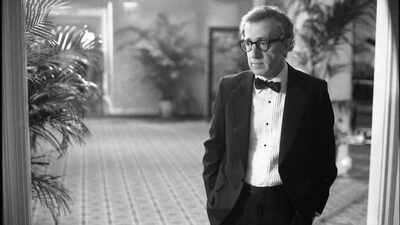
Woody Allen has written and directed more than 50 films over seven decades. He’s won four Academy Awards, nine BAFTA Awards, and two Golden Globes. He’s been nominated for more Oscars for Best Original Screenplay than any other writer in history. But when you ask him about success, he doesn’t talk about talent or inspiration. He talks about the most basic thing a person can do.In a 1989 letter to the New York Times, responding to language columnist William Safire, Allen confirmed a saying that had been attributed to him for years. “I did say that 80 per cent of success is showing up.”Today’s quote of the day by Woody Allen reads: “Eighty per cent of success is showing up”
What does the quote by Woody Allen really mean?
Woody Allen is describing a practice. Showing up sounds easy in theory, but it’s harder in practice. It means getting out of bed on the days you don’t feel like it and doing the work when nobody is watching, and nobody would blame you for quitting.Showing up builds momentum. It’s easier to keep going than it is to start. When you show up every day, you stay in the habit. You stay connected to the work. You stay sharp. The days you miss are the days you start to lose your edge. The days you show up are the days you keep it. That’s the eighty per cent.Allen elaborated on this in an interview on August 15, 2008. with Collider, where he was asked what life lessons he learned as a boy that still inspire him. “I think that the biggest life lesson I learned as a boy that has helped me and is still with me is that you really have to discipline yourself to do the work,” he said. “You have to just do the work. There’s no other way”. It’s an act of discipline. You don’t wait for inspiration. You don’t wait for the right mood. You just go. You sit down. You start.
How is the quote by Woody Allen still relevant today?
Allen isn’t talking about the glamorous moments. He’s talking about the ones where you have nothing to show for your effort yet. The ones where the only reward is that you did it. Most people don’t fail because they lack talent. They fail because they stop showing up, and eventually they’re so far behind that catching up feels impossible. The person who succeeds isn’t always the smartest or the most gifted. It’s the one who kept coming back.People are waiting for the right time. Allen is saying waiting is the problem. You don’t need the perfect conditions. You need to show up. You need to start. You need to do the thing, even if you’re not sure it’s going to work.When you remember how much he’s produced. He’s averaged roughly one film per year since 1969. Some of them are masterpieces. Some of them are forgettable. He’s said he doesn’t watch his own movies after he finishes them. He just moves on to the next one. That’s the show-up philosophy in practice. You don’t agonize over whether every project is perfect. You show up for the next one. You keep going. You keep working.
Early life of Woody Allen
Woody Allen was born Allan Stewart Konigsberg on November 30, 1935, in the Bronx, New York. His parents were both first-generation Americans. His father, Martin Konigsberg, worked as a jewellery engraver and waiter. His mother, Nettie Cherry, worked as a bookkeeper at her family’s flower shop. He was raised in Midwood, Brooklyn, in a Jewish household. He attended Hebrew school and later Midwood High School. He was a smart kid but not a particularly happy one. He’s described his childhood as lonely and his relationship with his parents as distant.He started writing jokes when he was a teenager. He sold them to newspaper columnists for a few dollars a piece. By the time he was 19, he was writing for television, including for Sid Caesar and Ed Sullivan. He changed his name to Woody Allen because it was simpler and easier to remember. He started performing his own material in the early 1960s. He was awkward. But he was funny. He wrote for ‘The Tonight Show’ and performed stand-up in small clubs. He was building a career one gig at a time.
Woody Allen’s rise to fame
His film career started by accident. He was hired to write a script for a film in 1965. He hated the experience. He decided he wanted to direct his own films. His directorial debut was ‘What’s Up, Tiger Lily?’ (1966), which he created by redubbing a Japanese spy film with comedic dialogue. His first original screenplay as a director was ‘Take the Money and Run’ (1969). He followed it with ‘Bananas’ (1971), ‘Sleeper’ (1973), and ‘Love and Death’ (1975).His breakthrough came with ‘Annie Hall’ in 1977. The film won four Academy Awards, including Best Picture and Best Director. It changed the way Hollywood looked at romantic comedies. He followed it with ‘Manhattan’ (1979), ‘Hannah and Her Sisters’ (1986), ‘Crimes and Misdemeanors’ (1989), and ‘Midnight in Paris’ (2011). He’s been nominated for 24 Academy Awards. He’s won four. He’s worked with Diane Keaton, Mia Farrow, Scarlett Johansson, Cate Blanchett, and Emma Stone. He’s still writing and directing. He’s still showing up. At 90, he’s still at the desk.