









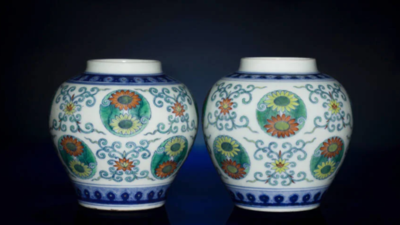
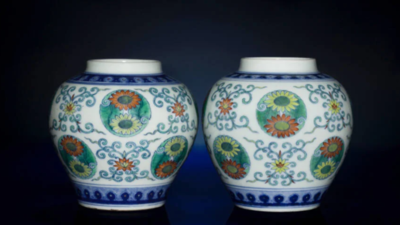
A routine visit to a London charity shop turned into an extraordinary discovery when a ceramics collector spotted two small porcelain jars that would later sell for thousands of times their purchase price. According to auction house Roseberys London and reporting by CNN and Artnet News, the pair was identified as rare Chinese porcelain dating to the 18th century and fetched £58,000, including the buyer’s premium, at auction in May 2023. The jars, purchased for around £20, or approximately $25, had initially appeared to be an unassuming thrift-store find. Their distinctive decoration and imperial markings, however, prompted closer examination, leading specialists to recognise their historical and artistic significance.
The details that revealed their origins
Measuring approximately 4.5 inches tall, the jars feature colourful chrysanthemums and lotus flowers against a yellow ground. The decorative style is known as doucai, a traditional Chinese porcelain technique that combines underglaze blue painting with coloured enamels applied over the glaze. The pieces were attributed to the Qing Dynasty, which ruled China from 1644 to 1912, and dated to the 18th century. Their bases bear marks associated with the Qianlong Emperor, whose reign lasted from 1735 to 1796 and is widely associated with the production and collection of fine imperial art.The collector reportedly became curious about the markings and began researching the objects before approaching specialists. Their assessment established that the jars were far more significant than ordinary decorative ceramics. The auction house noted that no exact prototype for the particular design had been identified, although comparable patterns were known on Chinese porcelain bowls. This distinction matters because identifying an object’s period, production context and rarity requires more than recognising a familiar motif or imperial seal.
Why the porcelain is so valuable
Chinese imperial porcelain is prized for its technical sophistication, artistic detail and association with the imperial court. During the Qing Dynasty, Jingdezhen, in present-day Jiangxi province, remained a major centre of porcelain production, with its kilns supplying highly refined ceramics for domestic and imperial use. The flowers decorating the jars also carry cultural significance. Chrysanthemums have traditionally been associated with longevity and a prosperous life in Chinese art, while lotus flowers often represent purity and renewal.The combination of craftsmanship, decoration and historical attribution helped distinguish the pair from the everyday ceramics that commonly pass through charity shops. Their condition, however, was not perfect. Hairline cracks and surface scratches were among the imperfections noted in the account of the discovery, potentially limiting their value compared with better-preserved examples. Even so, the objects attracted substantial interest when they reached auction.
A £58,000 auction result
The jars sold through Roseberys London in May 2023 for £58,000, including the buyer’s premium, equivalent to more than $74,000 at the time. That figure represented an exceptional return on the collector’s modest initial outlay. The result also reflected a wider market for rare Chinese ceramics, in which provenance, condition, period and the strength of the attribution can substantially influence final prices.Comparable pieces with similar floral decoration have achieved much higher sums at major auction houses, although differences in condition, design, provenance and completeness make direct comparisons difficult. According to reports surrounding the sale, a significant portion of the proceeds was intended to benefit the charity associated with the shop. The unexpected discovery therefore offered a financial benefit beyond the collector’s own windfall.
Why specialist knowledge matters
The find illustrates how valuable historical objects can remain unrecognised outside specialist markets. Charity shops process large volumes of donated goods, spanning everything from everyday household items to antiques, making it difficult for staff to identify every unusual object. For collectors, the lesson is not that every old jar is a hidden treasure. Rather, distinctive craftsmanship, unusual markings and a design that appears inconsistent with mass-produced modern ceramics can justify further investigation.In this case, curiosity led to research, research led to expert assessment, and that assessment transformed two inexpensive purchases into an auction discovery worth tens of thousands of pounds. The jars’ journey from a London charity shop to the auction room shows how a small detail on an overlooked object can open a window onto centuries of artistic and cultural history.