








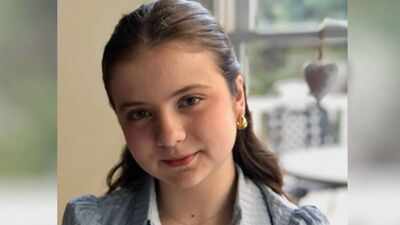
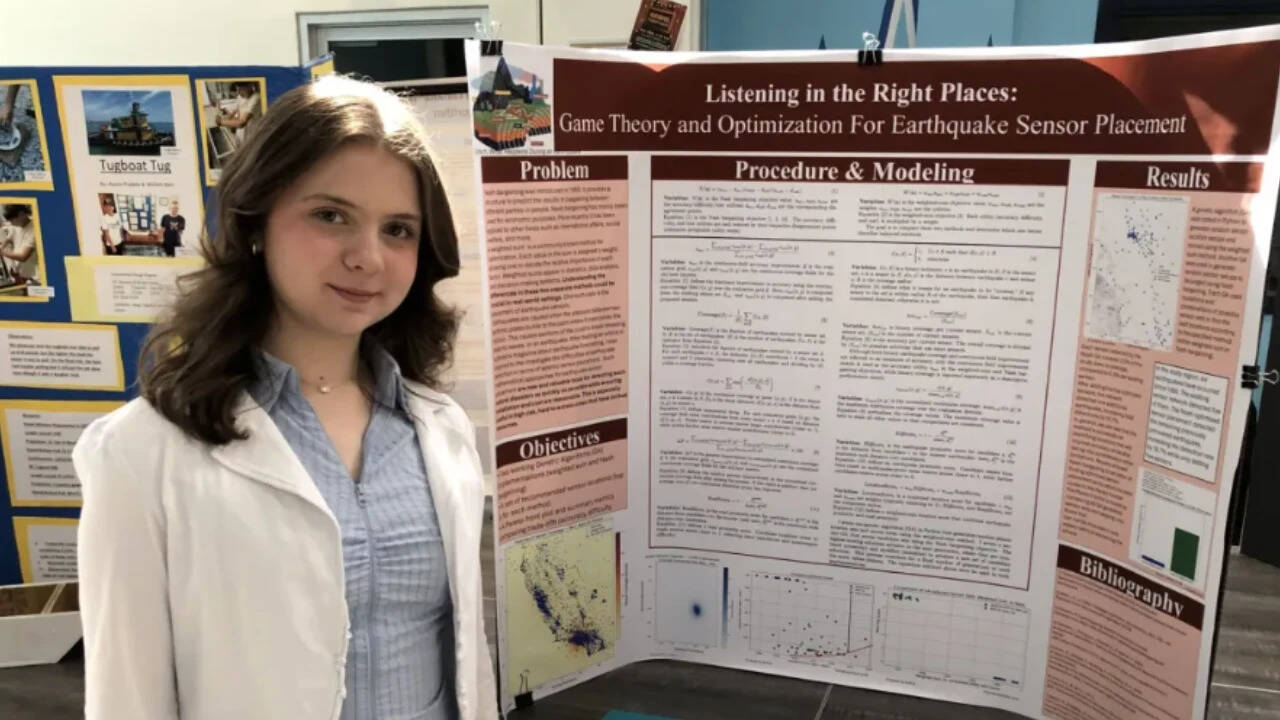
A 14-year-old student from Williamsburg, Virginia, has earned her a place among 30 finalists in the 2026 Thermo Fisher Scientific Junior Innovators Challenge for finding a new way to position earthquake sensors.Earthquake sensors can help detect seismic activity and provide early warnings, but deciding where to install them is not easy. Scientists must consider how accurately the devices can detect earthquakes, how much ground they can cover and whether their locations are accessible.According to The Virginian Pilot, Isabel Rossi, who carried out the research as an eighth-grader, developed a computer-based model that showed a possible 16.7% improvement in earthquake detection coverage using just five additional sensors.The finding emerged from a six-month project in which Isabel examined whether mathematical methods commonly used to make decisions could help identify better locations for earthquake sensors. For this, she worked with existing earthquake records and computer-generated sensor arrangements.Nearly 10,000 students applied to the national competition, which recognises research projects completed by middle school students across the United States. Isabel developed her project independently while attending James Blair Middle School. She is currently a freshman at Jamestown High School.According to Society for Science, which organises the challenge, Isabel’s project, titled Listening in the Right Places: Game Theory and Optimisation for Earthquake Sensor Placement, was based on simulations.
Importance of choosing sensor locations
Earthquake monitoring depends on instruments that record seismic waves travelling through the ground. Some of these waves can be detected before stronger shaking reaches an area, allowing early warning systems to issue alerts. However, the usefulness of a sensor network also depends on where its instruments are located.For her study, Isabel concentrated on the Los Angeles region of California. She accessed a data library containing information about previous earthquakes and the locations of existing sensors. This allowed her to examine different arrangements without physically moving or installing any equipment.She wrote a computer program that generated random sets of possible sensor locations. Each arrangement was then assessed using two mathematical methods: a weighted sum model and Nash bargaining.The weighted sum model evaluates several objectives by assigning different levels of importance to them. Nash bargaining, a concept associated with game theory, looks for solutions that balance competing interests. Isabel used these approaches to examine the relationship between earthquake detection accuracy and sensor accessibility.The idea came after she read an article in Physics Today about the difficulties involved in detecting earthquakes. Having experienced a major earthquake herself, Isabel was already interested in the subject.
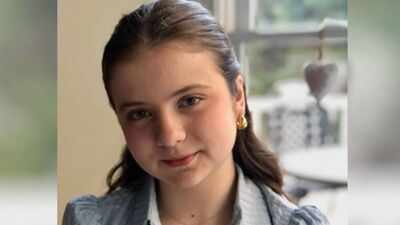
Isabel enjoys working through equations and mathematical proofs in her spare time (Photo: Instagram/wjccschools)
What did the experiment find?
Isabel compared their proposed sensor arrangements against the Pareto frontier, a mathematical concept used to identify solutions where improving one objective would mean making another worse.She examined whether an arrangement could provide better earthquake coverage without sacrificing another consideration, such as accessibility.Nash bargaining performed better in this comparison, producing arrangements closer to the Pareto frontier. Also, one model indicated that adding five sensors could improve simulated coverage by 16.7%.The finding does not establish that the same improvement would occur in an operational earthquake monitoring network. It does, however, show how mathematical modelling could help researchers compare possible sensor locations before making installation decisions.Isabel believes such methods could be particularly useful in places where reaching sensor locations is difficult or resources are limited.
Isabel’s love for mathematics
Isabel enjoys working through equations and mathematical proofs in her spare time and has described the precision of mathematics as one of its main attractions.“I like the precision of it. Over time it’s become one of my favorite free time activities,” she told Society for Science.Her interest in scientific experiments began during childhood. Her father, Enrico Rossi, teaches physics at William & Mary, while her mother, Margarita Marinova, is an English professor at Christopher Newport University. Isabel also grew up watching her older sister Eleanor use chemistry and physics experiment sets.At nine, she began meeting a retired NASA engineer introduced to her by a teacher. Their activities included building homemade rockets, measuring their launches and making adjustments to improve their performance.She later organised a MathCounts team at James Blair Middle School and helped arrange a STEAM event to encourage younger students to explore science and mathematics. She continues to coach the mathematics team.Isabel also plays violin in the Williamsburg Youth Orchestra and participates in environmental science activities. She has expressed interest in careers involving aerospace engineering, applied mathematics or medicine.The national competition’s final round will take place in Washington, DC, from October 23 to 28, bringing together students from 17 states and Puerto Rico. Finalists will compete for more than $100,000 in awards, including a $25,000 grand prize.