







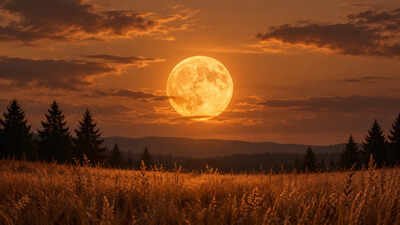
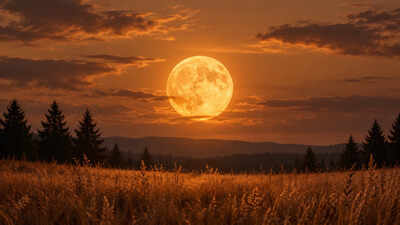
Tonight’s bright full moon has a name: the Hunter’s Moon. Yet scroll through social media, and you’ll see plenty of posts calling it the Harvest Moon. Others insist the Harvest Moon was last month. Some will say both names apply. The confusion is understandable. These two autumn full moons look alike, behave alike and sometimes even swap months. But there’s a clear rule that separates them.
What Makes a Harvest Moon
The Harvest Moon is the full moon closest to the Northern Hemisphere’s autumn equinox. The equinox falls around September 22 or 23 each year. In 2026, the full moon on September 26 sat closest to it, so that was the Harvest Moon.The name comes from farming. Before electric lights, farmers relied on bright moonlight to keep gathering crops after sunset. Around the equinox, the full moon gave them extra working hours just when they needed them most.There’s an astronomical reason this works. Usually the Moon rises about 50 minutes later each night. But around the autumn equinox, the Moon’s path makes a shallow angle with the horizon at mid-northern latitudes. So for a few nights in a row, it rises only 20 to 30 minutes later than the night before. That meant bright light soon after sunset for several evenings in a row.
Where the Hunter’s Moon Fits
The Hunter’s Moon is simply the next full moon after the Harvest Moon. In 2026, it reaches full phase in the early hours of October 26 by universal time. That’s Sunday evening, October 25, across most of the United States, and the morning of October 26 in India.By late October, the fields had been cleared. Animals had fattened up for winter, and with no crops in the way, hunters could spot them more easily. Hunters used the moonlight to track game and store meat before the cold months arrived. So this moon earned its name.The Hunter’s Moon shares some of the Harvest Moon’s rising pattern. It too rises fairly soon after sunset for a few nights, though the effect is a little weaker.
Why People Mix Them Up
Several things blur the line.First, the Harvest Moon doesn’t belong to a fixed month. If the September full moon comes early, the October full moon may sit closer to the equinox. Then October gets the Harvest Moon title, and the Hunter’s Moon shifts to November. That happened in 2025, when the Harvest Moon fell in early October.Second, both moons look very similar. Each can appear large and orange when it first rises. That colour comes from light passing through more of Earth’s atmosphere near the horizon, which scatters blue light and leaves warmer shades. The huge size near the horizon is mostly a perceptual trick.Third, the names come from old European and North American traditions. They aren’t official astronomy terms. Different almanacs and websites sometimes use them a little differently. People also use the name “Harvest Moon” more generally for a big autumn moon.And in the Southern Hemisphere, the seasons are reversed. There, a harvest-time full moon arrives in March or April instead.
The Indian Connection: Sharad Purnima
India has its own name for this autumn full moon. Sharad Purnima, the full moon of the Ashwin month, falls around October 25 or 26 this year, depending on the panchang. It’s also called Kojagari Purnima in Bengal and parts of eastern India.Families celebrate by worshipping Goddess Lakshmi and keeping kheer out overnight under the moonlight. The belief is that moonbeams on this night carry healing and nourishing qualities. Many people stay up late, since tradition says Lakshmi visits homes that night asking, “Ko jagarti?”, meaning “Who is awake?”So tonight’s moon carries three names, depending on where you stand. Hunter’s Moon in the West. The successor to the Harvest Moon in farming tradition. Sharad Purnima in India. It’s the same bright disc, seen through very different cultures.