







Lab-grown mini models of the human brain have helped researchers identify electrical signals corresponding to Braille letters, offering a new direction for research into biohybrid computing. Scientists at the University of Bristol connected tiny brain organoids to a tactile sensor and found that a computer could classify the resulting neural activity with measurable accuracy.The experiment achieved 61% accuracy when signals from one organoid were used. When researchers combined responses from three organoids, the recognition rate increased to 83%. The findings, published in Frontiers in Artificial Intelligence on October 16, 2026, demonstrate how biological neural networks could be connected to artificial sensors and electronic systems.
How did the researchers connect mini brains to Braille?
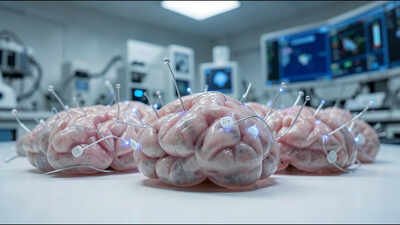
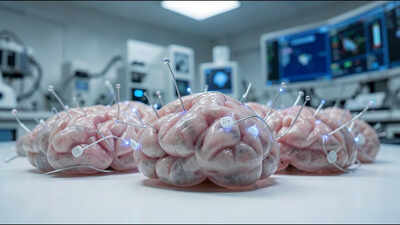
The team used brain organoids, which are small, lab-grown models containing some of the cell types and neural networks found in the human brain. Each organoid measured less than a millimetre across and contained approximately 10,000 neurons, along with supporting cells.These organoids are not miniature human brains. They lack several structures and functions of a complete brain and were used in the experiment as biological neural networks.The researchers placed them on multielectrode arrays, which allow electrical signals to be delivered to the organoids and their responses to be recorded. A tactile sensor was used to capture patterns associated with the 26 letters of the Braille alphabet. The researchers then converted these patterns into electrical stimulation signals and presented them to the organoids.The resulting neural activity was analysed using a machine learning algorithm called a support vector machine. This computer-based method classified the signals and identified which Braille letters they corresponded to.
Why did three organoids perform better than one?
The researchers found that combining the responses of three organoids improved recognition accuracy from 61% to 83%.They have not yet established exactly why this happened. One possible explanation is that individual organoids have slightly different neural connections, developmental states and patterns of ongoing activity. Their responses may therefore provide complementary information when combined.However, this variation also presents a challenge. If different organoids respond inconsistently, developing a predictable and standardised computing system could become more difficult.The team also tested how well the system handled artificial noise added to the Braille signals. The researchers found that decoding the responses after they had passed through the organoids was more resistant to this noise than attempting to classify the obscured signals directly using the computer algorithm.
Could brain organoids help build future computers?
The research is part of a developing field known as biohybrid computing, which explores ways of combining living biological systems with electronic components.Biological neural networks process information differently from conventional computer systems. Researchers are investigating whether their properties could eventually contribute to computing systems that use energy more efficiently.The Bristol experiment provides an example of how an artificial sensor can transmit information to a living neural network and how a computer can subsequently interpret the network’s responses. However, it does not demonstrate a working computer or establish that organoid-based systems are more energy-efficient than existing technology.
Can mini brain organoids learn through experience?
The researchers have also clarified what the experiment did not establish. The organoids received electrical stimulation and produced neural activity that could be classified, but the study did not demonstrate that they learned to recognise Braille or changed their responses through experience.Tianyi Liu, a PhD student at the University of Bristol and the study’s first author, said the next stage would involve moving beyond Braille to more complex tactile information, including textures and edges.The team also wants to investigate closed-loop experiments, in which an organoid receives feedback based on its responses. Such work could help researchers examine whether these biological networks can adapt through experience.The study therefore represents an early step towards connecting artificial sensors with living neural systems, rather than a demonstration of a biological computer capable of independently reading or understanding text.Source: University of Bristol research announcement, October 16, 2026; study published in Frontiers in Artificial Intelligence, “Encoding tactile stimuli for Braille recognition with organoids”.