

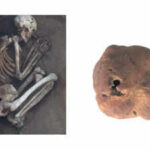







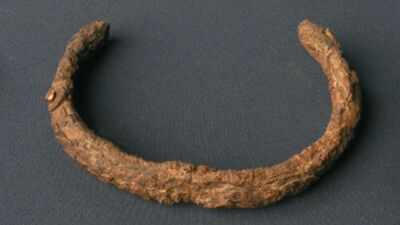
Two iron objects found in a Spanish treasure discovered in 1963 may have been made from metal that arrived on Earth from space. The objects, a hollow hemisphere and an open bracelet, form part of the Villena Treasure, a major collection of Bronze Age goldwork found in Alicante, in southeastern Spain. Their iron-like appearance had raised questions about the treasure’s age, as terrestrial iron production began later than the period in which the collection may have been buried.The findings were published in a research paper in Trabajos de Prehistoria, titled ‘Meteoritic iron in the Villena Treasure?’, which examined the chemical composition of both objects. The results are compatible with a Late Bronze Age date, before widespread terrestrial iron production began.
What makes two iron objects in Spain’s Bronze Age treasure unusual
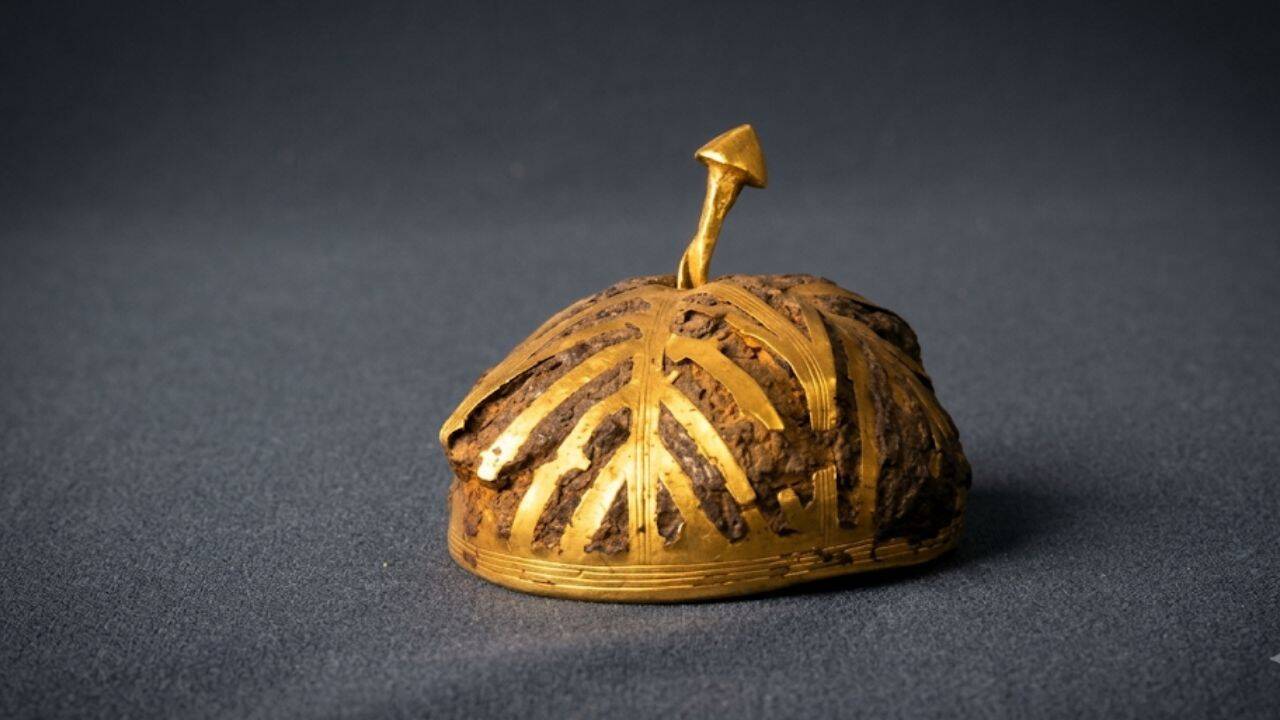
The Villena Treasure was discovered by José M.ª Soler at Rambla del Panadero in late 1963 and is held at the Villena Museum in Alicante. It is one of the most important collections of Bronze Age goldwork in the Iberian Peninsula. The two objects are a hollow hemisphere covered with a pierced gold sheet and an open bracelet.The hemisphere has been interpreted as the top of a sceptre or staff of authority, or as a sword hilt. The bracelet has a flat-convex cross-section and rounded, slightly flattened ends. Both objects have iron-like surfaces affected by corrosion. Their presence created a dating problem because researchers had to establish whether the material was terrestrial or meteoritic iron used to make them.
PC: Trabajos de Prehistoria
How did scientists test the Spanish treasure’s iron objects for meteoritic metal
Meteoritic iron occurs in certain meteorites and is mainly an iron-nickel alloy. Its nickel content is usually above 5% by weight, and it also contains smaller amounts of other elements, including cobalt. Terrestrial iron generally has low or undetectable nickel levels. Researchers collected tiny samples of corrosion from both Villena objects in 2007, with the museum’s permission. Initial portable X-ray fluorescence tests detected iron and nickel, but the samples were too small for reliable measurements.The researchers later sent them to a specialist laboratory in Mannheim, Germany, for laser ablation inductively coupled plasma mass spectrometry. This method can detect very small quantities of elements and trace elements needed to classify meteorites. Both samples weighed only fractions of a milligram each.
Nickel measurements provide clues to the meteoritic origins of the two iron objects
The first laboratory results suggested that the hollow hemisphere contained 5.5% nickel, leading the specialist who examined the data to consider it possibly meteoritic. The bracelet contained 2.8% nickel, which was initially considered too little for meteoritic iron. Researchers therefore obtained permission to take a second sample from the bracelet in 2013, going deeper into its corrosion layer.An X-ray fluorescence analysis of this sample produced a higher nickel result. The researchers noted that nickel levels can increase towards the interior of corroded meteoritic iron. They then compared the objects’ nickel-to-iron and nickel-to-cobalt ratios with data for meteorites and prehistoric iron objects. Both objects fell within the meteoritic iron distribution region. The researchers also examined gallium, germanium and ruthenium levels.
Chemical findings support the possible Bronze Age origins of the two iron artefacts
The analyses indicate, with a high degree of probability, that both objects were made from meteoritic iron. Similar levels of minor and trace elements, particularly gallium, germanium and ruthenium, may point to a common origin. The researchers said the findings are compatible with a Late Bronze Age date, before widespread production of terrestrial iron began.They linked this dating possibility to the relationship between the Villena Treasure and the Cabezo Redondo Treasure, whose settlement was abandoned before 1200 cal BC. However, they said further tests would be needed to increase certainty. These could include non-invasive techniques such as gamma spectrometry, proton-induced X-ray emission, computed tomography, and muon radiography.