







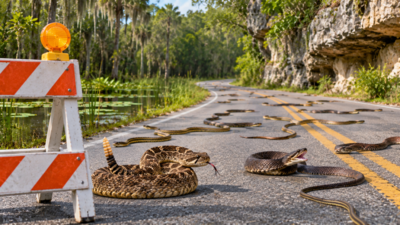
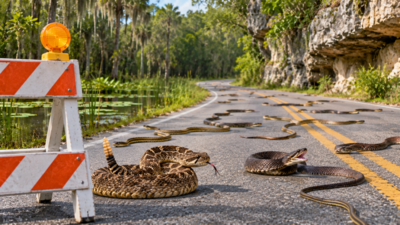
A road in southern Illinois, United States, has an unusual reason for closing to traffic twice a year: thousands of snakes and other reptiles need to cross it during their seasonal migration. Known as Snake Road, the 4-kilometre stretch in Shawnee National Forest connects LaRue Swamp with the limestone cliffs of LaRue-Pine Hills. The animals travel towards the wetlands in spring to feed, mate and rest before returning to the cliffs in autumn for shelter. To protect them from passing vehicles, the US Forest Service closes the road during both migration periods, allowing visitors to explore it on foot.
Why do thousands of snakes migrate across Snake Road twice a year
Snake Road lies between two important ecosystems in the Shawnee National Forest. To its west is LaRue Swamp, which forms part of the Mississippi River basin. To the east are the LaRue-Pine Hills, an area known for its limestone cliffs, which rise 46 metres above the surrounding landscape.The seasonal movement takes place as temperatures change. In spring, reptiles emerge from hibernation as the weather becomes warmer and travel towards the swamp, where they can feed, mate and rest. When autumn arrives and temperatures begin to fall, they return towards the limestone cliffs, which provide places to shelter from colder conditions.
US Forest Service enforces two seasonal road closures
The US Forest Service closes Snake Road during two periods each year to protect migrating wildlife. According to the BBC, the road is closed from 15 March to 15 May in spring and from 1 September to 30 October in autumn.The closure dates were established following an earlier conservation measure introduced in 1972. Initially, the road was closed for three weeks during both the spring and autumn migration periods. However, biologist and herpetologist Scott Ballard, who worked with the Illinois Department of Natural Resources, found that the migration lasted longer than the original closure period. The Forest Service subsequently extended the restrictions to cover the longer migration.
Seasonal road closures protect snakes from deadly traffic
The seasonal closure is intended to prevent reptiles from being accidentally killed by traffic while crossing the road. Snakes and other cold-blooded animals can move particularly slowly during cooler periods, making it difficult for them to cross before vehicles approach.According to the BBC, the black asphalt can retain warmth during early mornings and evenings, but the reptiles may still move slowly. They also tend to stop when approached, including when a vehicle is coming towards them.The scale of the threat has also been documented in research. According to National Geographic, biologist Rich Siegel reported that almost one in four snakes he collected for a study had been killed by traffic. The seasonal road closure helps reduce this risk by removing vehicle traffic during the migration periods.
More than 23 snake species inhabit the Snake Road area
More than 23 species of snakes have been recorded in the area, according to biologist Mark Vukovich, as reported by 5Chicago. The location is also home to several other reptiles and amphibians that use the route during their seasonal movements.Three of the snake species found in the area are venomous: the northern cottonmouth (Agkistrodon piscivorus), the copperhead (Agkistrodon contortrix) and the timber rattlesnake (Crotalus horridus). Other species that visitors may encounter include southern leopard frogs, different types of toads and salamanders, as well as turtles and lizards.These animals use the road as a passage between the two habitats. Their seasonal movement is the reason the Forest Service maintains restrictions on vehicles during specific months of the year.
Visitors can explore Snake Road on foot during seasonal closures
Although vehicles are prohibited during the seasonal closures, visitors are permitted to walk along the 4-kilometre stretch of Snake Road to observe the migrating wildlife. However, sightings are not necessarily as frequent as some visitors might expect.Scott Ballard explained that visitors should not expect to see large numbers of snakes crossing the road simultaneously. He said, “If you see twenty snakes while you’re out here, that’s a good day.”Visitors are advised to observe the reptiles from a safe distance and avoid approaching, handling or startling them. Collecting reptiles is also prohibited under federal and state law.The seasonal closure allows snakes, amphibians and other reptiles to move between LaRue Swamp and the LaRue-Pine Hills without vehicle traffic during their migration. By restricting access to cars during these periods, the Forest Service protects wildlife travelling along one of the United States’ most unusual roads.