






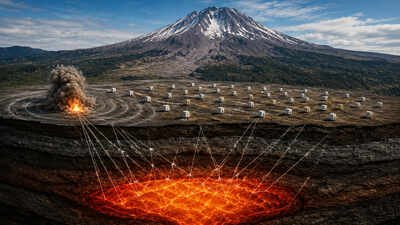
In 2014, scientists set off 23 explosions and deployed 3,500 seismographs around Mount St Helens; the experiment helped image a magma reservoir roughly 4 to 15 km beneath the volcano

In 2014, scientists set off 23 explosions and deployed 3,500 seismographs around Mount St Helens; the experiment helped image a magma reservoir roughly 4 to 15 km beneath the volcano

Representative Image (AI-generated) Mount St. Helens is one of the most closely studied volcanoes in the United States, but scientists still cannot directly see the complex system of magma and rock hidden beneath it. In 2014, researchers launched an ambitious experiment to change that. According to the Imaging Magma Under St. Helens (iMUSH) project, a…
Read More
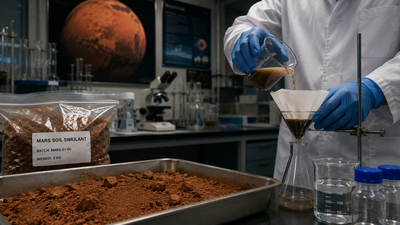
Meet Jeremiah Bents, the Minnesota student who recreated Mars soil in a lab to test whether future astronauts could clean contaminated water |

Meet Jeremiah Bents, the Minnesota student who recreated Mars soil in a lab to test whether future astronauts could clean contaminated water |

Mars may be millions of kilometres from Minnesota, but for Cloquet student Jeremiah Bents, one small part of a future Mars mission could be tested much closer to home. Instead of looking at how to reach the Red Planet, Bents turned his attention to what astronauts might do once they get there, particularly when dealing…

Read More
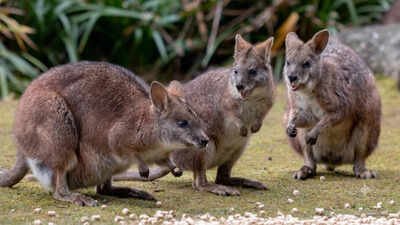
In 1912, New Zealand released wallabies near Rotorua; they now occupy more than 200,000 hectares and, if left unchecked, could spread across a third of the country by 2065, causing  million in damage a year

In 1912, New Zealand released wallabies near Rotorua; they now occupy more than 200,000 hectares and, if left unchecked, could spread across a third of the country by 2065, causing $84 million in damage a year

Authorities are asking people to report sightings and signs of the animals. (Photo: WWF Australia) Wallabies introduced to New Zealand more than a century ago have spread across more than 200,000 hectares in the country’s North Island. Authorities are now working to control their population because the animals can damage native forests, compete with farm…

Read More
In 1926, a 10-ft rocket flew 41 ft; 35 years later, NASA honored its creator in space |

In 1926, a 10-ft rocket flew 41 ft; 35 years later, NASA honored its creator in space |

Goddard physicist Henry Plotkin inspects the retroreflector array destined for the 1964 Beacon Explorer A satellite, PC: Henry Plotkin/ Nasa On October 29, 1964, a team at NASA‘s Goddard Space Flight Centre in Greenbelt, Maryland, recorded the first successful laser returns from an artificial satellite. The target was Beacon Explorer B, also known as Explorer…

Read More
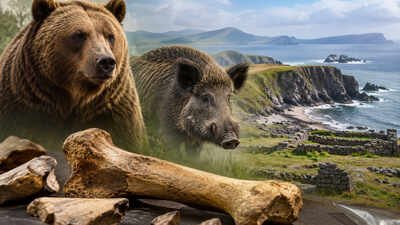
Scientists reidentify Ireland’s famous “Kerry Cow” bones as ancient bear and wild boar remains, challenging a long-held theory about how farming reached the island

Scientists reidentify Ireland’s famous “Kerry Cow” bones as ancient bear and wild boar remains, challenging a long-held theory about how farming reached the island

Representative Image (AI-generated) For more than three decades, a collection of animal bones from Ireland’s Ferriter’s Cove was considered some of the earliest evidence that farming had reached the island. But new research has now overturned that interpretation. According to University College Dublin (UCD), bones once identified as cattle have instead been identified as belonging…

Read More
Dr DisRespect vs Nickmercs controversy: Streamer threatens to assault Nickmercs during Call of Duty stream

Dr DisRespect vs Nickmercs controversy: Streamer threatens to assault Nickmercs during Call of Duty stream

Dr DisRespect vs Nickmercs heats up as Doc appears to threaten him during Call of Duty stream. (Image via: Instagram/@drdisrespect & @nickmercs) Dr DisRespect, whose real name is Herschel “Guy,” has once again taken aim at Nickmercs, this time during a Call of Duty Modern Warfare 4 Beta livestream. On August 24, 2026, a 42-second…

Read More
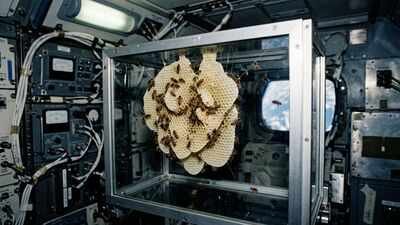
In 1984, NASA sent thousands of honeybees into space to build a honeycomb without gravity, and the tiny colony eventually created 31 square inches of comb |

In 1984, NASA sent thousands of honeybees into space to build a honeycomb without gravity, and the tiny colony eventually created 31 square inches of comb |

A small box of honeybees once became an unusual passenger aboard the space shuttle Discovery. In 1984, Nasa sent thousands of honeybees into orbit to see how they would behave when gravity was no longer guiding their movements. The experiment was less about honey and more about a basic piece of bee life: building a…

Read More
Nathan Cofnas, scholar who exposed Jason Arday’s plagiarism, says he had no ill will towards him: “This was about DEI” | World News

Nathan Cofnas, scholar who exposed Jason Arday’s plagiarism, says he had no ill will towards him: “This was about DEI” | World News

Nathan Cofnas (left), Jason Arday (right) Nathan Cofnas, the American researcher who first publicly detailed extensive plagiarism allegations against Cambridge University’s youngest Black professor, Jason Arday, has said he bore no personal animosity towards the late academic. In his first detailed comments to VRT NWS after Arday’s death, Cofnas stated that he “had zero interest”…

Read More
“I deceived people, I lied”: A 37 year old woman pretrended to be a child for years and convinced families she needed protection; now she is convicted of fraud

“I deceived people, I lied”: A 37 year old woman pretrended to be a child for years and convinced families she needed protection; now she is convicted of fraud

Amanda Maria Souza de Oliveira (Image Credit: Facebook/ @Nate Eaton – Reporter) A bizarre case in Brazil has drawn widespread attention after a woman in her 30s was convicted of fraud and false identity following years of pretending to be a child. Amanda Maria Souza de Oliveira is accused of creating a false identity and…

Read More
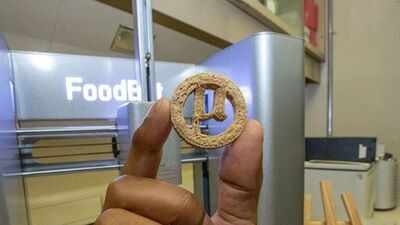
Scientists turned plastic bottles and corn waste into protein-rich cookies; the food could help tackle hunger problem and also feed space crews

Scientists turned plastic bottles and corn waste into protein-rich cookies; the food could help tackle hunger problem and also feed space crews

The technology could also potentially be used in places such as submarines and future human settlements on the Moon or Mars (American chemical society photo) Researchers at Southern Illinois University Carbondale (SIU Carbondale) are working on a technology that turns plastic waste from a water bottle into part of a cookie. For this, they programmed…

Read More