






For 18 years, researchers kept large herbivores out of fenced plots in a Kenyan savanna to study what happened to the trees in their absence. During that period, tree cover increased rapidly, trees became taller, and tree numbers rose. The fences were removed in 2017, allowing elephants, giraffes and other large herbivores to return to the plots. Tree cover then fell over the following years and, by 2025, had returned to levels close to those recorded when the experiment began. Tree density, however, was still higher than before at the last field survey in 2019, while tree mortality increased after the animals returned to the previously fenced plots.
How did large herbivore exclusion change African savanna trees
According to the study published in Ecology Letters, titled ‘Responses of African Savanna Trees to Large Herbivore Extinction and Rewilding’, the absence of large herbivores was followed by a marked increase in tree cover. In the unfenced control plots, tree cover remained between 21% and 32% throughout the study period. In the exclosure plots, however, tree cover increased rapidly during the first 10 years of herbivore exclusion and exceeded 60% on average by 2009. It then remained at that level through 2016. The researchers reported that tree cover was greater in the exclosures than in the controls in every year from 1999 to 2016.The change was also reflected in the trees themselves. By 2016, trees inside the exclosures had reached a mean height of 2.37 metres, compared with 1.49 metres in the unfenced control plots. Tree density also increased: the mean density in exclosures rose from 1,544 trees per hectare in 1999 to 3,285 trees per hectare in 2009, while density in the control plots remained essentially unchanged. The researchers found that recruitment was greater in the exclosures during the first 10 years of exclusion.
What happened when the herbivores returned
The fences were removed in 2017, allowing the large herbivore community to return to the previously protected plots. The researchers recorded substantial changes after reintroduction. During the first three years after fence removal, trees in the formerly fenced plots experienced the most negative height growth recorded during any phase of the experiment. Two years after herbivores returned, there was no longer a difference in mean tree height between the formerly fenced and control plots.Canopy growth also changed after the animals returned. During the first two years of reintroduction, trees in the newly unfenced plots experienced negative canopy growth on average. The study reported that Grewia tenax and Acacia mellifera, which had generally shown positive canopy growth in the exclosures during the exclusion period, experienced negative canopy growth after herbivore reintroduction. According to the study, the quick return of tree height and recruitment to pre-exclusion levels was consistent with heavy browsing by elephants on adult trees, and with smaller browsers such as impala and dik-dik moving back into the plots.
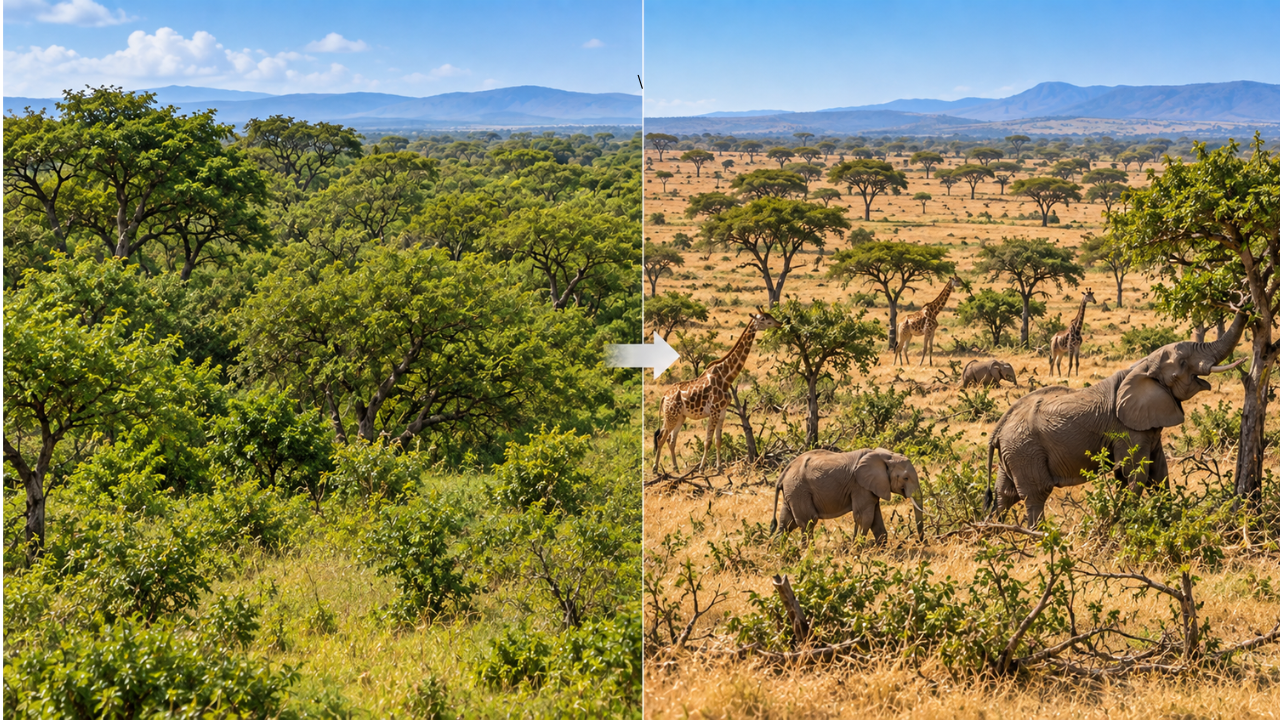
Image AI generated
How did tree cover change after rewilding
Tree cover declined after the return of the herbivores. According to the study, the decline occurred at a rate comparable to the earlier increase during the first decade without herbivores. By 2025, tree cover in the formerly fenced plots was nearly identical to the levels recorded at the beginning of the experiment, although it remained slightly higher than in the control plots. The researchers reported an average cover of 36.2% in the exclosures at the beginning of the experiment and 36.5% in the formerly fenced plots in 2025.Tree density, however, did not return in the same way. The researchers found that density had become elevated in the exclosure plots within three years and remained high after herbivore reintroduction. Mortality in the fenced plots had already risen to 19.2 trees per year between 2009 and 2016. It increased further after the animals returned, reaching an average of 30.5 trees per year between 2016 and 2019, compared with 14.0 in the control plots over the same period. The study concluded that some vegetation changes caused by the absence of herbivores could remain after their return, describing these shifts as potentially “resistant to rewilding”.