









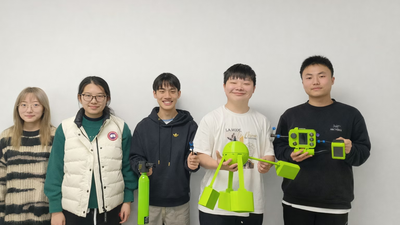
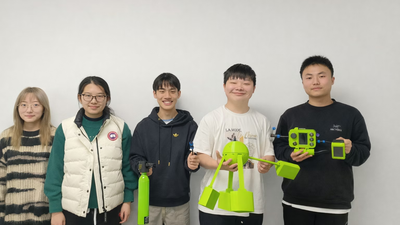
For divers beneath the surface, communication can become surprisingly difficult. Radio signals that work reliably on land do not travel effectively through water, leaving divers dependent on hand signals, pre-arranged plans or specialised equipment when they need to communicate. Five Chinese students, Hao Ting Lyu, Qing Ying Cao, Bai Xuan Ye, Yuanhao Zhang and Jia An Pan, have designed a potential solution to that problem. Their project, called DiveGuard, is a cost-effective underwater short-message communication system designed to let divers and surface teams exchange text-level messages underwater. The team developed the system as part of the Conrad Challenge, where DiveGuard was selected as a finalist and later recognised with a Power Pitch Award at the 2026 Innovation Summit. The official Conrad Challenge profile lists Zhi Heng Dong as the team’s coach. Rather than attempting to bring conventional wireless communication underwater, the students built their concept around low-cost acoustic communication, turning sound into a means of transmitting short messages beneath the surface.
Why is underwater communication so difficult?
The problem DiveGuard tackles begins with a basic limitation of radio technology. On land, smartphones, radios and Wi-Fi systems can transmit information through the atmosphere using electromagnetic waves. Underwater, however, those systems become far less effective because water absorbs radio-frequency signals, particularly at the frequencies commonly used for conventional wireless communication. Divers therefore often communicate through gestures, lights or specialised systems. These methods can become unreliable when visibility falls, when divers are separated by distance or when an emergency develops. The Conrad Challenge describes this as a critical safety gap for recreational divers, underwater workers and marine operators. DiveGuard was designed specifically for environments where conventional network connectivity is unavailable. That includes situations where divers may need to coordinate movements, communicate with a surface team or send an emergency message.
How does DiveGuard send messages underwater?
Instead of depending on radio transmission, DiveGuard uses underwater acoustic communication. The system is designed to convert information into acoustic signals that can travel through water. Those signals can then be received and interpreted by another DiveGuard device, allowing users to exchange short, text-level messages. The students’ concept is aimed at keeping the system relatively inexpensive while still providing a communication function that is usually associated with more specialised underwater equipment. According to the Conrad Challenge, DiveGuard is intended to provide real-time messaging between divers and surface teams, potentially improving situational awareness and emergency response in environments with low visibility, no network coverage or elevated risk. That makes the idea different from a conventional dive computer. Instead of primarily recording information about a dive, DiveGuard is focused on allowing people involved in the dive to communicate.
Who are the five students behind DiveGuard?
The project was developed by Hao Ting Lyu, Qing Ying Cao, Bai Xuan Ye, Yuanhao Zhang and Jia An Pan, representing China in the 2026 Conrad Challenge. The official competition listing places the team in the Cyber-Technology & Security category and identifies their project as DiveGuard, DG-01. The students were among the finalists selected for the 2026 Innovation Summit, an international competition that brought together student innovators working on projects across areas including cyber technology, aerospace, health, energy and water-related challenges. Their project ultimately received a Power Pitch Award, recognising DiveGuard among the competition’s award-winning innovations.
Could a low-cost system make diving safer?
The students’ argument is that underwater communication does not necessarily need to rely on expensive, highly specialised equipment. DiveGuard is intended for several groups, including recreational divers, underwater workers and marine operators. For recreational divers, short messages could potentially help with coordination during a dive. For professional underwater workers, communication could be particularly useful when several people need to work together beneath the surface. Emergency communication is another important part of the concept. An underwater accident can quickly become more serious if a diver cannot communicate what has happened. A system capable of transmitting even simple messages could provide information that hand signals cannot, particularly when the recipient is a surface team or another diver who cannot clearly see the person sending the signal. The Conrad Challenge says DiveGuard is intended to improve situational awareness and emergency response in challenging underwater environments.
DiveGuard could target a growing underwater technology market
The students are also positioning DiveGuard as more than a school engineering project. Their Conrad Challenge profile identifies the global dive tourism market as the broader market opportunity, with smart diving devices representing a smaller target segment. The team proposes an initial focus on Southeast Asia, where recreational diving and marine activity create a potential market for affordable underwater technology. The project’s low-cost approach is central to that strategy. Expensive specialist equipment can be out of reach for recreational divers, smaller operators and organisations working in locations where sophisticated underwater communications infrastructure is unavailable. A simpler acoustic messaging device could potentially lower that barrier. The technology could also have applications beyond leisure diving, including underwater inspection, marine operations and other activities where people need to exchange information while submerged.
Why acoustic communication could be useful underwater
Sound has a major advantage beneath the surface: it travels efficiently through water. This is why underwater environments already rely heavily on acoustic technologies for applications such as sonar, navigation and communication. DiveGuard applies the same broad physical principle to a much more accessible purpose, sending short messages between people underwater. The challenge is turning that principle into a compact, affordable and practical communication system. The students’ approach focuses on short-message communication rather than attempting to reproduce the full capabilities of a mobile phone underwater. That narrower goal could make the system more practical for situations where users only need essential information. A message such as an instruction, warning or emergency alert could be far more useful underwater than trying to maintain a conventional internet connection that was never designed for the environment.
From a student project to a potential underwater safety tool
DiveGuard is still a student innovation rather than an established replacement for professional underwater communication systems. Its recognition at the Conrad Challenge, however, has placed the project among a group of young innovators attempting to solve real-world problems with relatively accessible technologies. For them, the problem began with something deceptively simple, how do you talk to someone when both of you are underwater? Their answer is to use sound rather than radio and short messages rather than conventional wireless networks. If the technology can eventually be developed into a reliable, affordable product, DiveGuard could give divers something they currently cannot take for granted, a simple way to say what is happening beneath the surface.