








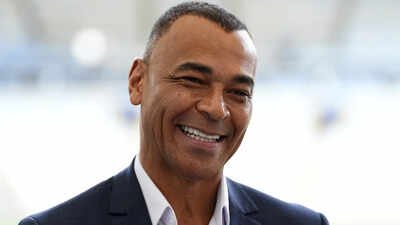
Navi Mumbai: His words were in Portuguese. His expression, however, reflected love and happiness, just like how he played the game.Standing on stage, as he addressed the enchanted students of Pillai University here, Cafu soaked in the adulation. The smile on his face was constant and matched the one of him in the background poster with that enduring image — of him holding aloft the 2002 FIFA World Cup trophy.More than 24 years later, the hair on his head may have thinned. His popularity clearly hasn’t, judging by the increasing decibel levels as he spoke to the young gathering, many of whom came dressed in Brazil’s iconic canary jersey.The excitement all around peaked when the Brazilian great showed off some of his skills in a brief ball-juggling exchange with India international Nikhil Poojary.A small sample perhaps of a bigger Brazil-India clash coming up in Kolkata next month, when Khalid Jamil’s side host the five-time world champions in an international friendly.The high-profile fixture has been the topic of debate. What will India, ranked as low as 138th, truly stand to gain from taking on a footballing giant? A fair bit, according to Cafu.“Well, if you go by the rankings, there is a significant difference between Brazil and India, but football has modernized. Today, everyone plays on equal terms,” the charismatic former AC Milan and Roma right back told reporters later. “You saw this in the World Cup. In the World Cup, national teams like Curacao, teams like Cabo Verde, played on equal terms with all the big national teams.“We hope that Brazil and India can play a great game. It will bring many benefits to the Indian people and to the Indian national team, which will face a team that is a five-time world champion. I think establishing this connection between these countries, now that FIFA has expanded the World Cup, opening up space for other countries, will be important for India as well.”But what about Brazil? How does the only man in history to play in three consecutive World Cup finals explain the decline of the once-mighty Selecao ever since he led them to their fifth star that evening in Yokohama 24 years ago?“We see that every change is necessary in football. Brazil has been going through a difficult period when it comes to the national team, because it has been more than 24 years — completing 28 years by 2030 — without winning a World Cup title,” Cafu, now 56, said.“You cannot compare it to the era when we played, when we played in three consecutive World Cup finals. That was an era that has passed. It is a new generation, they are new players, and we have to root hard so that this new era and these new players can achieve what we achieved: reaching a World Cup final.”But even under one of the game’s most decorated coaches in Italian Carlo Ancelotti, a man Cafu knows very well, the challenge of returning to the pinnacle of world football remains complicated, the two-time World Cup winner pointed out.“The World Cup is not an exact science. The best do not always win, and the champion is not always the best team. It is a sequence of factors that makes you win a World Cup,” said Cafu, who won the UEFA Champions League in 2007 with AC Milan under Ancelotti’s watch.“I am very hopeful when talking about the Brazilian national team. I hope Brazil can win the World Cup in 2030 now and end this 28-year drought.”Asked whether the growing trend of Brazilian talent moving to Europe’s footballing elite prematurely was, in some way, to blame for the national team’s struggles, Cafu felt conflicted over the argument.“I am biased to speak because when I played my third consecutive World Cup final, I was playing in Italy,” he said.“This is very relative. All national teams, except for the 1994 team, had the majority of their players playing outside the country, playing in other teams that were not Brazilian clubs.“Today, young Brazilian players are leaving earlier for other countries, and because of that, perhaps they do not develop an identity with the Brazilian national team, an identity with the Brazilian people. Perhaps that is what is missing most for our Brazilian national team: a bit more Brasilidade (Brazilianness) in these players—feeling the weight of what it means to play for a Brazilian club, going to the Brazilian national team, and only then going abroad to another country.”Hailed as one of the game’s greatest full backs, Cafu, who enthralled fans with his charging runs up and down the right flank, said modern-day tactics meant the position today didn’t quite offer players the same freedom.“Everything has changed in our position. In our time, the full-back was a full-back. He covered the midfield, covered the wings, went to the far post, crossed and came back.“I, as a full-back, ran 22 km in one match. That was the intensity with which we played,” Cafu said. “Today, I see that most wingers are having a little more difficulty, because most of the coaches are playing with systems that restrict the full-back’s overlapping runs and prevents them from reaching the byline.“But we were stubborn wingers. We didn’t listen to what the coach said and liked to play. That’s why we attacked and defended with the same intensity.”Towards the end of his media interaction, the broad smile appeared once more when one asked Cafu whom he would choose, if he had to pick between Ronaldo, his former Brazil teammate, and Lionel Messi? “Ronaldo fenomeno,” he grinned.