






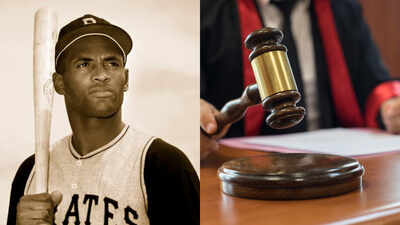
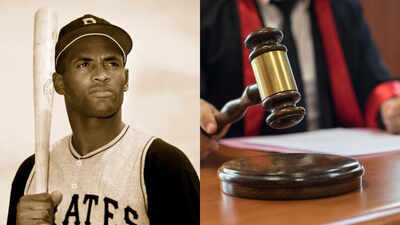
A sporting legend’s legacy can live far beyond the stadium, but deciding who controls that legacy can become a complicated legal battle. More than half a century after Roberto Clemente’s death, his name and image have become the subject of a dispute between his family and his native Puerto Rico. In 2022, the US territory issued souvenir license plates featuring the baseball star without his sons’ consent, causing a dispute. Now, the US Supreme Court‘s refusal to hear their appeal has left the family’s fight over trademark rights and compensation unresolved.
Supreme Court declines to intervene
According to Reuters and ESPN, the Supreme Court declined on November 9 to consider an appeal filed by Clemente’s three sons against Puerto Rico’s use of their father’s likeness on commemorative licence plates and vehicle registration tags.Roberto Clemente Jr, Luis Roberto Clemente and Roberto Enrique Clemente had challenged the programme, arguing that the government had appropriated trademark rights belonging to the family. Their lawsuit, filed alongside two companies they own that work to protect Clemente’s brand and philanthropic legacy, sought to prevent future use of his image on vehicle plates.The family also sought $45 million in damages and an additional $3.15 million in compensation for trademark infringement. The sons maintained that the programme generated approximately $15 million for Puerto Rico through the sale of the commemorative registrations.The Supreme Court rejected the appeal without providing an explanation. However, the decision does not resolve every aspect of the wider dispute. According to Reuters, the family’s legal representatives intend to continue pursuing the claims that remain before the lower courts.
How the commemorative plates sparked a dispute
Puerto Rico introduced the special plates and registration tags in 2022 to mark the 50th anniversary of Clemente’s death. The designs featured his portrait, his iconic Pittsburgh Pirates jersey number 21 and recognition of his remarkable achievement of recording 3,000 career hits.According to USA Today, the registration programme involved fees of $21 and $5, which collectively generated around $15 million for the territory. The initiative was introduced during a difficult economic period, as Puerto Rico continued recovering from bankruptcy.Clemente’s children objected to the arrangement because the revenue went to the government rather than businesses associated with preserving and promoting their father’s legacy. The programme was discontinued at the end of 2022.The family subsequently filed a lawsuit, arguing that the unauthorised commercial use of Clemente’s identity amounted to a government taking of private property under the Fifth Amendment of the US Constitution.
Trademark rights at the centre of the legal battle
The central question concerned whether constitutional protections against government seizure of private property extend automatically to intangible assets such as trademarks.A federal district court in San Juan, presided over by Judge Gina Méndez-Miró, dismissed the family’s case. The Boston-based 1st US Circuit Court of Appeals subsequently upheld parts of that decision, rejecting the argument that Puerto Rico’s use of the trademarks constituted an unconstitutional taking.According to Reuters and ESPN, the family’s lawyers argued before the Supreme Court that the lower courts had weakened constitutional safeguards by treating trademark rights differently from physical property.Puerto Rico claimed the appeals court can protect intangible property under the Constitution. Its legal representatives argued that the decision simply applied existing Supreme Court precedents to the circumstances of the case.
Remembering a baseball icon
The dispute concerns the legacy of one of baseball’s most celebrated players. Born in Carolina, Puerto Rico, Clemente spent 18 seasons with the Pittsburgh Pirates between 1955 and 1972.He earned 15 All-Star selections, won two World Series championships and finished his career with exactly 3,000 hits, alongside a .317 batting average, according to USA Today. He was inducted posthumously into the National Baseball Hall of Fame in 1973.Clemente died on December 31, 1972, aged 38, when the aircraft carrying him humanitarian supplies to earthquake victims in Nicaragua crashed.His sporting achievements and humanitarian contributions have made his identity an enduring part of baseball history. His sons’ remaining legal claims mean the dispute over who controls and profits from Clemente’s image may continue after the Supreme Court’s Nov. 9 decision.Images Courtesy: istock and Roberto Clemente website