









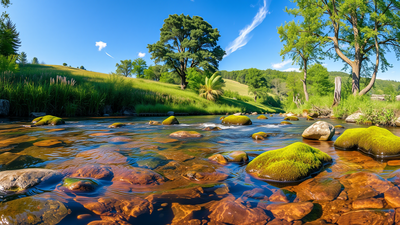
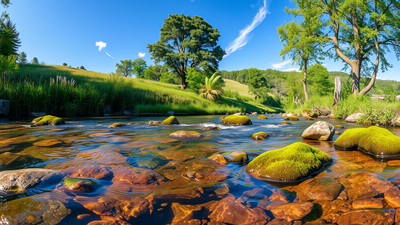
In 1962, Marion Stoddart moved with her husband and three young children to Groton, Massachusetts, settling less than a mile from the Nashua River. At the time, the Nashua ranked among the ten most polluted rivers in the United States, running a different colour depending on what paper mills and factories had discharged into it that day, its stench reportedly detectable from a mile away. Rather than accept this as simply the way things were, Stoddart made restoring the river her personal mission, organising a grassroots campaign that combined door-to-door petitioning, direct meetings with the governor, and years of sustained pressure on state lawmakers. Her efforts helped push through the Massachusetts Clean Waters Act, one of the earliest state-level water pollution laws in the country, and laid the groundwork for a river restoration effort that continues to protect 174 miles of waterway today.
How Marion Stoddart built a grassroots campaign to save the Nashua
According to the Nashua River Watershed Association, the organisation Stoddart herself founded, she formed the Nashua River Clean-up Committee and led an effort that gathered more than 6,000 citizen signatures on a petition protesting the river’s condition. Stoddart and her committee presented these signatures directly to Massachusetts Governor John Volpe, reportedly bringing along a jar of the river’s polluted water to make the point visually, a jar Volpe is said to have kept on his desk afterwards as a reminder of the problem.Beyond the petition itself, Stoddart spent years building relationships with local mayors, town officials and state legislators along the river’s path, working to convince riverside communities to invest in wastewater treatment infrastructure that had never previously existed. According to Freedom’s Way National Heritage Area, part of the National Park Service’s heritage area network, this sustained coalition building across dozens of local governments was central to how the cleanup effort eventually gained the political support it needed.
What the Massachusetts Clean Water Act actually achieved
Stoddart’s advocacy work directly contributed to the passage of the Massachusetts Clean Waters Act, formally codified as chapter 21, sections 26 to 53 of the state’s General Laws. According to the State Library of Massachusetts, the act was originally enacted in 1966, making it one of the first state level anti water pollution laws in the country. According to an official Massachusetts state government retrospective published by the state’s Division of Ecological Restoration, Stoddart was also instrumental in the passage of the federal Clean Water Act, which further reinforced the legal framework needed to hold industries accountable for what they discharged into public waterways.The legislative change alone did not clean the river. It took years of follow-up work, persuading individual municipalities to fund and build wastewater treatment plants, most of which came online through the 1970s, before pollution levels in the Nashua began falling in any meaningful way.
Why Stoddart founded the Nashua River Watershed Association
In 1969, with the initial legislative fight won but implementation still ongoing, Stoddart founded the Nashua River Watershed Association to oversee the river’s long-term protection and expand her focus beyond pollution control alone. The organisation set out to establish continuous greenways of protected land along the river and its major tributaries, aiming to buffer the waterway from stormwater runoff carrying agricultural chemicals, vehicle pollutants and other contaminants that could undo the earlier cleanup work.
From one of the country’s most polluted rivers to a swimmable waterway
The turnaround, once underway, proved significant. The Nashua River, once so polluted it was considered biologically dead in stretches, became swimmable again by the 1980s, a transformation that took roughly two decades of sustained legislative, municipal and community effort following Stoddart’s original petition campaign. In March 2019, sections of the Nashua River and its Squannacook and Nissitissit tributaries were formally designated under the National Wild and Scenic Rivers System, a recognition widely seen as a direct tribute to the decades of restoration work Stoddart helped set in motion.
Why Stoddart’s campaign remains a reference point for grassroots environmental advocacy
Now in her late nineties, Stoddart has continued to speak publicly about the Nashua River cleanup, often describing her approach as something available to anyone willing to commit to a long-term goal rather than requiring any particular expertise or status. Her work has been documented in the award-winning film Marion Stoddart: The Work of 1000, which continues to be shown in schools and universities across the country as a case study in sustained, community-driven environmental advocacy.More than six decades after she first moved to Groton and encountered the reeking, sludge-filled river a short walk from her home, Stoddart’s campaign remains one of the clearest American examples of how a single, sustained citizen-led effort helped reshape state environmental law and permanently changed the trajectory of a river that had once been written off as an industrial dumping ground.