









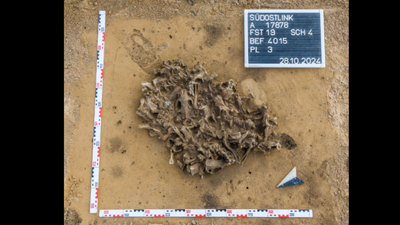
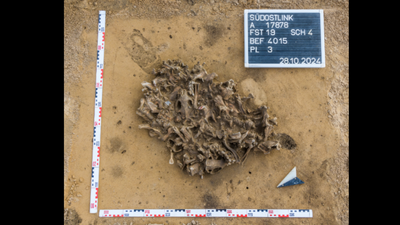
Archaeologists in Germany have uncovered a Stone Age pit near Alsleben, Saxony-Anhalt, containing the bones of at least twelve beavers, offering an unusually vivid window into how Europe’s earliest farmers exploited animal fur. The roughly 7,000-year-old feature was first unearthed in 2024 during surveys ahead of construction of the SuedOstLink power line, and has now been dated to between 4935 and 4787 BC, placing it within the Linear Pottery culture.The bones, described by researchers as “exceptionally well preserved and mostly unfragmented,” show no anatomical connection to one another, suggesting the beavers were skinned and their carcasses left to decompose before the remains were finally gathered and buried together. Excavated by the State Office for Heritage Management and Archaeology (LDA) of Saxony-Anhalt, the find points to a deliberate, organised hunting episode, and hints at the surprisingly elaborate fur clothing worn by some of the continent’s first farming communities.
7,000-year-old beaver bones found along a major power line route
The find emerged during preparatory archaeological surveys for the SuedOstLink, a major high-voltage direct current power line being built across Saxony-Anhalt. Investigations in the Salzland district were carried out by the State Office for Heritage Management and Archaeology (LDA) of Saxony-Anhalt, working closely with grid operator 50Hertz ahead of construction work along the route.The power line stretches roughly 170 kilometres through the state, running largely alongside the A14 and A9 motorways and cutting through what the LDA describes as old settlement land with exceptionally fertile soils. This has meant an unusually high concentration of archaeological sites requiring excavation and documentation before building work can proceed, and it was this process that first brought the pit to light near Alsleben in 2024.
PC: State Office for Heritage Management and Archaeology Saxony-Anhalt
How archaeologists found a beaver bone pit near the Saale River
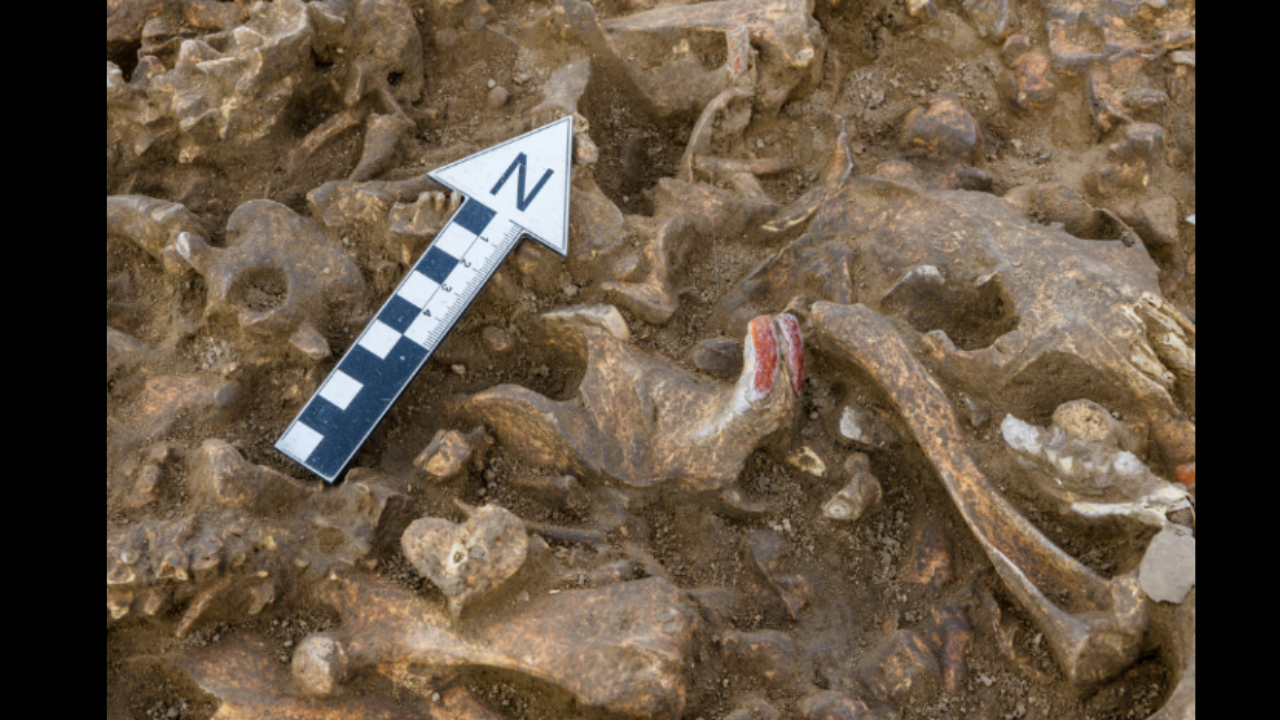
The site itself sits above the Saale River, at the point where the power line is due to cross beneath it using a trenchless tunnelling method. According to the press release by the State Office for Heritage Management and Archaeology Saxony-Anhalt, the area “had already been chosen as a settlement site in the Neolithic period (New Stone Age) and was also used during the Bronze and Iron Ages,” making it a long-favoured spot for human occupation across millennia.Amid a dense scatter of postholes, storage pits and burial sites, one feature caught researchers’ attention. Archaeologists describe an “initially inconspicuous-looking pit, approximately 80 centimetres in diameter,” which turned out to be tightly packed with animal bone. The distinctive orange-to-reddish-brown teeth scattered through the fill immediately identified the remains as beaver. A flint tool found near the surface of the deposit hinted at an early date, prompting the team to lift the entire feature as a soil block for careful excavation under laboratory conditions.
Why the 7,000-year-old beaver pit belonged to the Linear Pottery culture
Radiocarbon analysis has since pinned the pit firmly to between 4935 and 4787 BC, placing it within the Linear Pottery culture, one of the earliest farming societies to spread across central Europe. Crucially, the bone assemblage is unusually pure: it consists exclusively of beaver remains, and the bones themselves are described as “exceptionally well preserved and mostly unfragmented.”Skull evidence points to a minimum of twelve individual beavers, spanning a wide range of ages from under a year old to more than eight years. Yet the bones show no anatomical connection to one another, and several elements are missing altogether, strong evidence, researchers say, that the carcasses were already fully skeletonised by the time they were finally buried in the pit.
How the beaver bones reveal a deliberate hunting and fur-making process
Taken together, the evidence points to a single, deliberate hunting episode rather than gradual accumulation over time. The LDA suggests the beavers were hunted along the Saale, skinned for their pelts, and their carcasses then left to decompose elsewhere before the disarticulated bones were finally gathered and disposed of in the pit, a two-stage process that speaks to a surprisingly organised approach to fur production.For researchers, the implications go well beyond hunting technique. As the LDA notes, the find “not only points to specialised hunting strategies in the early Neolithic period, but also allows us to draw conclusions about the clothing worn during this time, which we can imagine to have been quite elaborate.” It is a rare direct link between a single archaeological deposit and the everyday material culture, in this case, warm, durable fur garments, of some of Europe’s earliest farming communities.