








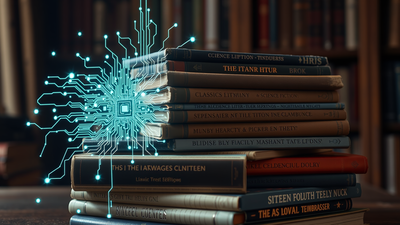
Books are like homes. They are cauldrons of experiences, carrying within them countless lives, emotions, and memories. They have survived wars, fires, floods, censorship, and the slow decay of time. They have travelled across generations, preserving the voices of authors long gone. They have transcended borders, enshrining cultures that might otherwise have vanished.More than anything else, books have been our camaraderie in our darkest hours. Every book lover will understand what it means. We know how many times we have cried when a favourite character died. We know how often, as grown adults, we have smiled at the description of a bird taking flight or paused over a passage so beautiful that it felt written just for us. Many of us have fallen in love through books or perhaps understood what love truly means because of them.Whenever life threatened to knock us down, books held us steady. They stood beside us through our triumphs and our failures, our joys and our grief. On countless lonely nights, when no one else seemed to understand, books absorbed our tears without asking a single question.Yet, in an era that prides itself on technological advancement, books are confronting an adversary unlike any before: artificial intelligence.This time, the threat is not ideological censorship or political persecution. It is the relentless appetite of machines.Across Europe and beyond, antiquarian booksellers have begun receiving unusual bulk purchase requests from companies seeking thousands of books in one go. The objective is startlingly simple: Buy physical books, scan every page at high speed, extract every word to train AI models, and then destroy the originals. Once digitised, the books are no longer seen as objects of history or culture. They become disposable raw material. The process may be legal in certain jurisdictions. But legality does not always settle the larger moral question.
When books become fuel instead of companions
The rise of generative AI has transformed books into something they were never meant to be, industrial feedstock.For centuries, readers approached books with curiosity, patience, and imagination. Every page turned was part of an intimate conversation between writer and reader. Reading demanded silence, reflection, and time. It rewarded empathy and critical thinking. Artificial intelligence reverses that relationship.Machines do not read books. They consume data. Every novel, historical account, scientific paper, or philosophical treatise becomes another sequence of tokens to strengthen prediction models. Meaning gives way to patterns. Stories become datasets. Literature becomes code. Books are no longer valued only for what they say to people but for what they can teach machines. Some viral claims suggest that some rare books with no surviving copies are also being crushed for training artificial intelligence.
Not even rare books are being spared?
A viral post by X user Hedgie (@HedgieMarkets) has fuelled fresh concerns over the use of books for training artificial intelligence models. The user alleged that some AI companies are buying books in bulk, including rare and historically significant titles, cutting off their spines for high-speed scanning and shredding the originals afterwards. The post further claimed that pre-2022 books are especially sought after because they are largely free of AI-generated text, and argued that destroying irreplaceable works under the guise of “digital preservation” could permanently erase literary and historical treasures that have survived for centuries.Responding to the post, billionaire entrepreneur Elon Musk said his SpaceX AI team had been instructed to preserve rare books rather than destroy them during digitisation. “I’ve asked the SpaceXAI team to preserve any rare books in a library and scan them the hard way vs just cutting off the spine and scanning,” Musk wrote on X, signalling support for digitising historic works without damaging the original copies.
The new race for human knowledge
Behind this unprecedented buying spree lies a growing challenge for AI developers. The internet, once considered an endless reservoir of human knowledge, is increasingly flooded with AI-generated content. As synthetic text multiplies across websites, developers are discovering that machines trained on machine-generated material eventually lose quality.The solution is obvious. Return to human-created knowledge. That means books. Millions of them. Publishers, second-hand dealers and book distributors have suddenly become part of a global search for authentic human writing. Every forgotten paperback, academic volume or out-of-print title represents fresh linguistic material capable of making AI systems more accurate and persuasive. Ironically, the very technology replacing human creativity is now dependent on it for survival.
A cultural loss hidden behind legal arguments
Supporters argue that purchasing physical books grants companies the right to scan them under existing legal interpretations. Critics counter that buying a book should never automatically translate into permission to build commercial AI systems capable of competing with the very authors whose works they ingest. The debate is often framed as one about copyright. It is, in reality, much larger.What disappears when a physical book is destroyed is not merely paper and ink. Marginal notes left by previous owners vanish forever. Binding styles unique to a period disappear. Rare print editions carrying historical significance are reduced to pulp after a few seconds beneath industrial scanners.A digital copy preserves information. It rarely preserves history. The distinction matters because books are cultural artifacts as much as they are vessels of text.
The death of physical library
Libraries and antiquarian bookshops have always represented something more profound than storage spaces.They embody memory. Walking through shelves filled with centuries-old books offers an experience that no digital archive can reproduce. The smell of aging paper, handwritten inscriptions, worn covers, and imperfect printing tell stories beyond the printed words themselves.When books are systematically destroyed after digitisation, humanity loses part of that physical memory. Future generations may inherit unlimited digital access while never experiencing the object that carried knowledge through centuries.
Reading was never meant to be efficient
Perhaps the greatest casualty of AI’s expansion is not books themselves but our relationship with reading. Reading has always resisted speed. A novel asks readers to linger over characters. A poem demands repeated interpretation. History invites comparison between past and present. Philosophy forces uncomfortable questions.Artificial intelligence rewards the opposite. Summaries replace chapters. Bullet points replace arguments. Instant answers replace intellectual struggle.Instead of discovering ideas gradually, readers increasingly expect algorithms to extract conclusions before they engage with the source material.The consequence is subtle but profound. Reading shifts from exploration to consumption. Knowledge becomes transactional rather than transformative. Technology should preserve culture, not consume itDigitisation is not the enemy. For decades, archivists, universities, and libraries have digitised manuscripts to safeguard fragile works from deterioration while preserving the originals. Digital preservation has saved innumerable historical documents from permanent loss.The current controversy is different. Here, destruction is built into the process because it is faster, cheaper and legally advantageous.Efficiency has become more valuable than preservation. That is a dangerous precedent. Civilisations have historically judged themselves by what they chose to preserve. From the Library of Alexandria to medieval monasteries safeguarding manuscripts, societies understood that protecting books meant protecting civilisation itself. Treating books as disposable training material reverses that principle.
The paradox of artificial intelligence
There is a striking irony at the heart of this debate. The more advanced artificial intelligence becomes, the more dependent it grows on the creativity, imagination, and intellectual labour of human beings.Machines cannot produce meaningful culture without first consuming enormous quantities of human culture. Yet in doing so, they risk eroding the very ecosystem that produced those works.If authors feel exploited, fewer may write. If rare books are destroyed, future scholarship loses irreplaceable sources.If readers rely only on AI-generated summaries, fewer people may experience literature in its complete form. The technology that promises to democratise knowledge may ultimately narrow humanity’s relationship with it.
The final chapter
The destruction of books for AI training is not merely a dispute over copyright or scanning practices. It reflects a deeper question about what society believes books are worth.Are they simply containers of information waiting to be converted into data? Or are they living cultural objects that deserve preservation long after their words have been digitised?Artificial intelligence will continue to evolve. That is inevitable. But if progress requires sacrificing the physical legacy of human thought, and reducing centuries of literature to disposable input for algorithms, the real cost may not be measured in lost books alone.It may be measured in something far harder to rebuild: humanity’s reverence for reading itself.