









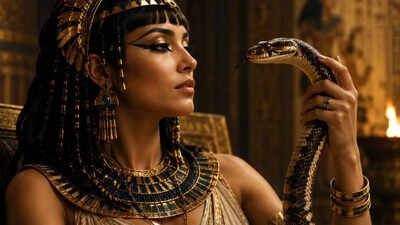
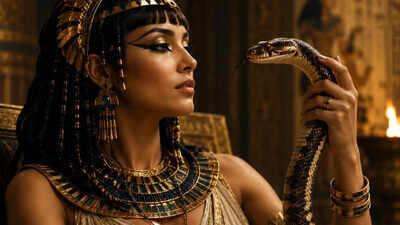
For centuries, the death of Cleopatra has been wrapped in mystery, drama, and legend. Most people know the famous version of the story. The last queen of Egypt reportedly allowed a deadly snake to bite her inside her royal chamber after the fall of her kingdom to Rome. It is one of history’s most repeated images, appearing in films, paintings, books, and television dramas for generations. Yet modern experts now believe the truth may have been very different. Scientists and Egyptologists from the University of Manchester have questioned whether a snake could realistically have killed Cleopatra and her two servants in the way ancient stories describe. Their research has reopened one of history’s oldest debates. The legendary Cleopatra snake bite story might not be as convincing as people once believed.
Cleopatra’s snake bite mystery still puzzles historians
Cleopatra VII was the final ruler of the Ptolemaic dynasty in Egypt. According to BBC reports, she died in 30 BC at the age of 39 after the defeat of her forces and those of her ally and lover, Roman general Mark Antony. Ancient Roman writers claimed that Cleopatra chose suicide rather than surrender to Octavian, the future Emperor Augustus.According to the traditional account, Cleopatra arranged for a venomous snake, often described as an asp or Egyptian cobra, to be smuggled into her mausoleum hidden inside a basket of figs. The snake supposedly bit Cleopatra and her two loyal servants, Charmion and Iras, killing them shortly before Roman guards arrived.The story survived for centuries because it felt dramatic and symbolic. In Ancient Egypt, the cobra represented royalty and divine power. Cleopatra herself was closely associated with the goddess Isis, who was also linked to the cobra symbol. Historians believe this symbolism helped the snake story become widely accepted over time. The image of Cleopatra calmly accepting death from a royal serpent became part of popular culture. Hollywood films, stage plays, paintings, and even comedy sketches repeated the scene again and again.
The centuries-old mystery of Cleopatra’s death
Modern experts say there are serious practical problems with the famous story. Researchers from the University of Manchester examined the biological and historical evidence surrounding Cleopatra’s death and concluded that the traditional version may be highly unlikely.One major issue is the size of the snake itself. Egyptian cobras are large animals. Experts say they usually grow between 5 and 6 feet long and can reach nearly 8 feet. A snake of that size would have been difficult to hide discreetly inside a basket of figs without attracting attention.Researchers also questioned whether a cobra could realistically kill three people in quick succession. According to herpetology experts, snake bites are unpredictable. Many venomous snakes deliver what are known as “dry bites,” where little or no venom is injected. Even when venom is delivered, death often takes time and can involve severe pain, paralysis, and slow physical decline.As reported by National Geographic, Andrew Gray, a snake expert from Manchester Museum, reportedly explained that snakes conserve venom for hunting and defence. Because of this, experts believe it would have been extremely unlikely for one cobra to deliver enough venom to kill Cleopatra and both of her servants one after another. These findings have caused many historians to reconsider the famous legend.
Could poison have killed Cleopatra instead of a cobra
Now, some historians think that she might have used a completely different technique. It is indicated by ancient documents that the death of Cleopatra might have occurred due to poison, not snakebite.According to experts, the consumption of an accurately administered poison was safer and more predictable than cobra venom. The Ancient Egyptians had detailed knowledge about medicine and botany.Some researchers believe Cleopatra may have taken a deadly mixture containing substances such as hemlock, opium, or wolfsbane. These poisons could reportedly have caused a faster and more controlled death than snake venom. German historian Christoph Schaefer proposed one such theory after studying ancient texts alongside toxicology research. According to his findings, a combination of plant-based toxins might explain how Cleopatra and her servants died within a relatively short time.The poison theory also avoids the practical difficulties involved in secretly transporting and handling a dangerous cobra inside a royal palace.
Roman politics may have shaped Cleopatra’s death story
Cleopatra’s death becomes even more mysterious if one takes into consideration Roman politics. A lot of facts about Cleopatra known today were written by authors belonging to ancient Rome and living many years after the queen died. Many Roman writers sympathized with Octavian, the person who defeated Cleopatra and then became the first Roman emperor.It is possible that the image of Cleopatra killing herself with the help of a snake was convenient for the victor. Cleopatra turned out to be his serious political opponent and a symbol of propaganda. Describing her death as an unusual tragedy probably helped create certain stereotypes among people.Moreover, it is believed by some historians that Cleopatra did not kill herself voluntarily at all. There is a theory stating that she could have been ordered to commit suicide by Octavian himself. Of course, this fact cannot be confirmed without evidence or eyewitnesses.