






![Jailer 2 Full Movie Collection: ‘Jailer 2’ box office collection Day 4 [LIVE]: Rajinikanth starrer sets sight on Rs 200 crore gross on first Sunday after surpassing Vijay’s ‘Jana Nayagan’ and Suriya’s ‘Karuppu’ | Tamil Movie News](https://bekhabarnewss.in/wp-content/uploads/2026/10/jailer-2-day-4-150x150.jpg "Jailer 2 Full Movie Collection: ‘Jailer 2’ box office collection Day 4 [LIVE]: Rajinikanth starrer sets sight on Rs 200 crore gross on first Sunday after surpassing Vijay’s ‘Jana Nayagan’ and Suriya’s ‘Karuppu’ | Tamil Movie News")


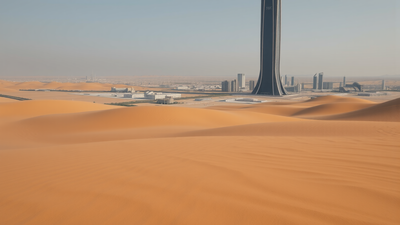
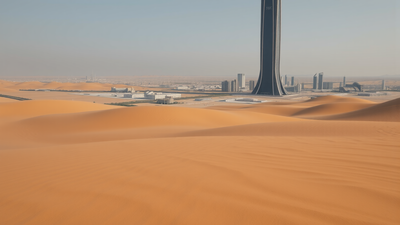
About 45 kilometres east of Cairo, in a stretch of desert that held nothing but flat, arid gravel and sand only a decade ago, Egypt has built an entire new city from the ground up. Officially called the New Administrative Capital, and more recently renamed The New Capital, the project spans roughly 700 square kilometres between the Cairo Suez road and the Regional Ring Road, an area comparable in size to Singapore. At its centre stands the Iconic Tower, a 385 metre skyscraper that became Africa’s first supertall building when it was completed, its glass and steel silhouette rising out of the desert as the most visible symbol of a government project meant to relocate Egypt’s administrative heart away from one of the most crowded capitals on the continent.
Why Egypt decided to build an entirely new capital
Cairo has long struggled under the weight of its own size, home to roughly a fifth of Egypt’s population and known for chronic traffic congestion, air pollution and overcrowding that officials have described as increasingly difficult to manage within the existing city. Plans for the New Administrative Capital were first announced by Egypt’s housing minister at the time, Mostafa Madbouly, at the Egypt Economic Development Conference in March 2015, positioned as part of the country’s broader Vision 2030 economic strategy. According to CNN’s reporting on the project, construction formally began in 2016 and has continued in phases since, with the Administrative Capital for Urban Development, a company in which Egypt’s military holds a 51 percent stake and the Ministry of Housing holds the remaining 49 percent, overseeing the entire development.
What the Iconic Tower actually involved building
The centrepiece of the new capital’s Central Business District is the Iconic Tower, designed and supervised by the architecture and engineering firm Dar Al Handasah Shair and Partners. According to Dar’s own project page, the firm was commissioned by the Administrative Capital for Urban Development not only to design the tower itself but also to assess and validate the strategic master plan for the entire 71,400 hectare capital project, alongside six additional office towers, five residential towers and two hotel towers within the wider Central Business District. Construction of the tower itself was carried out by China State Construction Engineering Corporation, one of the contractors involved in building out the district’s roughly twenty planned skyscrapers.
Why building a supertall tower on this scale was such a technical challenge
Raising a structure of this height required Dar and its contractor, China State Construction Engineering Corporation, to solve a genuinely difficult engineering problem, casting the tower’s entire foundation as a single, uninterrupted mass of concrete. According to Dar’s own account of the project, the tower’s steel skeleton rests on a semi-circular reinforced concrete raft laid directly onto a basalt rock layer, measuring 3,710 square metres in area and five metres thick, for a total volume of roughly 18,500 cubic metres. The reinforcement alone added around 4,600 tonnes of steel to the raft. To manage the intense heat generated as that much concrete cured, engineers built a 5x5x5 metre mock-up beforehand to measure the heat of hydration, used a cement mix incorporating silica fume specifically to control that heat, and ran a full 8,500 cubic metre trial raft on a separate tower first to test the entire casting plan before attempting the real one.
How the tower fits into the wider vision for the city
The Iconic Tower was never intended to stand alone as simply an architectural showpiece, it forms part of a much larger plan for the surrounding Central Business District and the city beyond it. According to Dar’s own account of the wider masterplan, the surrounding development includes a roughly ten kilometre long Central Park, described as twice the size of New York’s Central Park, running like a green spine through the new capital and intended to combat desertification while supporting the wellbeing of residents. Beyond the business district, the broader capital has been designed around what officials describe as smart city principles, incorporating digital services, renewable energy infrastructure and planned public transit intended to connect the new capital back to Cairo, including a light rail network and monorail linking directly into the existing Cairo Metro system.
Whether the new capital is actually easing pressure on Cairo
More than a decade after it was first announced, the New Administrative Capital has moved well beyond the drawing board, with government ministries, the Egyptian parliament and other state institutions having already relocated there in phases. According to CNN, tens of thousands of government employees now work in the new city, with officials involved in the project projecting the resident population to grow steadily as further housing phases are completed. Whether the project genuinely succeeds in relieving Cairo’s chronic congestion and overcrowding, rather than simply relocating Egypt’s centre of government to a newly built, more spread out location, remains a question that will likely take years of continued growth and habitation to properly answer.
Why the Iconic Tower may not remain Africa’s tallest building for long
Even as the Iconic Tower stands as the current benchmark for African skyscrapers, plans already exist for it to eventually be surpassed within the very same business district. A second, considerably more ambitious tower called the Oblisco Capitale has been approved by the Egyptian government, designed by the Egyptian architectural firm IDIA to resemble a traditional obelisk and targeting a proposed height of 1,000 metres, which would place it among the tallest structures ever built anywhere in the world if construction eventually proceeds as planned. For now, the Iconic Tower remains the clearest physical evidence of just how far Egypt has been willing to go to build its new capital, a supertall structure rising out of what was empty desert only a few years earlier, standing as a deliberate statement of ambition as much as a functioning piece of urban infrastructure.