









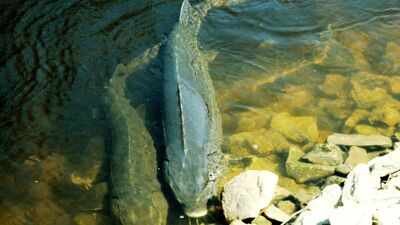
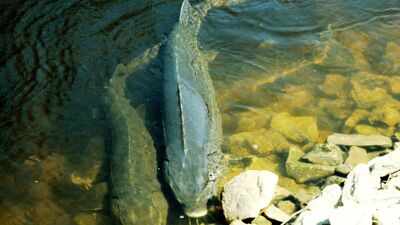
For centuries, lake sturgeon have moved quietly through the rivers and lakes of the Great Lakes region, growing slowly and aging in a way that has been difficult to measure. Their lives can stretch far beyond those of most freshwater fish, but just how far has remained uncertain. New research now suggests that some may survive for more than four centuries. Female lake sturgeon were estimated to reach as much as 427 years of age, while the oldest males in the study were estimated at 279 years. The results are a striking revision of earlier estimates, which generally placed the species’ upper lifespan at about 150 years. They also offer a different way of looking at a fish whose life can span several human generations.
Lake sturgeon: A fish that may have been swimming for centuries
Lake sturgeon are among the oldest-looking fish found in North American freshwater. Their lineage stretches back hundreds of millions of years, and their slow growth and long lives set them apart from many other species inhabiting the Great Lakes.The new estimates suggest that some individuals alive today could have been swimming through the region for centuries. A fish reaching 200 years old would have hatched before many of the major changes that shaped the modern United States. A fish approaching 400 would belong to a still earlier period.
Some female lake sturgeon may reach 427 years old
The research published in the Journal of Fish Biology, titled, ‘Lake sturgeon (Acipenser fulvescens) growth and longevity estimated from adult capture–mark–recapture data‘ involved five lake sturgeon populations in the Great Lakes region. Fish from Black Lake, the St Clair River and the Sturgeon River in Michigan were included, along with populations from the Menominee River, which runs along the Michigan-Wisconsin border, and Wisconsin’s Lake Winnebago.The longest-lived fish were found in the Sturgeon River and Black Lake populations. Sturgeon from the St Clair River had shorter estimated lifespans, while those from Lake Winnebago and the Menominee River fell somewhere between the two extremes.As reported by Wisconsin Public Radio (WPR), the figures were especially striking at the upper end. Researchers estimated that males could reach 279 years, while females could live to about 427 years.Those numbers do not mean every lake sturgeon reaches such an age. They represent the upper limits indicated by the study’s modelling.
Why scientists had underestimated their age
Ageing a sturgeon is not as straightforward as counting rings on a tree.For years, researchers relied on growth rings found in parts of the fish’s anatomy, including ear bones and fin rays. The method can work well when growth is relatively regular and the rings remain distinct. Sturgeon, however, become extremely slow-growing as they get older.Eventually, the rings can become difficult to distinguish from one another. That leaves researchers trying to interpret increasingly compressed evidence. Older estimates were therefore based partly on the best available readings of those growth structures, rather than a direct record of the entire life of an individual fish.
Four decades of fish records helped change the picture
Researchers had access to long-term records of lake sturgeon that had been caught, measured, tagged and later encountered again. In the Lake Winnebago population, some of that information extended across as many as 44 years.Those repeated measurements gave scientists a way to examine how quickly sturgeon grew over long periods. Rather than relying solely on physical growth rings, they could use observed growth patterns to work backwards and estimate the ages associated with very large fish.The calculations focused on males measuring around 160 centimetres and females around 180 centimetres. From those growth relationships, the researchers estimated how long it could take individuals to reach those sizes.
Females can take decades to reach maturity
Lake sturgeon do not hurry through life. Males generally reach breeding age at around 15 years, while females may not become sexually mature until roughly 24. By the time an individual has reached adulthood, it has already spent a considerable period growing.That slow pace continues as the fish gets older. The species’ biology means that an individual can remain in the population for many decades after reaching reproductive maturity.In Lake Winnebago, the average age of lake sturgeon is estimated at about 100 years, according to Wisconsin Department of Natural Resources biologist Margaret Stadig. The newly estimated extremes suggest that much older fish could also be present.Sturgeon measuring well beyond a century are therefore not necessarily anomalies in the way they might be for a shorter-lived species.
Why lake sturgeon’s slow growth made decades of overfishing so damaging
A very long lifespan can be an advantage in some circumstances, but it also creates a particular problem when a population is heavily exploited.Lake sturgeon grow slowly and take years to reach breeding age. Removing mature fish can therefore have consequences that are not quickly reversed. A population may need a long period to rebuild because replacement does not happen at the pace seen in faster-growing fish.Historical pressure on lake sturgeon was severe. More than 15 million are estimated to have once occupied the Great Lakes, but overharvesting and other pressures caused their numbers to collapse to less than 1 per cent of their former range.The species has since received conservation attention across the region, although its status varies between jurisdictions.
The fish is protected differently across the region
The US Fish and Wildlife Service decided in 2024 not to place lake sturgeon on the federal endangered species list, concluding that the species was not facing extinction across its full range.That decision does not mean the fish is free from conservation concerns. Michigan lists lake sturgeon as a threatened species, while Wisconsin classifies it as a species of special concern. Management therefore remains important, particularly because a fish that can take decades to mature cannot quickly replace large numbers of adults removed from the population.The new longevity estimates could help wildlife managers account for that unusually long life cycle when making decisions about harvest and population targets.
Lake Winnebago has an unusual relationship with sturgeon
Wisconsin’s Lake Winnebago system contains one of North America’s largest lake sturgeon populations. It is also the setting for a long-running winter sturgeon spearing season.More than 1,500 lake sturgeon were harvested during the most recent winter season. That makes accurate information about the fish’s growth and age particularly relevant. A population made up partly of very old individuals requires management that takes account of how slowly those fish are replaced.The new research does not suggest that every harvested sturgeon is centuries old. It does, however, show that the species is capable of reaching ages far beyond what previous estimates had indicated.
The old fish still swimming beneath the surface
Lake sturgeon have already survived major changes in the Great Lakes and a long history of human pressure. Their recovery in parts of the region has been supported by years of management and monitoring.The new research adds another detail to that story: some of these fish may live for centuries rather than merely decades.For wildlife managers, that means patience is built into the biology of the species. For anyone looking at a large sturgeon moving through a Great Lakes river, its age may be almost impossible to guess from its appearance. And, according to the latest estimates, a very old individual could have been swimming there long before the modern world around it took shape.