







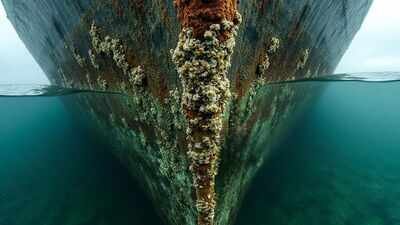
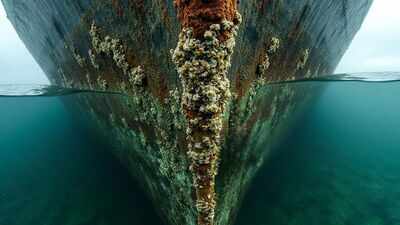
The submerged surfaces of nearly 30,000 commercial vessels arriving in Alaska over 11 years created more opportunities for marine organisms to hitchhike to new locations, according to a research.The study, published in Frontiers in Marine Science, examined 29,799 commercial vessel arrivals to Alaskan ports over the 11-year period, Frontiers Media SA reported. It looked at six major vessel types inlcuding bulkers, container ships, general cargo ships, passenger vessels, tankers and roll-on-roll-off (RoRo) vessels, to assess their potential role in transporting non-indigenous species through biofouling.Biofouling happens when marine organisms attach to or occupy submerged parts of a vessel. These can include fixed organisms such as tunicates, bivalves, sponges, bryozoans and algae, as well as mobile organisms. Some of these species can become marine invaders if they survive transport and establish themselves in a new environment.The researchers found that overall vessel arrivals to Alaska increased 23% during the study period. However, the wetted surface area increased faster, rising from 39.9 sq km in 2012 to 59.7 sq km in 2022 which was a 50% increase. The rise was mainly driven by growing traffic from large passenger vessels.
Passenger vessels introducing more marine NIS
Passenger vessels made up the largest share of arrivals during the study period, with 15,984 arrivals in total. They were followed by tankers, with 6,481 arrivals, and container ships, with 3,808 arrivals.The size of the vessels was important because larger vessels provide more submerged surface where biofouling organisms can grow. Passenger vessels had the highest mean WSA per arrival at 17,658 sq m. Tankers followed with 13,503 sq m, while bulkers had an average of 10,066 sq m.Passenger vessels also accounted for more than half of the total WSA arriving in Alaska. They contributed an annual average of 25.7 sq km, compared with 8 sq km from tankers and 2.9 sq km from container ships.The researchers found that passenger vessels had the highest relative likelihood of introducing marine non-indigenous species or NIS through biofouling among the vessel types included in the study. Their importance was linked not only to their size, but also to their high number and frequency of arrivals and their connections with environmentally similar locations.
Risk varied across Alaska
The amount and type of vessel traffic differed considerably between Alaska’s coastal regions. The North American Pacific Fjordland region recorded the highest number of arrivals, with 14,951 during the study period. The Gulf of Alaska followed with 11,292 arrivals, while the Aleutian Islands recorded 2,299.Passenger vessels dominated traffic in the North American Pacific Fjordland region, while tankers were the most common vessels in the Gulf of Alaska. Container ships dominated arrivals to the Aleutian Islands, particularly at Dutch Harbor.The North American Pacific Fjordland and Gulf of Alaska regions were identified as having the highest relative risk of marine NIS introduction from hull biofouling. These areas receive large amounts of vessel traffic and have connections with regions where environmental conditions can be relatively similar.More than half of all arrivals came from locations within Alaska. A total of 16,269 arrivals represented 237.6 sq km of WSA. Nearly a third of all arrivals, or 9,368 vessels, came from the North American Pacific coastline, representing 139.6 sq km of WSA.The researchers also examined how similar the environmental conditions were between a vessel’s last port of call and its arrival location. Smaller environmental distance indicates greater similarity and potentially better conditions for a transported species to survive.
Time in port and dry docking also matter
WSA was only one of the factors examined. The researchers also considered environmental distance, the amount of time vessels remained in port and the number of years since their last dry dock.Longer residency time can provide biofouling organisms with more opportunity to reproduce or move into an arrival port. Passenger, RoRo and container vessels had the shortest average residency times, ranging from 0.5 to 1.1 days. General cargo vessels and tankers averaged 3.2 and 3.4 days, respectively, while bulkers had the longest average stay at 5.6 days.The researchers also used years since the last dry dock as an indicator of potential biofouling accumulation. More time since dry docking can be linked to greater accumulation, although the study did not treat this measure as a direct measure of biofouling because dry docking does not always include hull treatment.The risk assessment does not mean that every organism transported on a vessel will become established. The researchers noted that successful establishment depends on both the number of organisms introduced and whether they can survive and reproduce in the new environment.
Climate change adds another concern
The study says Alaska faces a changing risk because environmental conditions and shipping patterns are also changing. Warming waters may make parts of the state more suitable for marine NIS that were previously limited by colder conditions.At the same time, reduced sea ice is making Arctic shipping routes more accessible. The researchers noted that vessels travelling through the Arctic must cross the Bering Sea when travelling to or from the Arctic Ocean, potentially increasing traffic through Alaska’s subarctic regions.The researchers said the findings can help identify vessels and ports that should receive greater attention for monitoring. They suggested prioritising vessels with larger WSA, longer stays in port, greater environmental similarity with their previous locations or longer periods since dry docking.For Alaska, where ports can be remote and resources for monitoring are limited, the researchers said establishing a baseline of biofouling risk could help direct monitoring and mitigation efforts towards the vessels and locations with the greatest potential for marine NIS introduction.