








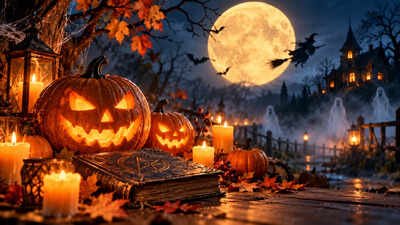
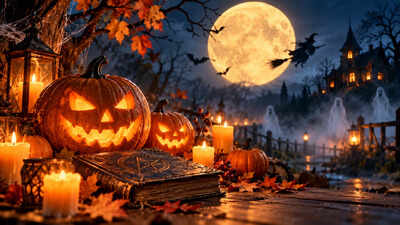
Walk past a decorated house on October 31, and you’ll see the same three things almost every time. A carved pumpkin on the steps, grinning. Candles flickering in the windows. And somewhere, a ghost made from a white sheet, swaying on a string. They feel like they’ve always belonged together. In fact, each one comes from a different corner of history, and each carries an older meaning that has very little to do with sweets and costumes.
The Pumpkin and the Man Who Tricked the Devil
The carved pumpkin owes its name to an Irish folk tale. It tells of a man called Stingy Jack, a drunkard and a cheat. One version says he tricked the devil twice: first by getting him to climb a tree, then by carving a cross into the trunk so he couldn’t climb down. In exchange for freedom, the devil promised never to claim Jack’s soul.When Jack died, heaven refused him for his sins. The devil, true to his word, refused him too. He sent Jack off into the dark with a single burning coal. Jack placed it inside a hollowed-out turnip and has wandered the earth ever since. People called him Jack of the Lantern, which became jack-o’-lantern.In Ireland and Scotland, families carved faces into turnips and potatoes and set them in windows to scare off Jack and other restless spirits. When Irish immigrants reached North America in the nineteenth century, they found pumpkins, a native American crop that was larger and much easier to carve. The pumpkin quickly took over.Today, the pumpkin also works as a harvest symbol. It’s round, orange and abundant, a reminder of the season’s plenty just before winter.
Candles in the Window
Light has always answered long autumn nights. At Samhain, the Celtic festival behind Halloween, communities lit bonfires on hilltops. Families sometimes carried embers home to relight their hearths, symbolising renewal for the dark half of the year.Christian practice added its own candles. Around All Saints’ Day and All Souls’ Day on November 1 and 2, Catholic families in many parts of Europe lit candles on graves and in churches. In Poland, cemeteries still glow with thousands of small lamps on these nights.Another custom was to place a candle in the window. The light was meant to guide loved ones’ souls home or show wandering spirits that the house was protected.Spiritually, a candle has a simple meaning across most traditions. It’s light held against darkness. It stands for memory, prayer and hope. That’s why it fits so naturally into a festival about the dead.India offers a close parallel. Diwali, which falls on November 8 this year, fills homes with diyas to drive away darkness and welcome prosperity. The festivals come from different worlds, yet both put a small flame at their heart.
The Ghost in a White Sheet
Ghosts are the oldest part of Halloween’s story, going back to the belief that the dead could return at Samhain. But the familiar white-sheet ghost is more recent.For centuries in Europe, people buried the dead wrapped in a simple white cloth called a shroud. When people imagined a returning spirit, they pictured it still wearing that shroud. Artists and later illustrators turned that image into the floating white figure seen today. Cheap white sheets made it the easiest costume to make.The nineteenth century gave ghosts a boost. Spiritualism, a movement claiming contact with the dead, became popular in Britain and America. Ghost stories turned into a favourite form of entertainment, often told around the fire on long winter evenings.In spiritual terms, ghosts usually represent unfinished business. Many traditions describe a lingering spirit as one with something left undone, a wrong not righted or a farewell never said. That idea links Halloween quietly to remembrance. Behind the costumes sits an old wish to make peace with those who have passed.
Symbols That Still Speak
Taken together, the three symbols tell a small story. The pumpkin keeps danger away. The candle guides and protects. The ghost reminds the living that the dead are not entirely gone.This year, with Halloween falling during Scorpio season and a retrograde Mercury in that sign, astrologers note that themes of memory and the past may feel especially present.