








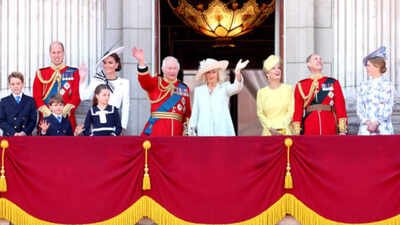
The British monarchy traces its roots back to more than 1,150 years, when Alfred the Great became King in 866. Today, it is the 5th richest royal family in the world with King Charles III being the 11th richest royal across the globe. From palaces to estates, the British royal family encompasses massive wealth. But if they don’t participate in governance and definitely don’t work at a 9-5, then how is the cash still flowing?King Charles II has become the first British monarch to reveal how much tax he pays and now, people have a more detailed insight into the royal finances than ever before. The king receives money in a number of ways to fund his official work as the head of the state, his personal expenditure and to cover the royal duties of his family.
Sovereign Grant
Every year the king receives the ‘Sovereign Grant’ paid by the government to cover the official duties of the royal family, upkeep of the royal palaces, other residences and historic buildings and their travel expenses. This is not the personal income of the royal family. The grant is calculated as a percentage of profits from the Crown Estate, which comprises vast tracts of land and most of Britain’s seabed. Legally, the estate belongs to the Crown but since 1760 the monarch has sacrificed its revenue in return for an annual payment and it is now an independently run, commercial business.The Sovereign Grant is currently set at 12% of its profits, which have soared in recent years due to offshore wind farm licences. In 2025/26 it was £132.1 million ($174.5 million) and will be £137.9 million in the current financial year. From 2027 to 2032, it will be cut to £100 million annually, partly as money will no longer be required for the £369 million refurbishment of Buckingham Palace and because Crown Estate profits are expected to fall as revenues from offshore wind leases drop, as per a report by Global Banking & Finance Review.
The Duchies
Since 1399, the reigning monarch has received income from the Duchy of Lancaster, an estate of 41,910 acres (16,960 hectares) including commercial properties in the centre of London and other cities. Its net assets in March 2026 were valued at £687.3 million. While the sitting monarch cannot use any proceeds from the sales of its land, they do receive the net revenue surplus. In 2025/26, this was £25.2 million. The money received is used to run his private homes and for the incomes of the working royals who are not allowed outside earnings. Currently, that list includes his sister Princess Anne, his younger brother Prince Edward and his wife, the Duke and Duchess of Gloucester, the Duke of Kent and Princess Alexandra.Another active duchy is the Duchy of Cornwall. Created in 1337, it provides income for the heir to the throne, currently Prince William and his wife Kate. The estate comprises 128,151 acres (51,861 hectares), spread across England and Wales, with net assets of £1.2 billion at the end of March 2026. William receives the net surplus revenue, which in 2025/26 was £21.55 million, stated the report.
Private sources of income
The king also has personal undisclosed assets and investments. He also receives income from his own large estates, Balmoral Castle in Scotland and Sandringham in eastern England. The income he receives from these is considerable but has not been made public.By law, the British monarch is not obligated to pay income, capital gains or inheritance tax. However, in June it was revealed that King Charles III had paid £12.9 million in 2024/25, £11.7 million in 2023/24, and more than £30 million in total since becoming king. This placed him in the top 100 taxpayers in the UK, they said. Likewise, William’s office revealed the prince had paid £7.76 million in 2024/25, and £8.34 million in 2023/24. He had paid more than £20 million in tax since becoming the heir and Prince of Wales.