








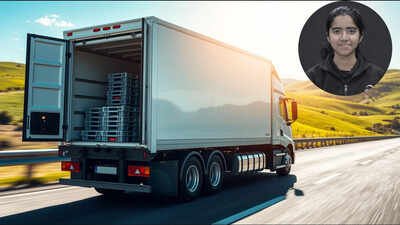
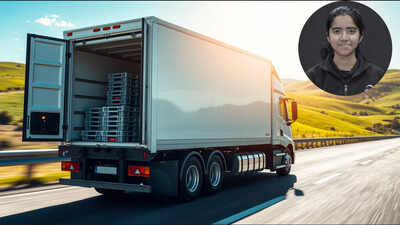
India produces enormous quantities of fruits, vegetables and dairy products every year. Yet a significant share never reaches consumers because maintaining the right temperature from farm to market remains a major challenge.That is the problem Shaivee Malik, an IIT Delhi biotechnology graduate, decided to tackle—not by building another refrigerated truck, but by changing the way its refrigeration system gets its power.At 25, Malik is the co-founder of Yotuh Energy, a Chennai-based climate-tech startup developing battery-powered refrigeration systems that operate independently of a truck’s engine.The idea emerged from an unusual combination of biotechnology, motorsport and climate concerns.
From IIT Delhi’s racing team to cold-chain technology
While studying at the Indian Institute of Technology (IIT) Delhi, Malik joined Axlr8r, the institute’s Formula Student racing team. She eventually became associate team captain.It was there that she worked closely with Vivek Mahindrakar and Dharmik Bapodara, who would later become her co-founders.The three engineers wanted to work on climate-related problems. They eventually focused on India’s cold chain—a sector that quietly consumes large amounts of energy while playing a critical role in transporting food and other temperature-sensitive products.In 2022, they founded Yotuh Energy and subsequently moved to Chennai after entering an incubation programme at IIT Madras.
Why conventional refrigerated trucks waste fuel
A conventional refrigerated truck generally uses a refrigeration system powered by the vehicle’s engine.That creates an obvious problem when the truck is stationary.The engine may need to keep running simply to maintain the temperature inside the refrigerated compartment, consuming diesel even when the vehicle is stuck in traffic or waiting to load or unload.Yotuh’s approach is to separate the refrigeration system from the vehicle’s engine.Its refrigeration unit uses a lithium-ion battery, allowing cooling to continue independently of whether the truck engine is running.
| Conventional refrigeration | Yotuh Energy’s approach |
| Cooling linked to truck engine | Independent battery-powered system |
| Engine may need to idle | Refrigeration can operate while stationary |
| Engine breakdown can affect cooling | Separate refrigeration power source |
| Retrofitting can be difficult | Designed for diesel and electric vehicles |
| Fixed cooling behaviour | Sensors monitor door openings |
The system can reportedly operate for six to eight hours on a charge, while Yotuh says its technology can reduce refrigeration running costs by around 75%.The company also says each unit can avoid approximately 3 to 36 tonnes of carbon dioxide emissions annually, depending on usage.
Starting with family support, grants and prototypes
Yotuh’s journey did not begin with a large venture-capital cheque.Malik has said the founders initially received financial support from their families before obtaining government assistance and grants that helped them develop early prototypes.The startup later raised about Rs 1.53 crore, alongside support from government departments and programmes focused on agriculture, science and technology.The technology has since moved beyond prototypes into commercial use.Yotuh says its customers include distributors associated with Amul ice cream and McCain frozen foods, giving the startup an opportunity to test its technology in real-world cold-chain operations.
‘We are a cooling solutions company’
For Malik, refrigerated trucks are only the starting point.The underlying problem is broader: keeping temperature-sensitive products cold consumes energy, costs money and can contribute to emissions.“We are a cooling solutions company,” Malik has said, describing trucks as the first application because conventional refrigeration systems remain heavily dependent on diesel engines.That makes Yotuh’s story particularly relevant to India’s engineering students.Malik did not begin with a plan to build a refrigeration company. Her path went from biotechnology at IIT Delhi to Formula Student racing, then climate technology and cold-chain engineering.The larger lesson is perhaps even simpler: some of India’s biggest climate problems are hidden inside ordinary systems.Sometimes, solving them does not require inventing an entirely new machine.It requires asking a simple question: Why does the machine work this way in the first place?Disclaimer: This article is based on publicly available information and statements attributed to the company or its representatives. Performance, emissions and cost-saving figures cited above have not been independently verified by TOI Education.