






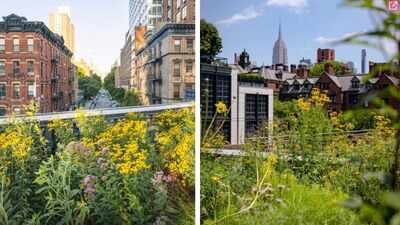
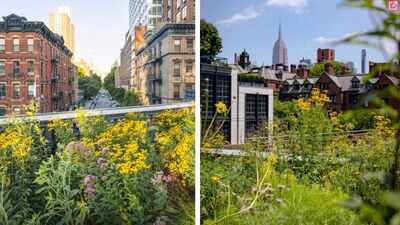
New York City’s High Line began in 1933 as the West Side Elevated Line, carrying meat, dairy, and produce above Manhattan’s streets. Nearly two decades after its first section opened as a public park in 2009, the final garden at West 34th Street is set to open in November, completing a greenway that now welcomes about six million visitors each year. According to People and Time Out New York, the new 34th Street Garden will include 2,561 square feet of planting beds and roughly 2,000 perennials, along with new paving and signage designed to create a proper entrance at the park’s northern end. Read more details about it, as per the reports, below:
From freight line to elevated park
The High Line began as the West Side Elevated Line, with its first train traffic running in 1933. The railway carried meat, dairy, and produce above Manhattan’s streets, serving the industrial businesses and warehouses along the west side. Its elevated design allowed freight to move without competing with street traffic, making it an important part of the city’s supply chain.By the 1960s, trucks had become the preferred way to move goods through New York, reducing the need for rail freight in the area. The southernmost section of the line was eventually demolished, and by the 1980s calls to remove the remaining structure were growing. For years, the abandoned railway sat above the city, largely unused and increasingly threatened with demolition.The turning point came in the early 2000s, when CSX Transportation donated ownership of the structure to the City of New York. Construction on the High Line park began in 2006, and the first public section opened in 2009 between Gansevoort Street and 20th Street. Over the following 17 years, additional sections opened as the park expanded northward along the former tracks.
The final garden at 34th street
The last piece of the High Line sits at West 34th Street and Twelfth Avenue, at the entrance to the Rail Yard Reserve. The area has been closed for construction for about a year, and visitors following smartphone directions often arrived expecting the start of the park only to encounter a construction barrier. The new garden is designed to change that experience with a proper, greener welcome.Richard Hayden, the High Line’s senior director of horticulture, said that when the 34th Street Garden opens, the entire High Line will be open and there will not be a construction shed anywhere on it. He told the New York Times that the design team wanted to provide an entrance experience worthy of the park’s fame and the expectations of its visitors.The garden will be filled with about 2,000 perennials, including sedges, grasses, and Heuchera villosa “Autumn Bride,” a coral bells variety with pale green leaves and white flowers. The planting beds will soften the surrounding urban landscape, which includes a large parking lot on one side and a roadway on the other. New signage and paving will help guide people into the park’s northernmost section.
A garden unlike the rest of the high line
One detail makes the 34th Street Garden especially important. It will contain the High Line’s only plantings rooted directly in the ground. Most of the park’s gardens sit on the elevated structure, where plants grow in soil only about 18 inches deep. At 34th Street, the plants will be able to extend their roots into the earth below, allowing for a more established and expansive garden.Dutch landscape designer Piet Oudolf, who created the High Line’s naturalistic planting style, returned to design the final space. He said the new entrance should invite people in, something he described as essential for that particular place. His work has helped make the High Line a habitat for bees, bats, butterflies, and birds, adding ecological value to a park built on industrial infrastructure, as per TimeOut.The final garden is not the only refreshed green space on the High Line. At West 17th Street, the Prairie Terrace was replanted after spending nine years beneath scaffolding during construction of the neighboring Faena New York hotel. Its walkway reopened last fall, and planting was completed in August, with new vine screens, shrubs, trees, and grasses adapted to changed sunlight and sightlines.
Completing a nearly 20 year vision
The opening of the 34th Street Garden will mark the first time the entire High Line is publicly accessible without construction barriers. That may sound like a small detail, but for a park that has expanded gradually over nearly two decades, it represents the completion of an ambitious idea: turning abandoned elevated railway tracks into a continuous public greenway above Manhattan.The High Line’s success has made it one of New York’s most popular attractions and a global model for adaptive reuse. It shows how obsolete infrastructure can be reimagined rather than demolished, creating space for walking, planting, wildlife, and public life in a dense city. The park’s transformation from a working freight line to an elevated garden has changed how people experience the west side of Manhattan.When the final 2,000 perennials are in place this November, the High Line will complete a journey that began with trains carrying food through the city in 1933. The last garden will not simply add greenery to the northern entrance. It will close the final gap in a park that now welcomes millions of people each year and stands as one of New York’s most distinctive outdoor spaces.