








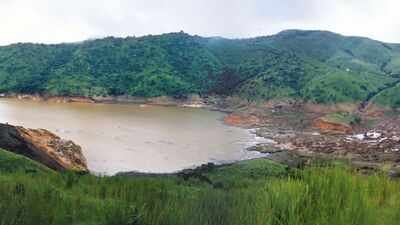
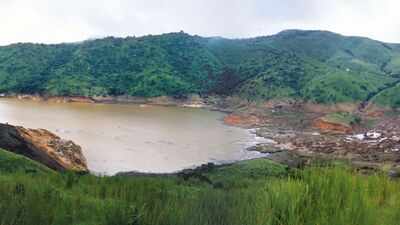
Lake Nyos looks deceptively ordinary in photographs. It sits in a volcanic landscape in north-western Cameroon, surrounded by steep green slopes and farmland. Yet beneath its surface, an unusual geological process once allowed enormous quantities of carbon dioxide to accumulate in deep water.On 21 August 1986, that gas escaped suddenly. A dense cloud of carbon dioxide moved away from the lake and into nearby communities, where it displaced breathable air close to the ground. By the time the event was over, 1,746 people had died, along with more than 3,000 livestock. It became one of the most closely studied examples of a limnic eruption, a rare phenomenon in which dissolved gas erupts from lake water.Three decades later, Lake Nyos had become the centre of something very different: a long-running international effort to understand volcanic lakes and reduce the possibility of another deadly gas release.
Lake Nyos showed why carbon dioxide remained a threat after 1986
The precise nature of the 1986 disaster was not immediately settled. Scientists considered different explanations for the sudden release, including the possibility of a volcanic event. The idea that the lake itself had released a huge store of dissolved carbon dioxide gradually gained ground as observations continued.The chemistry of the lake provided an important clue. Carbon dioxide continued to build up in the deep water after the disaster, effectively showing that the supply had not disappeared with the 1986 event. The gas was being replenished naturally beneath the lake.That made Lake Nyos more than the site of a single catastrophe. It became a natural laboratory for studying how gases behave in deep volcanic lakes, and how apparently quiet bodies of water can develop dangerous conditions below the surface. The disaster also changed the scientific attention given to volcanic lakes elsewhere.
The tragedy helped bring volcanic lake scientists together
In March 1987, less than a year after the disaster, scientists and specialists gathered in Yaoundé for an international conference on the Lake Nyos gas disaster. The meeting helped establish the International Working Group on Crater Lakes.The group later became part of the International Association of Volcanology and Chemistry of the Earth’s Interior, or IAVCEI. In 1993, it was formally incorporated as the Commission on Volcanic Lakes.The organisation created a place for specialists from different countries to exchange observations about volcanic lakes, their chemistry and the hazards they can present. Lake Nyos remained an important part of that work.By the time scientists returned to Cameroon for a three-yearly commission workshop in March 2016, the field had developed considerably since the first investigations following the disaster.
The gas beneath Lake Nyos did not simply disappear
The basic problem was hidden beneath the lake’s surface. Deep water at Lake Nyos can hold carbon dioxide that enters from geological sources below. Under pressure, the gas can remain dissolved in the water. But if conditions change and the gas comes out of solution rapidly, the result can be a sudden eruption of carbon dioxide from the lake.That process is different from a conventional volcanic eruption. There does not need to be lava, ash or a spectacular column of volcanic material. The danger comes from the gas itself.Carbon dioxide is heavier than air. In sufficient concentrations, it can collect close to the ground and reduce the amount of oxygen available to people and animals. That helps explain the extraordinary scale of the deaths in 1986, even though the event left little of the kind of physical destruction normally associated with a volcanic disaster.
Engineers found a way to safely release the lake’s deadly gas
A system for artificially removing carbon dioxide from the lake was eventually developed. Large pipes were placed into the deep water, allowing gas-rich water to rise towards the surface.As the water moved upwards, the pressure acting on it fell. Carbon dioxide could then escape from the water in controlled quantities rather than remaining trapped at depth until conditions might trigger another sudden release. The process is known as artificial degassing.By 2016, the system had been operating for years. Scientists monitoring the lake regarded the intervention as having substantially reduced the immediate risk associated with the build-up of dissolved carbon dioxide.The work can also be seen in the changing appearance of the lake. Iron-rich material brought upwards during the degassing process can oxidise at the surface, producing reddish areas in the water. It is an unusual visual reminder that the lake is still being actively managed.
The disaster became a scientific lesson far beyond Cameroon
At the 2016 workshop in Yaoundé, specialists who had played major roles in understanding Lake Nyos presented their work. Among them were Japanese limnologist Minoru Kusakabe, American scientist George Kling and French researcher J.-C. Sabroux, representing work associated with Michel Halbwachs’s team.The early disagreement over what had caused the 1986 release had largely disappeared by then. Years of measurements, observations and research had provided a much clearer picture of the processes involved.
Research continued well beyond Lake Nyos
The 2016 meeting was not confined to conference rooms. On 19 March, scientists carried out a multidisciplinary sampling and measurement campaign at Lake Nyos, continuing the long record of observations from the site.A few days later, on 22 March, the group travelled to Lake Barombi Mbo for a detailed survey. The lake is the largest maar lake in Cameroon, formed by a volcanic process quite different from the better-known volcanic landscapes associated with lava flows and large cones.Such fieldwork matters because volcanic lakes do not all behave in the same way. Their depths, chemistry, geological settings and sources of dissolved gases can vary considerably. Observations from one lake can inform understanding elsewhere, but they cannot simply be applied without examining local conditions.
The legacy of Lake Nyos is still tied to careful monitoring
By 2016, the Lake Nyos disaster was three decades old. The lake itself had changed little in appearance, but the understanding surrounding it had changed substantially.The artificial degassing programme had been running for about 15 years, and the lake was considered relatively safe following those risk-reduction measures. That assessment did not make the lake irrelevant to scientists. Quite the opposite. Continued observation remained necessary because the geological source feeding carbon dioxide into the deep water had not simply vanished.The 2016 workshop illustrated how much scientific work had grown from the events of August 1986. What began as an urgent attempt to explain a mass-casualty event had developed into an international research community studying volcanic lakes, gas chemistry, monitoring methods and hazard reduction.