






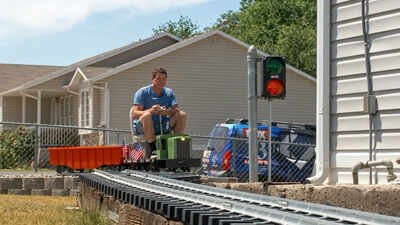
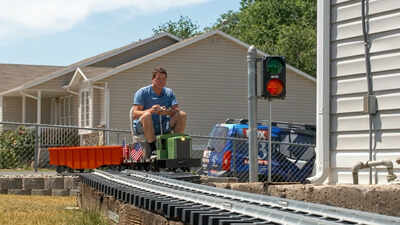
In 2015, Cory Mohl of West Valley City, Utah, turned a lifelong fascination with trains into a full-scale backyard project. Over the next several months he laid about 400 feet of track, hauled roughly 40,000 pounds of gravel for the roadbed, and invested hundreds of hours of labour into what he jokingly calls the Cory Mohl Railroad. By mid-2016 the line was complete, neighbourhood children were asking for rides, and Mohl told ABC News he expected the final cost to land near $17,500 to $18,000. Read on to know more about Mohl and his unusual idea here:
A childhood love that never faded
Mohl, then 43, described himself as a lifelong train enthusiast who had spent years building and storing model railroads.He told ABC News that he had always wanted to return to the hobby in a bigger way once his daughter was older and more independent. When the idea of a backyard railroad took hold in December 2015, he said he simply got a wild bug and decided to do it, turning a personal passion into a tangible, rideable creation.The project gave him a chance to revisit the joy he felt as a child around trains, but on a scale that friends and neighbours could experience directly. Instead of watching a miniature locomotive circle a tabletop layout, people could sit in a small car and travel along a real track that wound through his yard and even into a shed.For Mohl, the backyard railroad was both a personal milestone and a way to share his enthusiasm with the community around him.
Building a real railroad on a residential lot
The Cory Mohl Railroad stretches about 400 feet around the yard, not counting the sections that run through the shed. Laying that much track required careful planning to fit the line into a typical residential lot while still offering a satisfying ride. Mohl moved roughly 40,000 pounds of gravel to create a stable roadbed, then set the rails, ties, and switches by hand over many weekends and evenings, as per the report.He sourced the locomotive from another local enthusiast who lived about half a mile away and already had a railroad that ran around his house and across his driveway. That connection made it easier for Mohl to acquire equipment that was designed for backyard use and compatible with the scale of track he was installing. The purchase helped him avoid the cost and complexity of building a custom engine from scratch.
Hundreds of hours and a growing price tag
Mohl estimated that he spent hundreds of hours on the project between planning, earthmoving, track laying, and finishing work. Each stage demanded attention to detail, from grading the ground so the train would run smoothly to ensuring the track was level and properly aligned. The labour was largely unpaid, but the time investment was a major part of what made the railroad feel like a true passion project rather than a simple weekend upgrade.As materials and equipment added up, Mohl tracked his spending and told ABC News he expected the final cost to settle around $17,500, with some reports rounding that figure to nearly $18,000. That amount covered track, gravel, the locomotive, rolling stock, and various supplies needed to make the line safe and functional. For a backyard hobby, the price was substantial, but Mohl viewed it as the cost of building something unique and enduring.
Neighbours line up for rides
Once the railroad was operational, it quickly became a local attraction. Mohl said a few people started coming by to ask about the setup, and children in the neighbourhood began requesting rides. The sight of a small train circling a residential yard was unusual enough to draw attention, but the chance to actually ride it turned the project into a shared experience for families on the block.Those rides transformed the railroad from a private hobby into a community feature. Parents could watch their children climb into a car and travel along the track, while Mohl operated the train and explained how the system worked. In that sense, the backyard railroad became a social space as much as a technical achievement, creating moments of connection between neighbours who might not otherwise interact.
Plans to expand and decorate
Even with the main line complete, Mohl had ideas for making the railroad more elaborate. He said he intends to expand the track even more and add decorations for the upcoming holidays. These additions might include seasonal themes or lights or small structures along the route, all of which are intended to enhance the experience of riders and viewers alike. These expansions would be a continuation of what he had already created, making the railroad an evolving project rather than a one-time build. Each new section or decoration would be a reflection of his ongoing passion for trains and his desire to keep putting time and money into the hobby. The railroad, for Mohl, was never meant to be static, but rather a living manifestation of his childhood dream.
Why backyard railroads capture people’s imagination
Backyard railroads exist in a unique space between model train layouts and full-size heritage lines. They’re big enough to ride on and operate like real trains, but small enough to fit on private property and be maintained by one enthusiast or family. This middle road allows builders to combine engineering, landscaping and storytelling in a way that appeals to both adults and children. Mohl’s project demonstrates how a personal passion can bleed into the public realm, even within the confines of a residential yard. The Cory Mohl Railroad became a source of pride for the neighborhood, and a physical reminder that large-scale creativity is still possible in suburban settings. For Mohl, the satisfaction came not just from completing the track, but from seeing neighbors enjoy the rides and share in the experience.