







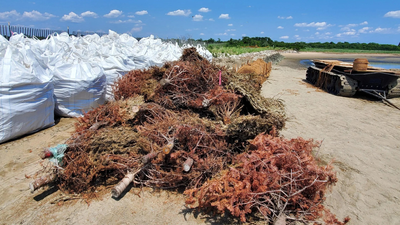
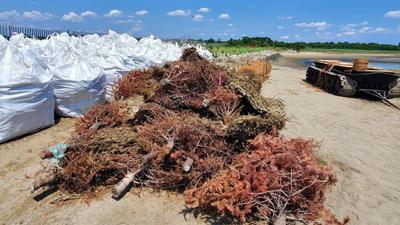
What looked like holiday waste ended up helping rebuild a fragile salt marsh at Jamaica Bay, where the trees were turned into nearly 600 feet of natural breakwaters. In 2024, 250 discarded Christmas trees were repurposed into nearly 600 linear feet of natural breakwaters at New York’s Jamaica Bay Wildlife Refuge, helping protect newly planted salt-marsh vegetation from waves and erosion, according to the Jamaica Bay-Rockaway Parks Conservancy (JBRPC) and its 2024 Wetlands Fellowship report. By autumn, the organisation said the barriers had begun trapping enough sediment to become partially buried in the growing marsh. It was an unusual afterlife for trees that, just weeks earlier, had stood decorated in New York homes.
From Christmas trees to coastal protection
The trees were used at the West Pond Living Shoreline, an ecological restoration project at the Jamaica Bay Wildlife Refuge. The shoreline had been badly damaged when Superstorm Sandy breached the freshwater pond in 2012, allowing saltwater to enter an ecosystem that had previously supported freshwater habitat.The restoration project, completed in 2021, rebuilt about 2,400 feet of shoreline, created more than nine acres of new habitat and introduced hundreds of thousands of native grasses and shrubs. But restoring the shoreline did not mean the work was finished. Young plants remained vulnerable to waves, erosion and shifting sediment.That is where the Christmas trees came in.Workers bundled the discarded trees into structures known as fascines, tightly bound bundles of woody material placed along vulnerable stretches of shoreline. Rather than forming a rigid seawall, the tree barriers slow waves, reduce erosion and allow sediment carried by the water to accumulate. Over time, the idea is for the marsh itself to become stronger.
The trees began disappearing into the marsh
The results seen in 2024 offered an encouraging sign. After the fascines were installed, new marsh vegetation flourished through spring and summer. By autumn, JBRPC’s stewardship team reported that substantial amounts of sediment had collected behind the tree barriers, with some of the structures partially buried by the expanding marsh.That matters because sediment accumulation helps raise and stabilise the shoreline, giving salt-marsh plants a better chance of establishing themselves. The approach is also deliberately temporary. Unlike concrete seawalls, tree fascines are biodegradable and are intended to become part of the evolving landscape rather than remain as permanent infrastructure.The technique is not entirely new to the West Pond project. Landscape designers had previously incorporated recycled Christmas-tree fascines alongside other nature-based structures, including oyster-shell breakwaters and coir logs, as part of the shoreline’s layered erosion-control system.
A different kind of recycling
The project illustrates a broader idea in ecological restoration: sometimes the best defence against environmental damage is not a harder barrier, but a living system that can adapt.The Christmas trees are one small component of that system. As they slow the water, sediment settles around them. As the sediment builds, marsh plants gain firmer ground. Their roots then help hold that sediment in place, gradually strengthening the shoreline. In that sense, the trees are not simply being reused. They are helping create the conditions under which the marsh can eventually protect itself.And for 250 Christmas trees that might otherwise have ended up as seasonal waste, their final chapter was far removed from the streets where New Yorkers first discarded them. They became part of a shoreline, and, for a while at least, part of New York’s defence against a changing coast.