









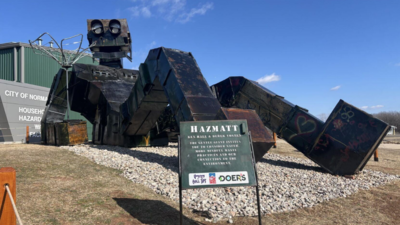
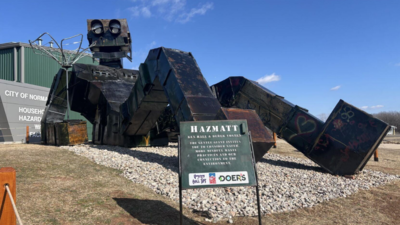
What happens when discarded dumpsters are given a second life? In Norman, Oklahoma, they have been turned into a 20-foot-tall robot that reclines on a hillside, holding a wildflower in one hand. Called Hazmatt, the unusual public sculpture transforms retired waste containers and reclaimed materials into an artwork designed to encourage people to rethink their relationship with rubbish and the environment. The City of Norman funded the multi-year project with just over $14,000 from leftover construction funds, and the sculpture was officially unveiled in January 2026.According to an announcement by the City of Norman dated December 12, 2025, Hazmatt was created by Kenneth Eugene Hall Jr., a Norman-based artist and founding member of Crucible Art Foundry and Gallery. The sculpture stands at the city’s Household Hazardous Waste Facility, where it serves as a reminder that materials often treated as waste can still have a purpose.
A giant robot built from discarded waste
Unlike conventional public sculptures made from bronze, stone or steel, Hazmatt was constructed almost entirely from retired dumpsters and reclaimed waste materials. The project brought together the idea of recycling with an imaginative design, turning objects associated with rubbish collection into a giant figure with a distinctly relaxed appearance. Hazmatt’s reclining posture is central to its message. Rather than depicting a robot in an aggressive stance or dramatic action pose, the sculpture appears to be resting on the hillside, holding a wildflower. The contrast between the imposing size of the figure and the delicate flower gives the installation a gentler character.The city describes Hazmatt as a “gentle giant”, with its relaxed and contemplative posture intended to encourage residents to consider their connection with the environment. Its construction also demonstrates how discarded materials can be repurposed rather than sent directly for disposal. Roadside America, which documented the installation following its unveiling, identifies local artists Ken Hall Jr. and Derek Vosten in connection with the sculpture. The travel website describes Hazmatt as being assembled from dozens of old dumpsters. The city’s original announcement, however, names Hall Jr. as the sculpture’s creator.
How much did the city spend on Hazmatt?
The sculpture’s reported cost is another notable aspect of the project. The City of Norman said the multi-year undertaking was funded at just over $14,000, using leftover construction funds from its Household Hazardous Waste Facility Capital Project. The city used money remaining from the facility’s construction project to support an installation that also reflects the site’s environmental purpose. The city said all fabrication and assembly took place either at the facility itself or at the city’s Container Maintenance Facility. This connected the sculpture’s creation to the municipal operations that handle waste and maintain city equipment.Hazmatt was officially dedicated during a ribbon-cutting ceremony on January 13, 2026, at 3803 Chautauqua Avenue. A subsequent report by Hoodline said the event included remarks from Mayor Stephen Tyler Holman, City Manager Darrel Pyle, artist Ken Hall Jr. and Derek Vosten, among others. The city’s council meeting records also refer to the ribbon-cutting and describe the sculpture as a creative, cost-effective alternative to disposing of decommissioned dumpsters.
Why the robot stands at a hazardous waste facility
The sculpture stands at Norman’s Household Hazardous Waste Facility, which began operating in 2022 and provides residents with a place to dispose of or recycle materials that require special handling. According to the city, the facility accepts items including pesticides, kerosene and paint removers. Such products cannot always be treated like ordinary household rubbish, making appropriate collection and disposal important for environmental protection.By placing the sculpture at the facility, the city has connected a public artwork with a practical waste-management service. Visitors arriving to dispose of household hazardous materials encounter a giant figure built from discarded objects, reinforcing the idea that responsible waste handling begins with considering what happens to unwanted materials.Michele Loudenback, manager of the city’s Division of Environmental Resilience and Sustainability, said Hazmatt would act as a friendly ambassador for visitors to the facility. In the city’s announcement, she described the installation as an example of waste reduction and resourcefulness. The sculpture’s message is therefore not limited to recycling alone. Its design encourages people to think about how everyday decisions, including the disposal of potentially harmful products, affect the environment.